
As digital assets evolve from speculative instruments to institutional-grade alternatives, private banks face a pivotal choice: adapt, or risk irrelevance. For Bordier & Cie in Singapore, the decision was made early. With roots in traditional Swiss banking and a 180-year heritage, the firm began its journey into digital assets nearly five years ago, well before the GENIUS Act, Bitcoin ETFs, or client mandates forced others to take notice.
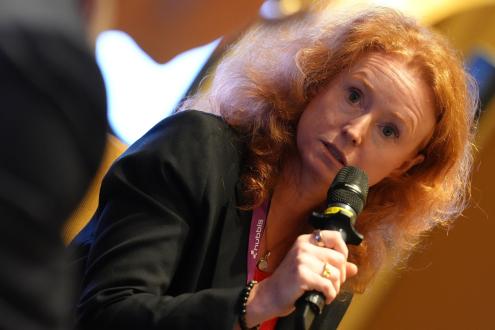
Speaking at a recent Hubbis event in Singapore, Valérie d’Argembeau, CEO of Bordier & Cie Singapore, discussed how the bank is responding to growing client demand for regulated crypto services. Drawing on a multi-year partnership with Sygnum, and observing first-hand a sharp increase in trading volumes, d’Argembeau laid out how institutional adoption is unfolding at the private banking level, and what it takes to make the leap from interest to practical implementation.
Key Takeaways
Client Demand Has Moved from Curiosity to Allocation: Bordier has seen a sharp rise in trading activity and client adoption, particularly in 2025, driven in part by US regulatory tailwinds.
Bitcoin Dominates among Private-Banking clients: For Bordier’s clients, Bitcoin remains the primary allocation to digital assets by a wide margin, with Ethereum as a distant second.
Direct Ownership Preferred over ETFs: Despite the hype around exchange-traded products, most of Bordier’s private clients prefer direct ownership of coins via segregated accounts.
Education Enables Engagement: A structured internal engagement and regular collaboration with Sygnum have been key to enabling meaningful client conversations.
Wallets and Bank Accounts Must Coexist: Rather than choosing between old and new systems, Bordier sees future infrastructure as hybrid, blending wallets and traditional banking rails.
From Legacy to Leadership: A Five-Year Evolution
d’Argembeau opened her remarks by acknowledging the contrast between Bordier’s traditional brand image and its role as a quiet innovator. “When people think of Bordier, they think about heritage,” she said. “They don’t necessarily associate us with digital asset leadership, but we’ve been building in this space for years.”
The journey began under the leadership of Evrard Bordier, who recognised early on that digital assets would evolve into a disruptive force within wealth management. That initial conviction led to a partnership with Sygnum, the Swiss digital asset banking group, and a step-by-step rollout of capabilities, including trading, custody, and staking, within Bordier’s core client offering.
While the first adopters were niche, d’Argembeau said 2025 marked a clear inflection point. “There was a massive jump in interest. What used to be exploratory became executable. Volumes increased eight to nine times across our book. The shift was not just perceptual, it was measurable.”
Bitcoin First, Ethereum Second, and Not Much Else
When asked about client preferences, d’Argembeau was direct: “Bitcoin dominates. Ethereum comes second. Beyond that, interest tapers off quickly.”
This concentration stands in contrast to the increasingly fragmented nature of the digital asset space, where altcoins, protocols, and stablecoins compete for attention. For Bordier’s private clients, simplicity and perceived safety still matter. According to d’Argembeau, roughly 90 percent of Bordier’s digital asset flows are channelled into Bitcoin.
More notably, most clients prefer direct ownership rather than indirect exposure. “Despite all the ETF headlines, we see very little volume in passive instruments,” she said. “Our clients want to own the coins directly, in a segregated account, within their private banking relationship. That trust layer still matters.”
From Product Shelf to Field Readiness: Educating the Front Line
A consistent theme throughout the session was the importance of education and internal buy-in. d’Argembeau was candid about the challenges of taking an abstract product, often misunderstood or misrepresented, and making it client-ready.
“In general, people don’t speak about what they don’t understand,” she said. “And that includes relationship managers (RMs) and bankers. If you want your team to engage clients in meaningful conversations about digital assets, you have to first give them the knowledge and confidence.”
To that end, Bordier implemented a structured programme, with Sygnum participating directly in investment meetings. This created an environment where the front office could ask questions, express concerns, and gain fluency in the terminology and risks of the asset class.
The result is not just product awareness, but relationship depth. “Clients now come to us with questions. They see that we understand the space. That opens the door to trust-based engagement.”
Clients Are Getting Younger, But Motivations Are Shifting
While digital assets are often associated with younger investors, d’Argembeau noted that interest at Bordier spans generations. “We don’t see a single profile,” she said. “It cuts across age groups and risk profiles. What unites them is the motivation: diversification and long-term value.”
Many clients see Bitcoin not just as a speculative play, but as a digital parallel to gold, with the added advantage of programmability and portability. Others are thinking about intergenerational wealth planning, and view digital assets as a legacy investment for their children.
Importantly, clients are becoming more sophisticated in how they engage. Where early adopters might have used unregulated exchanges, today’s clients ask detailed questions about custody, staking yields, and counterparty risk. This behavioural shift is what enables Bordier to operate confidently in the space. “It’s no longer about hype,” she said. “It’s about portfolio construction.”
Wallets, Not Walls: Designing Hybrid Infrastructure
One of the most insightful parts of the conversation came when d’Argembeau addressed infrastructure. Rather than seeing crypto and traditional banking as separate worlds, Bordier envisions a hybrid future.
“Our clients want to access digital assets, but they don’t want to leave their banking relationship to do it,” she said. “They want seamless integration. That’s why we set up segregated sub-accounts within their existing structures.”
But the next step, she noted, is bridging into wallet-based architectures that allow for self-custody and smart-contract interaction, without losing regulatory clarity or support. “We don’t think bank accounts will disappear,” she said. “But they’ll need to evolve, and co-exist with wallet environments.”
This is especially relevant as more real-world assets, such as money-market funds and tokenised treasuries, are brought on-chain. For Bordier, the goal is to prepare for this convergence without sacrificing oversight or compliance.
Planning Ahead: Momentum, Infrastructure, and Strategic Vision
In closing, d’Argembeau reaffirmed Bordier’s conviction in digital assets as a permanent fixture of the investment landscape. Short-term price volatility, she argued, is part of the journey, but no longer a deterrent.
“We’ve lived through enough cycles to know that this is not going away,” she said. “The question is not whether to engage, but how to do it responsibly and effectively.”
Looking ahead, Bordier plans to expand its capabilities in tokenised products, broaden its staking and yield offerings, and deepen its integration with regulated blockchain infrastructure.
The long-term vision is clear: to blend the precision and discretion of private banking with the flexibility and innovation of decentralised finance. That requires not just products, but mindset shifts, and the leadership to guide clients through both.