
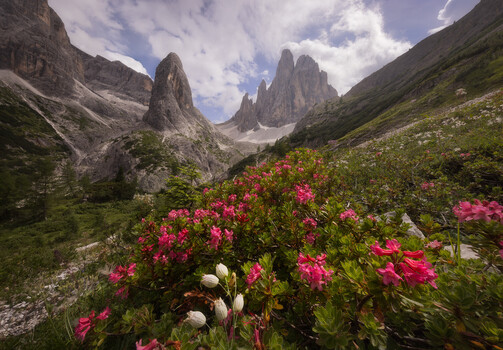
Erin Babnik is known internationally as a part of the nature photography team Photo Cascadia. Her work grew from experiences as an art historian and archaeologist, photographing in museums and at archaeological sites throughout Europe and the Middle East. Here she discusses her must-have gear, the value of museums, and when fixing it in post isn’t cheating.
What Are Must-Carry Items Always in Your Bag?
As a Canon Explorer of Light, I have the privilege of owning a large collection of Canon bodies and lenses. Having a pair of Canon EOS R5 Mark II bodies gives me a lot of options in the field when I bring both, but I often pack only one for longer hikes. The lenses provide a wide array of choices that destinations tend to inspire, but there is one lens that nearly always gets packed, and that is the Canon RF 24-105mm f/4 L IS USM, due to its great versatility for outdoor photography. Crucial camera support includes a ProMediaGear PLCR56 L-Bracket, a ProMediaGear BH50C40 ball head, and a ProMediaGear TR343C tripod, all from ProMediaGear (yes, I am a brand ambassador), and I use a Canon TC-80N3 Timer Remote Controller when the tripod is in action. My backpack collection is likewise substantial thanks to the generous support of f-stop Gear, but the one I use the most is a one-of-a-kind modified f-stop TILOPA in a custom purple color that I adore. Many accessories and clothing layers for safety and/or comfort are always in my bag, but one item that I never leave behind is a small folding foam sit mat that serves many functions, from giving me a place to kneel while shooting to helping me fan the flames of a campfire.
Laurel trees frame and echo each other while bathed in the atmosphere of low clouds on the island of Madeira.
What Is the Most Underrated Photo Skill?
Being able to think on your feet. Very often in outdoor photography it can be tempting to pursue a composition or location even when the conditions do not align with your expectations, but clinging stubbornly to an idea in the moment usually means missing an opportunity to find something more appealing for the circumstances.
Saguaros and cholla cacti backlit by crepuscular rays in the early morning in Arizona.
What Would Other Photographers Be Surprised to Find in Your Bag?
A short bungee cord. It’s very useful for stabilizing my tripod in strong wind or to ensure that it won’t get knocked off of a cliff edge. I secure one end to the hook on the bottom of the tripod and the other to my camera backpack, which is always very heavy and helps to anchor my gear.
What Technique Do You Use Most Often?
Focus stacking is probably the one specific technique that I use most often. Sometimes I embrace a shallow depth of field, but more often than not a landscape or nature image benefits from equally sharp focus throughout the frame.
Land and sky in the Eastern Sierra ablaze with color in winter. Created while working on a lens campaign for Canon USA.
What Art Books Should Every Photographer Own?
As many as possible, but I recommend having a good overview of art history, some technique books on painting, and at least one good book on color theory.
Do You Have Anything That Is a Daily Practice or Habit?
Yes, I get at least an hour of exercise every day. Not only is being fit a huge help in the field, but I get some of my best ideas while exercising, no matter where I am or what I’m doing.
Saguaros and ocotillo cacti catch the last rays of the day at Organ Pipe Cactus National Monument in Arizona.
Photographers Are Always Told to Develop a Style or Find a Voice, but There Is Little Advice on How to Find That Voice. What Guidance Can You Offer?
Experiment a lot and follow your nose. Style comes about through habit, and you’ll develop habits only through a lot of time and repetition. Experimenting all the while can help you to identify which habits are serving you well and which might be holding you back.
Looking down the throat of a Joshua Tree frond in California, shooting wide open with the Canon RF 85mm f/1.2L USM lens.
What Commonly Valued Photo Skill Is Overrated?
There is an old saying to “get it right in camera,” which many people push too hard. I’ve seen workshop students abandon a great composition in favor of a mediocre one just to avoid having to make any edits in post. Sometimes in the field it helps to shoot with editing in mind to accomplish a final image that cannot be created any other way.
If you want to sharpen your post-processing instincts to complement your in-camera work, Photographing the World: Landscape Photography and Post-Processing is an excellent resource for building that end-to-end vision.
Have You Ever Had a Creative Block? How Did You Overcome It?
It does happen, and the fix is always to go to an art museum to spend time in front of some great paintings or sculptures. Invariably the inspiration becomes very motivating.
What Is the Best Learning Experience You Have Ever Had?
Before the days of social media, I explored wilderness areas extensively without knowing what I would find there. Using topographical maps, I learned how to target elevations and features that were likely to be photogenic, and through this process I learned an enormous amount about my photographic interests and how to develop them.
Bio
Erin Babnik. a Canon Explorer of Light, is known internationally as a photographic artist, educator, author, and speaker. Her style of landscape photography springs from an unusual integration of wilderness exploration, progressive techniques, and a classical education in the arts. Erin has offices on two continents and travels extensively to teach photography workshops and for speaking appearances and commercial projects. Erin is known for blending educational insights with a flair for inspiration, making her a highly requested speaker.