
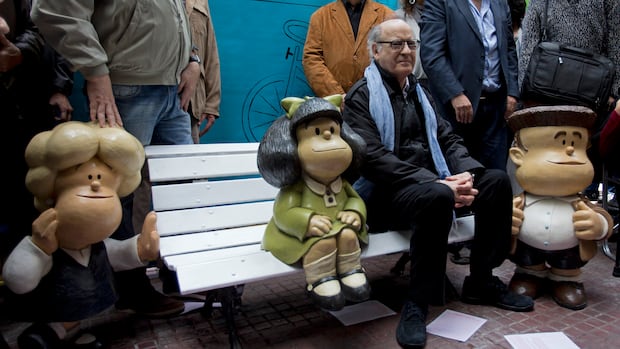
Back in her native Córdoba, Argentina, Livia Magnani was used to bumping into poets and philosophers immortalized in time as statues sitting among the living in plazas and cafés.
A Montreal art café owner, Magnani often thought: why not carve out a space here for one of the greatest thinkers of them all — never mind that they’re only six years old?
Mafalda, the irreverent pro-democracy feminist and soup-hater created by the late Argentine cartoonist Joaquín Salvador Lavado Tejón – better known as Quino – is now coming to Montreal.
Created in 1964 between Argentina’s fourth and fifth coup d’états, the wisecracking six-year-old character is often compared to Peanuts’ Charlie Brown — if he tuned into the news daily and read socialist literature.
On Friday, Montreal will become the first non-Spanish-speaking city to host a statue of Mafalda — the rest of which, all sculpted by Pablo Irrgang, are spread throughout Latin America and Spain.
“It’s a big emotion for me,” said Magnani, the owner of Mile-End’s Espace Amalgame, outside of which the statue will live.
“To have the sculpture here is like a way of saying ‘Hey, take a break in your life and think about other important things,’” she said, referring to Mafalda’s unending questions about the state of the world and the decisions made by the adults around her.
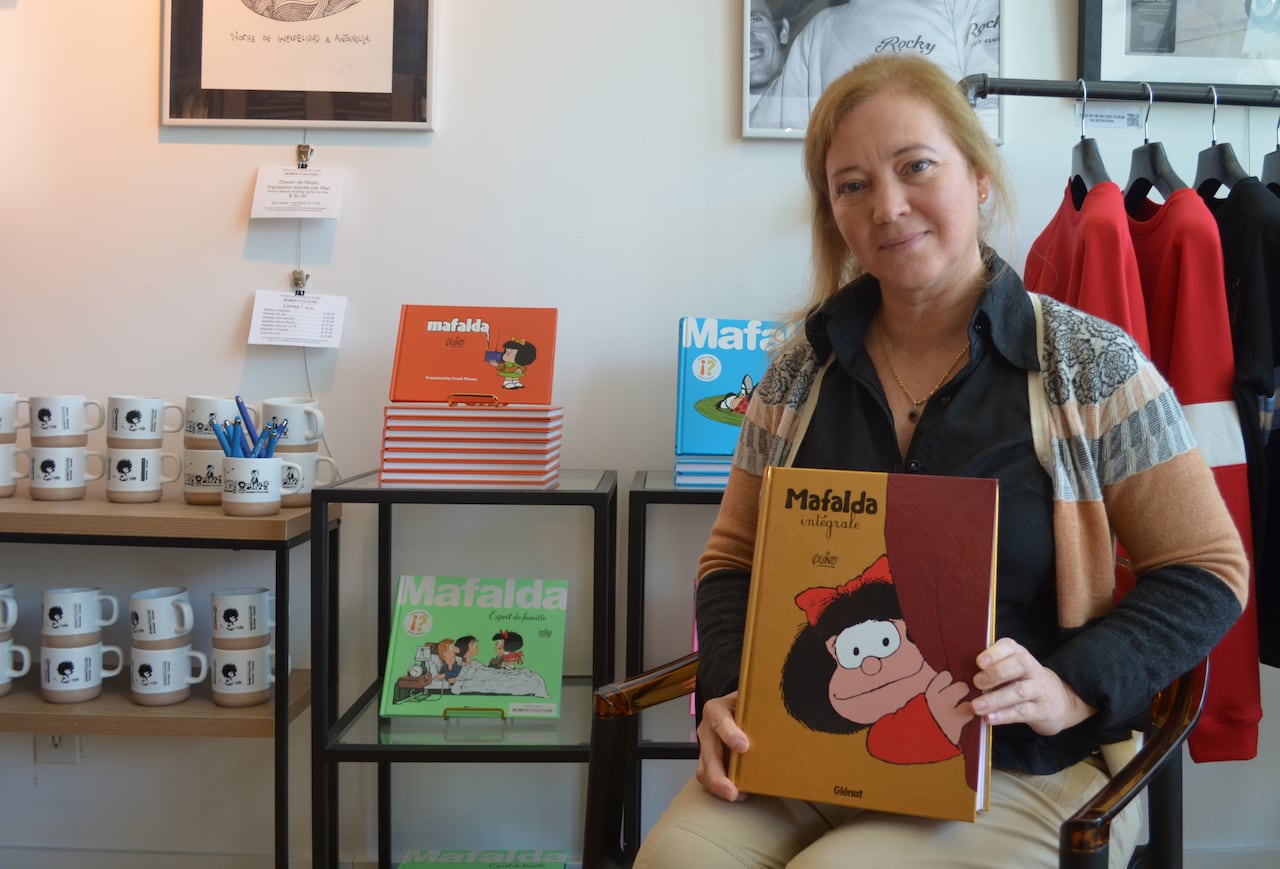 Livia Magnani is the owner of Espace Amalgame and the director of Moment!Culture, two organizations dedicated to highlighting arts and culture, with a special emphasis on Argentina. (Cassandra Yanez-Leyton/CBC)
Though Argentina’s most famous girl has known worldwide success — finding continued relevance well after Quino retired the strips in 1973 and with a Netflix series slated for 2027 —the comics only became widely available in English last year.
“A big chunk of the world never was in contact [with] Mafalda,” said Magnani, who is hoping the statue and special programming at the café will help change that.
Magnani has been working with the Argentine consulate to bring the statue to Montreal ever since she hosted an exhibition marking the character’s 60th anniversary in 2024, encouraged by the reactions from attendees at the time. Unlike most Anglos, francophones are already well acquainted with the character.
Montreal-based, Argentine-born graphic novelist Marina León says she’s met Quebecers who read the comics in French-language newspapers and thought Mafalda was from here. Change the language she speaks, and the portrait she paints of a disgruntled middle class too overwhelmed to grasp or care about global affairs is seemingly universal.
“There’s a lot of [issues] of control and inequity that’s still going on even if the government changed,” León said.
Did we mention she hates soup?
Mafalda has a deep disdain for soup — soup being a metaphor for the “military regimes that we had to swallow every day, even if one didn’t like it,” Quino once told journalist (and later president of Bolivia) Carlos D. Mesa Gisbert.
Though in many ways Mafalda is a children’s comic, it does demand some political awareness from its readers, says Isabella Cosse, an Argentine history professor and author of Mafalda: A Social and Political History of Latin America’s Global Comic.
“For example, it found success very quickly in Spain because … [Francisco] Franco’s Spain was an exercise for reading between the lines,” Cosse said, referring to the fascist dictator who ruled from 1939 to 1975. “And there was a very direct association to the world with a high number of conflicts, with a lot of coups d’états and repression.”
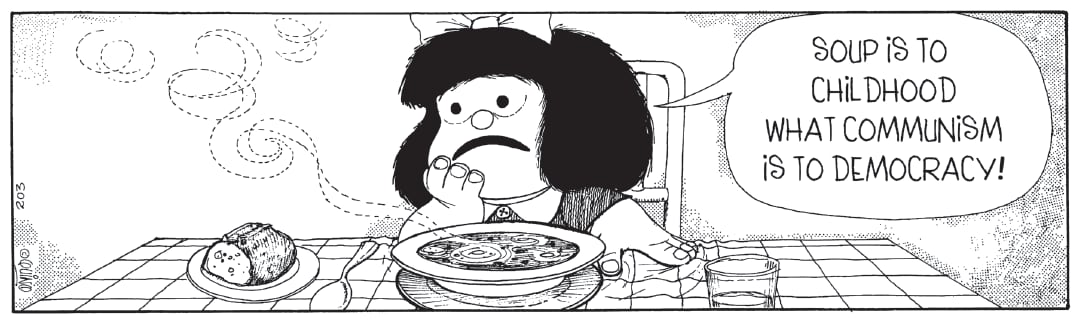 Mafalda is a six-year-old girl who lamented the state of the world and the economic, political, and social structures that prevented progress in the 60s and 70s. (Mafalda by Quino translated by Frank Wynne/Submitted by Elsewhere Editions)
The anti-capitalist Mafalda was, ironically, born out of a covert appliance ad, drawn up by Quino in 1963 at the behest of a company that wanted to see its products being used by a middle class family in a comic strip. The ads never ran but the big-headed character stuck and started to appear in Argentine newspapers and magazines before eventually fusing into the country’s identity.
As yet another 20th-century dictatorship began to grip Argentina, political exiles disseminated the comics abroad, and it took off. By the time a military junta formed government in 1976, Quino had already stopped drawing Mafalda and had left the country.
According to Cosse, Quino was able to pick up on movements, like feminism and a disaffected youth, that were still sort of emerging during the nine years that Mafalda ran.
“This then allows successive generations, in different parts of the world, to reinterpret it with their own perspectives,” she said.
That made it so that by the time León was born, in the 90s, there were still children like her, anxiously waiting every Sunday to read the long discontinued comic in local magazines.
“It’s part of our identity as Argentinians, like it’s always there,” she said.
Why did it take so long to translate into English?
Translating Mafalda into English became an “urgent” task for New York City publisher Jill Schoolman once she learned about Quino’s work while on an editors’ trip to Buenos Aires in 2011. When the press she founded, Archipelago Books, started a children’s imprint about seven years ago, Mafalda was one of the first works it tackled.
“If we’re going to have comic books at all, this is like one of the best ones around over the years,” said Schoolman. “Everyone we’ve talked to said ‘I grew up with Mafalda … she was a great influence on me,’ and so we wanted kids here to have that experience as well,” she said referring to conversations with people from Latin America, Spain, Italy — “everywhere.”
Some have theorized that editors in the U.S. stayed away from Quino due to his leftist politics. Or that there simply wasn’t any space left in the culture for Mafalda after Peanuts’ success and maybe less so after the (politically milder) Calvin and Hobbes by Bill Watterson started running in the mid-80s.
Or, maybe, Mafalda was too sophisticated for an American public. That’s what Kuki Miler, founder of Ediciones de la Flor, Mafalda’s original publisher, recalls an American editor telling her after the latter tried pitching the idea to translate Mafalda to her board.
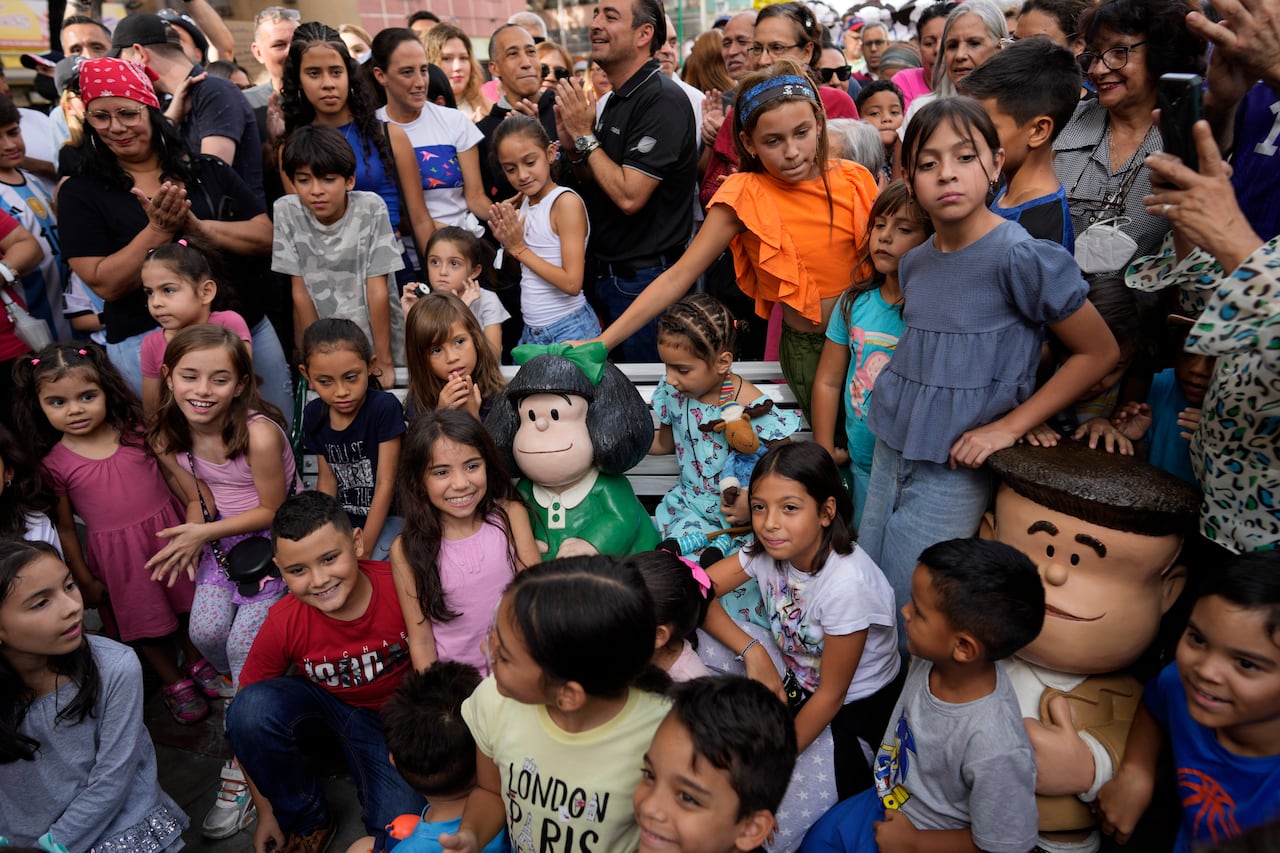 Children and people surround a sculpture of Mafalda, during its inauguration in Caracas, Venezuela, Sunday, June 25, 2023. (Ariana Cubillos/AP Photo)
Quino categorically wanted to see Mafalda translated into English and Ediciones de la Flor kept offering it to publishers to no avail, says Miler. In England, editors told Quino’s agents that their audience wouldn’t relate to Mafalda and her entourage.
“The character and her traits didn’t fit with what the idea those countries had of a family or a girl. Clearly, a middle class family in Argentina isn’t a family that has much to do with the behaviours of a family in London,” Miler said.
Ediciones de la Flor ended up publishing an English translation of Mafalda in 2004 at the insistence of Quino’s wife but only for small-scale distribution to bilingual Argentine schools.
So Mafalda didn’t learn to speak English not for a lack of trying. And now, her fluency is a work in progress.
The first English-language volume of Mafalda, translated by Frank Wynne for Elsewhere Editions, was released almost a year ago. The second is about a year’s away and three more are expected to come out every year after that, says Schoolman.
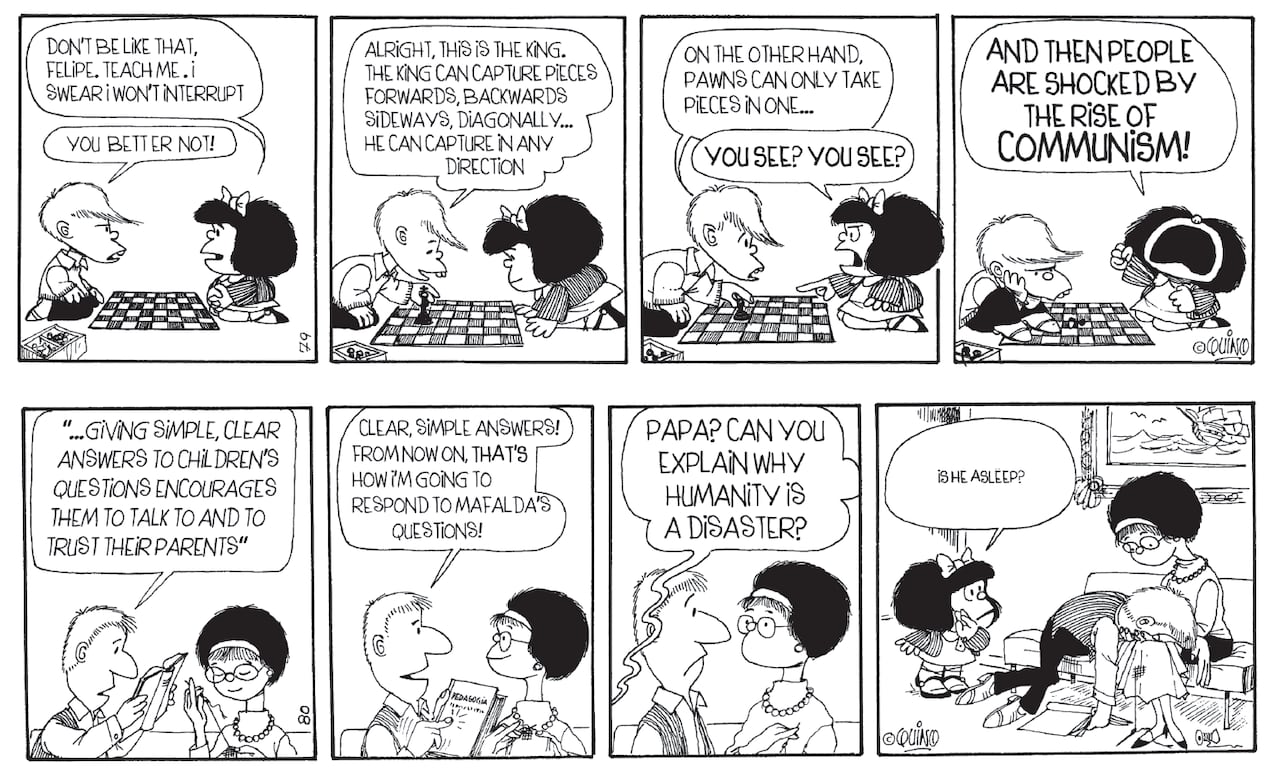 Elsewhere Editions, the children’s imprint of Archipelago Books, is working with translator Frank Wynne to publish Quino’s Mafalda in English. One volume out of a total of five is already available to the public. (Mafalda by Quino translated by Frank Wynne/Submitted by Elsewhere Editions)
She says the momentum is still growing and hopes each volume, and next year’s Netflix series, will generate new waves of excitement.
The Mafalda statue in Montreal could also help. Unlike the other 18 Mafaldas around the world, Montreal’s will be mobile so she can visit schools, libraries or wherever an activity centred around her might be taking place.
A new chapter for Mafalda
Miler says she was surprised but very happy to learn about the statue’s arrival in Montreal and is hoping the English translation of the comics finds its audience.
Self-described as Quino’s “first admirer,” Miler published the first Mafalda volume in 1970 and continued doing so until his estate sold the rights to his work to Penguin Random House in 2025.
“The day they told me I wouldn’t be able to publish Quino was a blow to my heart from all angles,” she said.
At 82, she’s now closing her independent publishing house at the end of this year, citing that loss among other factors for the closure. She tried making the announcement discreetly at a book fair last week but has been hounded by the press ever since, she says.
After all these years, she says she’s surprised Mafalda’s image and message are still so beloved despite clearly originating in the 60s.
“[Mafalda] continues to have the readers she has because of a very strong influence: in what she says, what she questions, in how she makes you think,” said Miler.
“During book fairs, three generations would come say hi to Quino — the grandmother, the mother, the daughter … thanking him for opening their eyes, opening their minds.”