
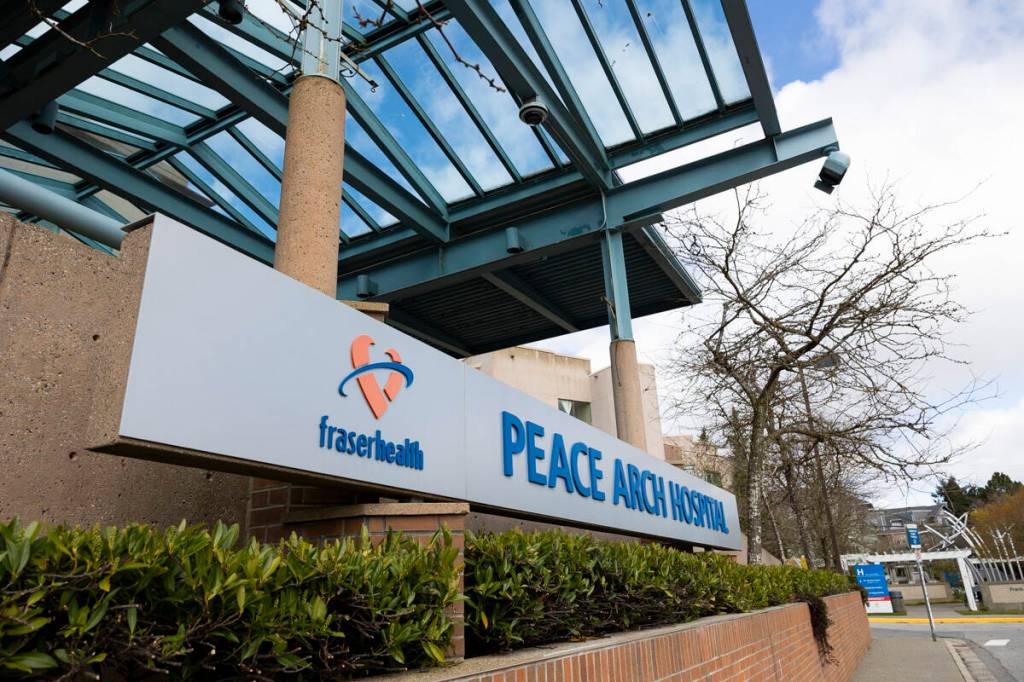
Health care in White Rock – and, by natural extension, South Surrey – has long been a source of both pride and concern.
On the pride front, the sentiments stretch back decades, to before the day that shovels first dug into the earth for Peace Arch Hospital and the city’s first doctor was making house calls to tend to the needs of the seaside community’s residents.
That pride has only grown over the years, despite challenges that have increasingly strained the area’s resources.
To be fair, concerns around local health care are also not a new development. The hospital came to be, in fact, through efforts to alleviate concerns over the lack of such a facility to serve the growing community.
It would be challenging to argue that either pride or concern has dissipated over the years. Evidence of both has been and continues to be voiced at all levels; by those who rely on the services, those who provide the services, those who develop or influence policies that affect the services, and those who devote their efforts to raising funds to improve on, expand on, or fill gaps in services.
As far as concerns go, the list includes: there’s not enough doctors, funding, equipment or access.
Maternity services have been a particular source of angst at Peace Arch Hospital of late, with multiple diversions implemented in recent months due to a shortage of obstetrician-gynecologists.
The issue – described as a “crisis” across the province by the head of the society representing the specialists (but not, as of press deadline, at least, by B.C.’s minister of health) – is anticipated to start easing this spring, credited to the work of a hospital-specific recruiter funded by Peace Arch Hospital Foundation for the past year to identify all manner of specialists and entice them to join the team.
“We wanted to have somebody who really was focused on recruiting for our hospital,” said Stephanie Beck, chief executive officer of the foundation. “So far, we are very pleased with the results.”
For maternity, “we do have candidates in the pipeline,” said Beck.
Beck noted the majority of change at the local hospital – whether in the past, underway, or planned – has been driven by support for and by the foundation; factors that evoke both pride and frustration, as infrastructure-funding needs at community hospitals like PAH continue to be “largely ignored” by government.
Minimal investment from the Ministry of Health has left services stretched in White Rock and South Surrey, and a plethora of residents of all ages waiting.
“It’s been the foundation’s advocacy and donor funds that’s moved the needle in our community,” said Beck. “It’s the reason why there has been redevelopment and renovation at the hospital, largely because the foundation has driven that.”
She named the Ellen Sinclair Kennett Lodge, opened in 2020 at 15575 16A Ave., as one example. It’s a foundation-owned building situated on foundation-owned land, with the space leased 100 per cent by Fraser Health to provide clinical services.
As well, “we really drove the development of the new ER and operating suites as well.”
“It wasn’t until the foundation agreed to fund part of the operating suites that that project really started to moved forward.”
In the works now is redevelopment of the hospital’s six-bed ICU and telemetry unit, with $35 million of the $38.5-million budget committed to it by the foundation.
“Health care is looking pretty good in White Rock because of the foundation, and (because) the community has rallied around our campaigns and been so generous.”
As of press deadline, Beck and others were waiting to see if the City of White Rock’s updated Official Community Plan will enable the foundation to push forward on plans to build a 15-storey medical building on land located immediately west of the ER entrance, currently used for parking.
In the draft OCP – approval of which was deferred at council’s March 9 meeting, and remained uncertain at press deadline – ‘Health District’ is among newly introduced land-use designations in the amending bylaw, intended “to support health and wellness services.”
“It encourages a mix of medical, wellness, and supportive residential uses in proximity to major health institutions,” the draft reads.
However, “we don’t have any surety about that until the OCP is approved,” said Beck.
At the same time, “a lot” of challenges continue at the primary care level, including that of ensuring residents – including the unhoused – have access to a doctor or nurse practitioner; an attachment that research has shown improves health outcomes.
The newest step taken for local primary care was shared earlier this month: the April 15 opening of the South Surrey Urgent and Primary Care Centre in space within Semiahmoo Shopping Centre (1711 152 St.).
In announcing the UPCC, Minister of Health Josie Osborne said the centre will boost access for area residents, “helping them get the right care in the right place,” and help reduce wait times at emergency departments.
The province has committed more than $5 million in annual operating costs, as well as a one-time startup amount of more than $800,000, a news release notes.
The centre – Surrey’s fourth UPCC, open from 9 a.m. till 8 p.m. daily – is expected to accommodate some 57,000 patient visits annually, with a focus on “urgent, episodic primary care.” It is not set up to attach patients to a GP, but those needing one will be assisted in registering on the Health Connect Registry (healthlinkbc.ca), the release adds.
White Rock-South Surrey Division of Family Practice vice-chair Dr. John Phillips spoke in March to the division’s focus on improving primary-care access; effort he said has led to “lots of optimism” for such services on the Semiahmoo Peninsula.
While thousands of White Rock/South Surrey residents remain unattached, as of late March, recruitment efforts by the division had enticed 13 doctors and two nurse practitioners here from within Canada, the United Kingdom and the U.S.
Phillips said for those who are looking for GP, there are at least eight providers in the area currently accepting patients.
Phillips named programs to help physicians improve clinic efficiency; workshops on team-based care; and working with partners including Sources, Alex House and Fraser Health to help address the mental-health crisis and substance-use disorders as among the division’s other areas of focus.
They’re looking forward to the opening of Foundry, a project in the works for the PAH campus that will offer youth who are struggling with mental health and substance use – and their families – a one-stop hub for services.
An “ambitious” project that supports the SFU School of Medicine and for which PAH is a pilot site is another point of pride.
“We’ll be taking a third of their students for clinical assignments,” Phillips explained, elaborating that the first cohort of 16 students, arriving this fall, will be involved with patient care at family practice clinics as well as the hospital.
Phillips said he is among “many” local doctors who have volunteered to be preceptors and mentors; whose practices the students will be linked to for at least two years.
“We’re very solution-minded,” Phillips said of the division’s 300-plus members.
“A lot of partners in the community are aware of the needs – maternity diversions, unhoused, longer waits. They’re a challenge to address, but behind the scenes there are a lot of people working on them.”