
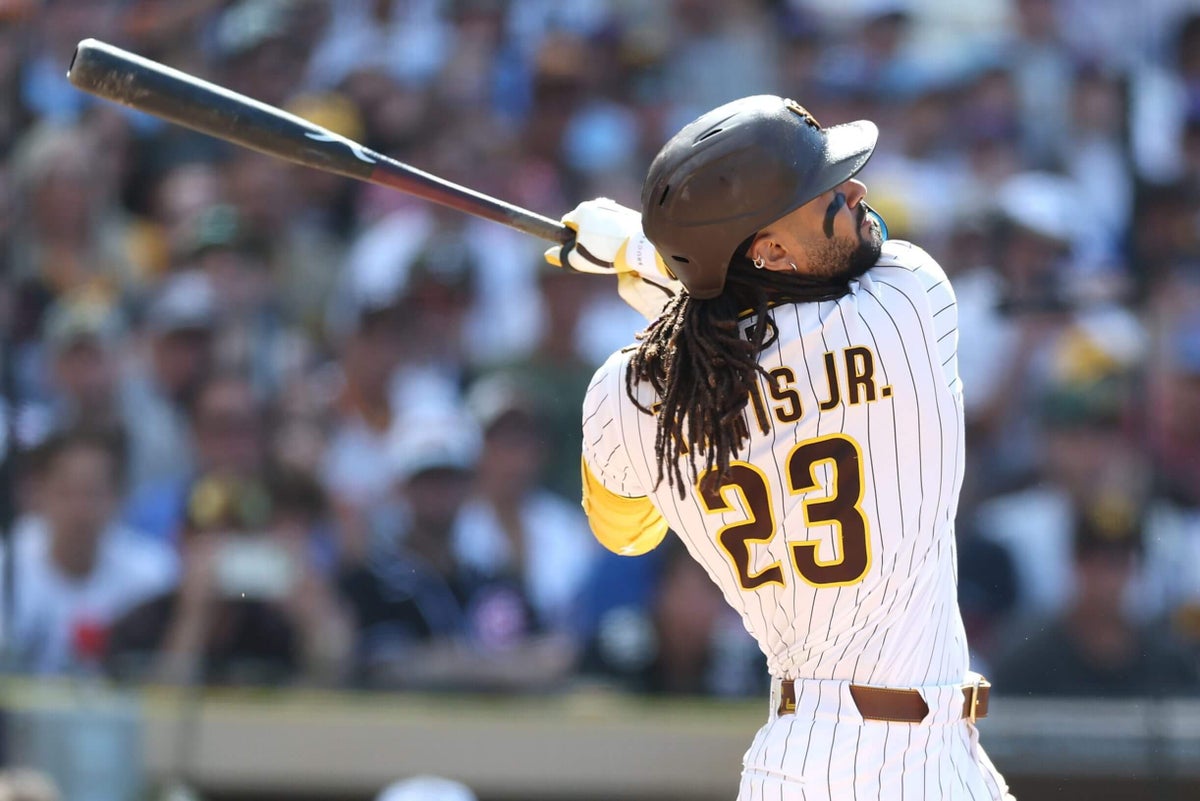
SAN DIEGO — Two hundred fourteen days after he last homered in a big-league game, Fernando Tatis Jr. stepped into the batter’s box with no outs and the bases loaded. It was the bottom of the eighth, the San Diego Padres trailed by two runs and the crowd at Petco Park stirred with anticipation. Then, on a 1-1 count, Chicago Cubs reliever Ben Brown hung a curveball.
Tatis coiled and unleashed an all-out swing, making 102.8 mph contact off the bat. For a second, he tracked the ball’s trajectory as it soared toward center field.
That was before he looked away in disgust.
“I’ve been close for a while, but it’s just a sacrifice fly,” Tatis said Wednesday, slouched in his clubhouse chair after a 5-4 loss. “I just see it that way.”
One of the most maddening months of his standout career had come to an unsatisfying end. Through 30 games, the Padres right fielder leads the majors with a 64.7 percent hard-hit rate, pacing ahead of Munetaka Murakami, Ben Rice and James Wood, all of whom have produced double-digit home runs.
Yet, Tatis, batting .250 with four doubles and no other extra-base hits, has practically nothing to show for it.
His 55 batted balls with an exit velocity of at least 95 mph are four more than the next-closest player, Kansas City Royals superstar Bobby Witt Jr. It’s also one of the higher totals since the start of the 2015 season; Tatis holds the Statcast-era record for a calendar month with 66 exit velocities of 95-plus mph. Unlike in August 2020, however, he has consistently struggled to elevate or pull baseballs, instead torching colonies of imaginary worms.
Tatis’ average launch angle, fly-ball rate and pull percentage are at all-time lows. His season-opening streak of 131 plate appearances without a home run is one shy of the career-worst power outage he experienced last summer. No other player has gone up to bat more times this season without going deep.
April is over for Tatis, but given his recent history, there might not be an end on the horizon.
“I’m doing everything,” Tatis said. “Hitting early, doing batting practice, after (games). It still doesn’t turn around. I don’t know. Trying to figure it out.”
It was almost three weeks ago that Tatis voiced his belief that “the baseball gods are really mad at me.” That sentiment remains unchanged. On the Padres’ recent trip through Coors Field and Estadio Alfredo Harp Helú — two ballparks located a mile or more above sea level — Tatis went 5-for-21 with five singles, inspiring sympathy and consternation.
“I’ve never seen that before,” Padres bench coach Randy Knorr said. “Every night, he’s just crushing balls, and it happens to be at somebody out there. And you kind of feel bad for him because he’s working hard every day, and you feel like if a couple of them would just drop for him, he can get on a roll.”
“I do think that he’s, like, super close,” Padres hitting coach Steven Souza Jr. said. “I feel like I’ve been saying that for three weeks, but I do think it’s a matter of a couple clicks and ironing some stuff out, and then it’s just going to go.”
“We’re working on it. We continue to work,” Padres hitting instructor Raul Padron said. “You know, being the No. 1 guy hitting the ball hard in all of MLB and not getting the result he wants, it’s kind of hard.”
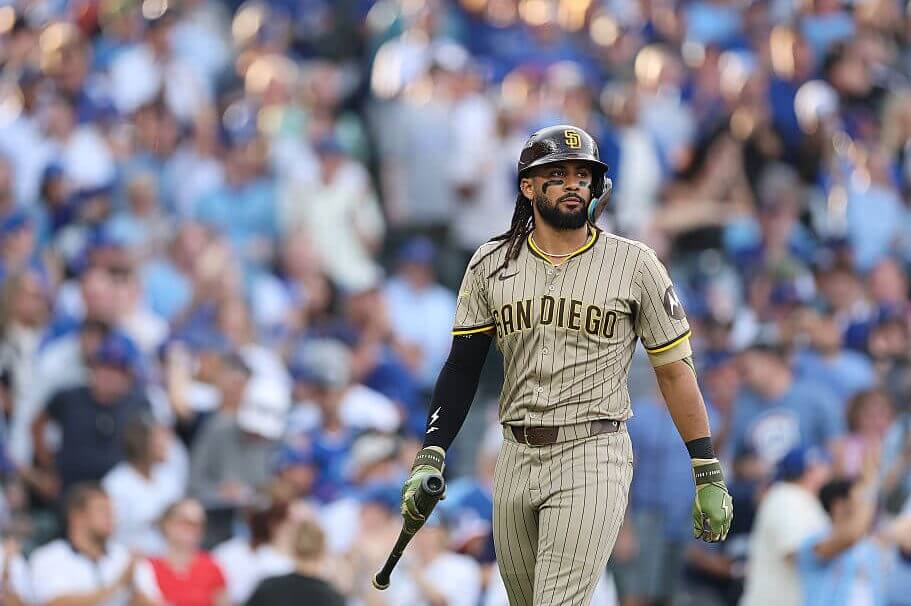
Fernando Tatis Jr.’s 131 plate appearances are the most by any player without a home run this season. (Michael Reaves / Getty Images)
Like Knorr and Souza, Padron is a newcomer on rookie manager Craig Stammen’s coaching staff, but he has known Tatis since the outfielder was a teenage shortstop. In 2018, Padron was the hitting coach for Double-A San Antonio when Tatis emerged as arguably the best prospect in baseball.
Since then, Tatis has received a 14-year, $340 million contract and delivered 42 home runs in an injury-shortened season. He has also undergone shoulder and wrist surgeries, served a PED suspension and, over the past three years, failed to come close to his previous power production.
Even so, a red-splashed Baseball Savant page hints at the ability that remains.
“It’s about timing,” Padron said. “It’s a little bit out of whack, but he’s continued to hit the ball hard. Good things are going to happen. … You just got to hang with it a little bit and put your work in every day, and eventually it will be happening for him.”
The Padres, Padron said, have implemented drills designed “to put his body in a great spot so he can drive the ball.” That isn’t necessarily as simple as having Tatis attempt to make pull-side contact earlier in the path of the ball; this season, the outfielder’s average contact point is deeper than ever.
“One of the interesting things about pulling the ball or just driving the ball is it actually is less effort, to be honest,” Souza said. “It’s trusting the fluidity of your swing, knowing when to take your shots, knowing how to stay through the ball, which he does very well. And being able to catch the ball deeper, which is kind of counterintuitive, because I know all the metrics say, ‘Hey, when you hit the ball out front, you hit it in the air, it’s the best possible outcome.’
“However, the way you approach the ball isn’t, ‘I’m going to go get it out there (in front of home plate), because he is hitting the ball out front as of recent, and it’s not working that way. … It’s not as easy as, ‘Hey, hit the ball out front. You’ll be better.’ You have to approach the ball. It’s the way you try and attack pitches. And he’s doing those things. It’s just not happening for him right now.”
(One rival scout said Tatis does not seem to be “letting the ball travel to the plate and putting leverage on the ball. Like, he is catching the top half of the ball … with topspin instead of backspin.”)
Souza can relate to Tatis’ current predicament. The first-year hitting coach was once a well-regarded prospect himself. He approached his potential in 2017, swatting 30 home runs as the Tampa Bay Rays’ everyday right fielder.
His career-best season came the year after he played with an injured hip and went 30 consecutive games without homering.
“The hardest thing about when you go through a stretch like this is to not try and do more,” Souza said. “When (Tatis) hits the ball, it’s like a hot knife slicing through butter, and it goes a long ways. The problem with any hitter in this room, not just Tati, is when you try and hit it far. That’s when you end up breaking down mechanically.
“Now, I don’t think he’s at that point just yet, but we’re all human, right? And we probably want to see a number up there that doesn’t say zero. But he’s been super mature through the process, and he’s been working every single day, so there’s not much more you could ask for.”
Wednesday, after another unfulfilling result, Tatis faced the center of the clubhouse as he slumped in his chair. For a couple of minutes, he did nothing but stare at his phone. Souza stopped by and offered a few words of encouragement.
Then, Tatis fielded more questions about a certain juxtaposition. The Padres finished April at 19-11. It’s early, but they again look like a postseason contender, even with Tatis and fellow stars Manny Machado and Jackson Merrill well below their career norms.
“It’s not just about the big guys,” Tatis said. “To go all the way and to perform in this long marathon, you need a whole team to win ball games.”
To advance further than they did the past two Octobers, however, the Padres will need Tatis to regain his power stroke. His early drought has already created a formidable challenge. Since Tatis made his big-league debut, only two players — Rafael Devers and Marcus Semien — have finished a season with at least 25 home runs after failing to homer in each of their first 30 games.
“Just not happy,” Tatis said. “I’m going through it, and I’m just trying to figure it out.”