

Listen to this article
Estimated 6 minutes
The audio version of this article is generated by AI-based technology. Mispronunciations can occur. We are working with our partners to continually review and improve the results.
Scenes of everyday life captured on cupboard doors, scraps of canvas and even old paper plates: it turns out Maud Lewis wasn’t the only Nova Scotian artist who built a body of artwork on whatever surfaces were available. Around the same time she was painting the black cats and harbour scenes that would eventually make her one of the nation’s most-lauded painters, another artist, Harold Cromwell, was pushing the very definition of folk art, while living only a half hour drive away from her famous painted house.
Now, Cromwell’s work and legacy are getting the highlight they deserve as the Art Gallery of Nova Scotia showcases its first solo exhibition of his art, On the Matter of Memory: The Drawings of Harold Cromwell, on view until September 13.
The descendant of Black loyalists, Cromwell was born in Weymouth Falls, N.S. in 1919. Chronicling working class rural life in fine-line pen drawings, Cromwell was beloved regionally: “There was not a moment where we met someone and told them what we were doing, and they did not have some story about Harold,” says Fabiyino Germain-Bajowa, curator of the AGNS show, referencing the time she and her co-curator spent researching at the Cromwell home and surrounding areas. Most of his works were sold at the Annapolis Farmer’s Market, she says, often for two to three dollars apiece — both in an attempt to secure funds and also to make room for new artwork as his house overflowed with it.
During Cromwell’s lifetime, his work was received casually or “maybe not something to preserve or to consider as a piece of history,” Germain-Bajowa explains. This is due, in part, to his use of everyday materials as well as the austerity that shaped daily life in the region at the time.
(Cromwell made art from the Great Depression into the 2000s, before passing away in 2008.)
To Audrey Sandford, owner of Black Sheep Gallery, a notable folk gallery in the area, where dozens of prominent Maritime folk artists are featured — including both Lewis and Cromwell — it’s about time more of the province (and beyond) got familiar with Cromwell’s work. “We have been collectors of Nova Scotia folk art for over 35 years, and we initially didn’t recognize the singular beauty of Harold’s work,” she says, adding his drawings weren’t included in “any of the folk art exhibitions or touring folk art shows put on by the Art Gallery of Nova Scotia, The Beaverbrook Art Gallery or the McMichael.”
She says that “Cromwell had a unique style, more like a very detailed etching and he did not fit in with the popular folk artists like Maud Lewis and Joe Norris who used bright primary colours and large solid shapes.” (It is worth noting that ARTSPLACE gallery in Annapolis Royal, N.S., did stage a show celebrating Cromwell in 2023.)
“Despite his desire to be recognized solely for his art rather than his race, he remains Nova Scotia’s only prominent Black folk artist,” Sandford adds.
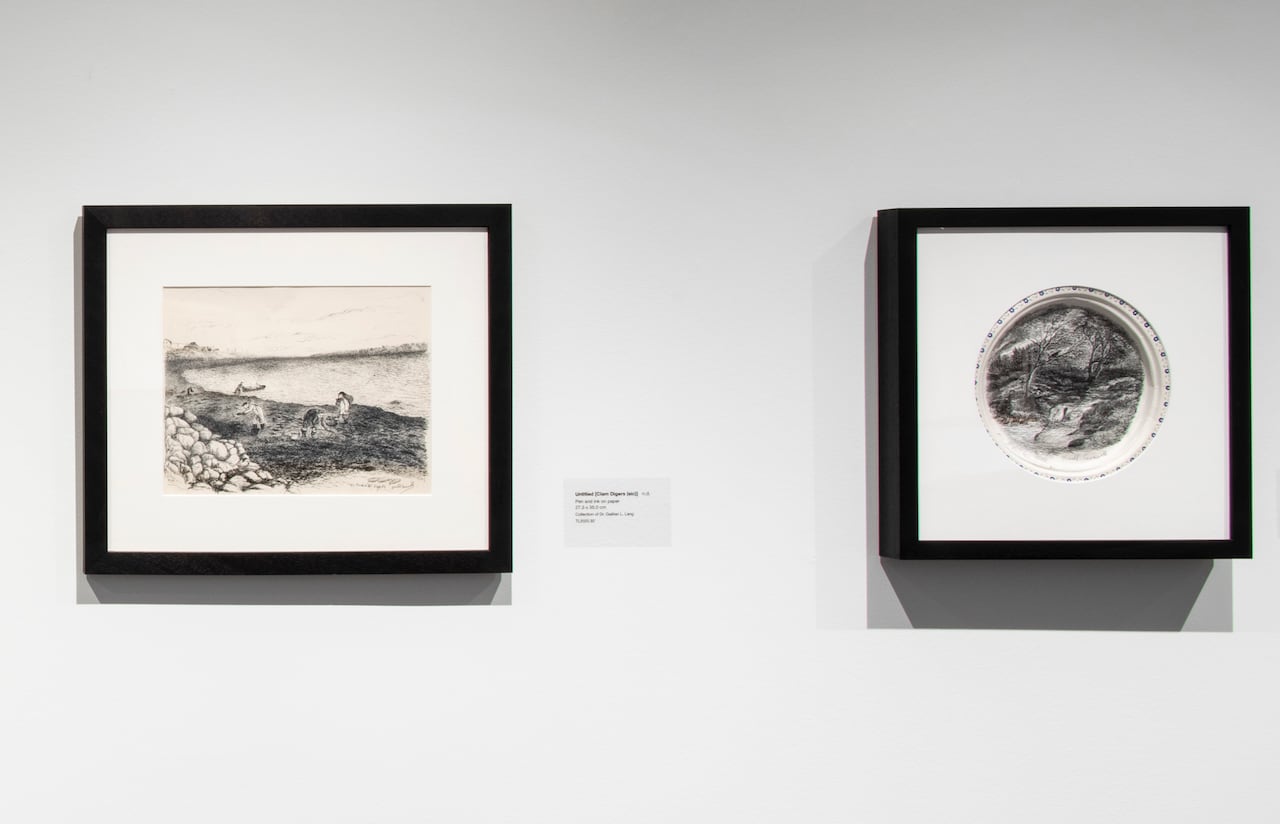 “Untitled (Clam Digers [sic])” and “It’s Fishing Time Get Our Your Line” by Harold Cromwell, from On the Matter of Memory: The Drawings of Harold Cromwell, on at the Art Gallery of Nova Scotia until Sept. 13, 2026. (Courtesy the Art Gallery of Nova Scotia)
“He really, really was quite loyal to his preferred Bic pen,” says Germain-Bajowa. In the show, one of Cromwell’s pieces has been enlarged on wallpaper. “When they’re enlarged like that, you can see every single pen stroke,” she adds. “They’re so small and condensed, and they’re layered and layered upon each other to create such amazing depth.”
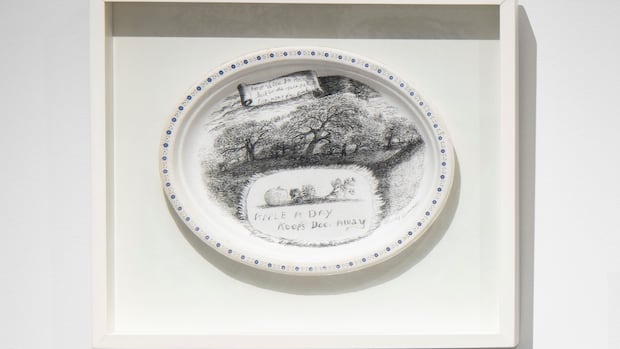
Cromwell’s drawings on (sometimes used) paper plates — old-school Royal Chinet brand ovals with a blue floral trim, the kind that are ubiquitous at barbecues and potlucks — play a particularly prominent role in the exhibit. Ignoring stains and splotches on these ad-hoc canvases, Cromwell’s fine-line style sings, capturing scenes of daily life and landscapes of apple orchards.
“A key aspect of these artworks is that they come from Harold’s life so clearly,” says Germain-Bajowa. They reflect the moral lessons and the experiences and the places and landscapes that he was growing up with. And I think seeing the, I guess, wear and tear, the wrinkles and the yellowing and the wearing away of ink in certain places where he might have dropped a bit of water, I think that really contributes to that invitation into the work, right?,” says Germain-Bajowa. “I personally really, really enjoy that. I don’t know if our collections and preparations team had as good of a time with that.”
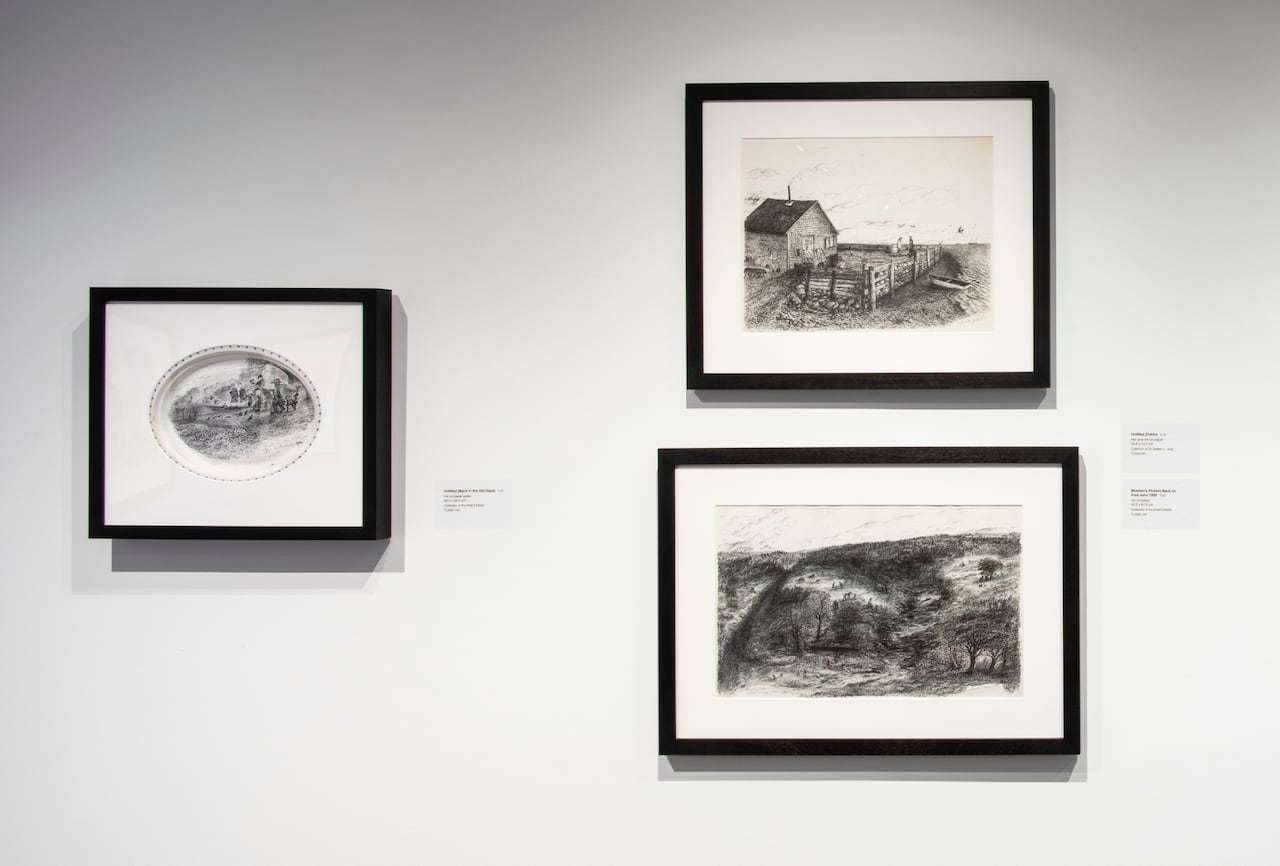 “Untitled (Back in the Old Days),” “Blackberry Pickers Back on Fred John,” “Untitled (Cabin)” by Harold Cromwell, on display as On the Matter of Memory: The Drawings of Harold Cromwell, on display at the Art Gallery of Nova Scotia until Sept. 13, 2026. (Courtesy of the Art Gallery of Nova Scotia)
From scenes of berry picking and clam digging that show how his community weathered times of economic downturn to pieces like 1932’s First Teenage Driver in the Country — in which a few teens speed down a country road in a car as bystanders jump back — Cromwell’s vision of Nova Scotian life centred beauty and hardship in equal measure. Germain-Bajowa’s favourite Cromwell piece might just be one in which two men walk a country lane, with one dryly assuring the other “don’t worry about it, there’ll be more work in 50 years.”
“He was celebrating these things, even though they were sometimes heavy and challenging,” Germain-Bajowa adds. “He was celebrating these moments for what they were, and the beauty that could be found in the everyday. And I think that’s something that you don’t often see in the folk art of that time.”
As Sandford puts it: “Go to the show, stand in front of his drawings and explore the nuanced detail, experience what it was like to live in rural Nova Scotia during the early 20th century and listen for Harold’s laughter.”