
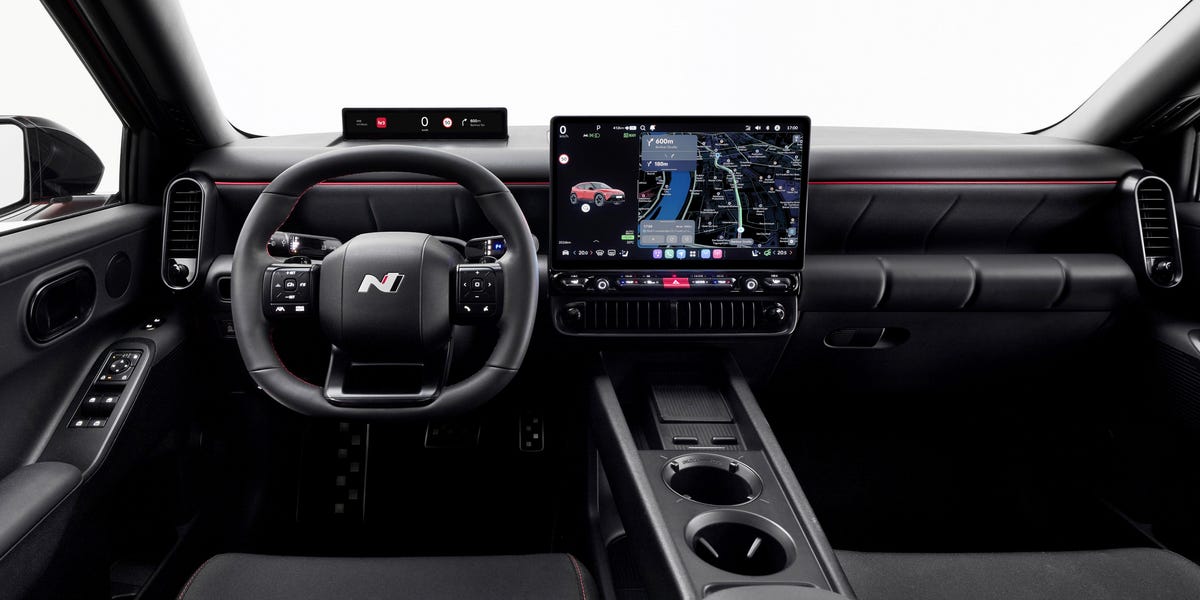
Hyundai is preparing to debut its next-generation infotainment system, called Pleos Connect. Along with a slim gauge cluster and real buttons, the Pleos system has a large center screen that allows video streaming and features an AI chatbot called Gleo. Pleos Connect will debut on the Korean-spec Hyundai Grandeur sedan, followed by the European Ioniq 3 hatch, but it’ll eventually reach the U.S. market.
Hyundai’s next-generation infotainment system will kick off the Korean brand’s move to software-defined vehicles. Dubbed Pleos Connect, Hyundai says this new system was designed to have a mobile-friendly interface and, naturally, it’ll heavily rely on AI technology. While Pleos Connect will soon make its way into the first production cars, it will be a while until the new infotainment system infiltrates Hyundai, Kia, and Genesis models sold on our shores.
A large touchscreen is the centerpiece of the Pleos Connect experience. Thankfully, Hyundai isn’t completely ditching physical switchgear to feign futuristic progress. Along with knobs for the sound system’s volume and tuning settings, the setup in the newly revealed Hyundai Ioniq 3 hatchback (pictured above) includes toggle switches for the climate controls. Additionally, a three-finger gesture lets users quickly close apps and relocate app windows on the large center screen.
Hyundai
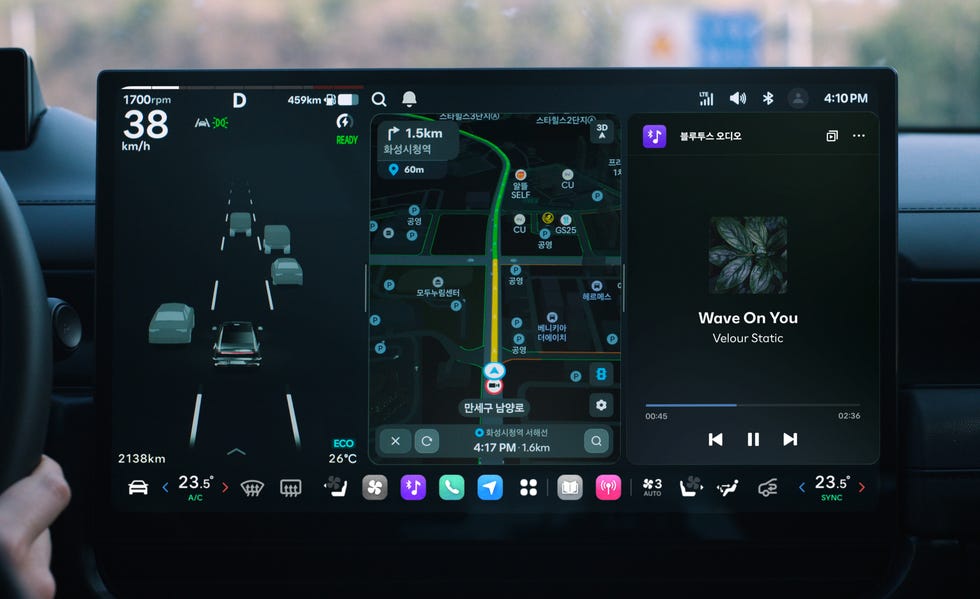
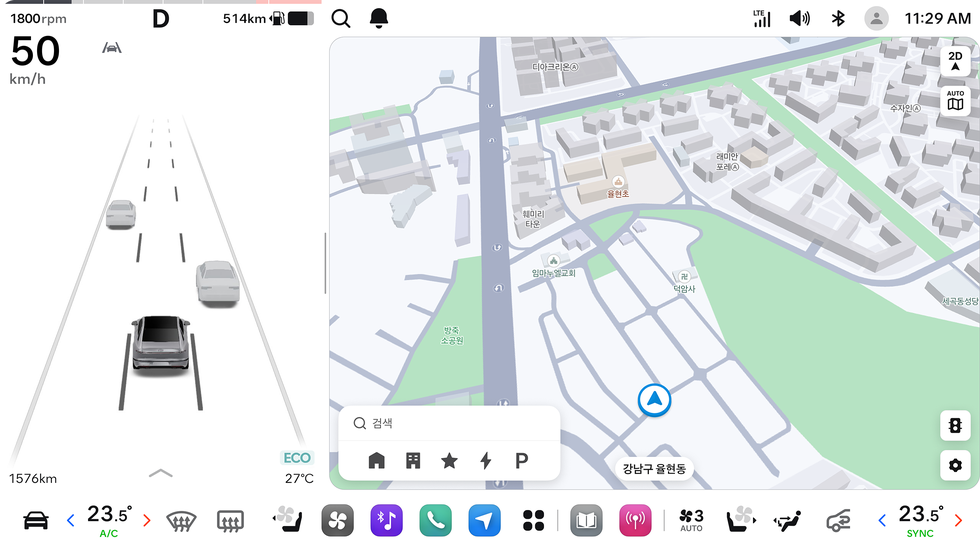
In Hyundai models with Pleos Connect, the driver faces a narrow digital display that sits atop the dashboard. It acts as a gauge cluster, showing speed, media info, and turn-by-turn directions. But the glut of information is found on the horizontally oriented center touchscreen, which is split into three sections. The one that’s closest to the driver shows all sorts of info, but it also includes a 3-D view of the objects and people that surround the vehicle, similar to the setup currently found in Tesla models. The other section hosts the navigation system, media settings, and third-party apps, and it can switch between a “Single Screen” mode, presumably for viewing streaming video, as well as a split-screen mode that lets the user juggle multiple tasks. The third piece of the puzzle is a static bar that contains a mix of redundant functions and shortcuts to apps.
Hyundai|Car and Driver
For those who need help getting around—we’re talking to you, Aunt Cheryl—Hyundai says it simplified the navigation system with Pleos Connect. Not only are the menus and layout reorganized to prioritize primary functions, but the graphic complexity has been reduced to easily identifiable icons. You can now customize the nav system’s configuration too, meaning it can share the screen with other apps at the same time. Specific details, such as ETA and a view of the full route, can appear in separate “floating” tiles.
A next-gen infotainment system wouldn’t be complete without some sort of artificial intelligence. That obviously applies to Pleos, with Hyundai calling its built-in AI agent “Gleo.” Initially, Gleo’s voice controls will center around familiar functions (adjusting in-car settings, handling web searches, and navigation assistance), but eventually it will evolve through over-the-air updates that enable greater capabilities, such as personalized services.
Hyundai will launch Pleos Connect on the new Grandeur sedan. However, that car is only sold in Korea. Pleos will migrate to other global models after that, starting with the Ioniq 3 that’ll be sold in Europe. When will it come to America? That’s not yet clear, but it should be sometime in the next year or two, with Hyundai saying it plans to have Pleos Connect running in 20 million Hyundai, Kia, and Genesis models by 2030.
Related Stories➡️ Skip the lot. Let Car and Driver help you find your next car.
Eric Stafford’s automobile addiction began before he could walk, and it has fueled his passion to write news, reviews, and more for Car and Driver since 2016. His aspiration growing up was to become a millionaire with a Jay Leno–like car collection. Apparently, getting rich is harder than social-media influencers make it seem, so he avoided financial success entirely to become an automotive journalist and drive new cars for a living. After earning a journalism degree at Central Michigan University and working at a daily newspaper, the years of basically burning money on failed project cars and lemon-flavored jalopies finally paid off when Car and Driver hired him. His garage currently includes a 2010 Acura RDX, a manual ’97 Chevy Camaro Z/28, and a ’90 Honda CRX Si.