
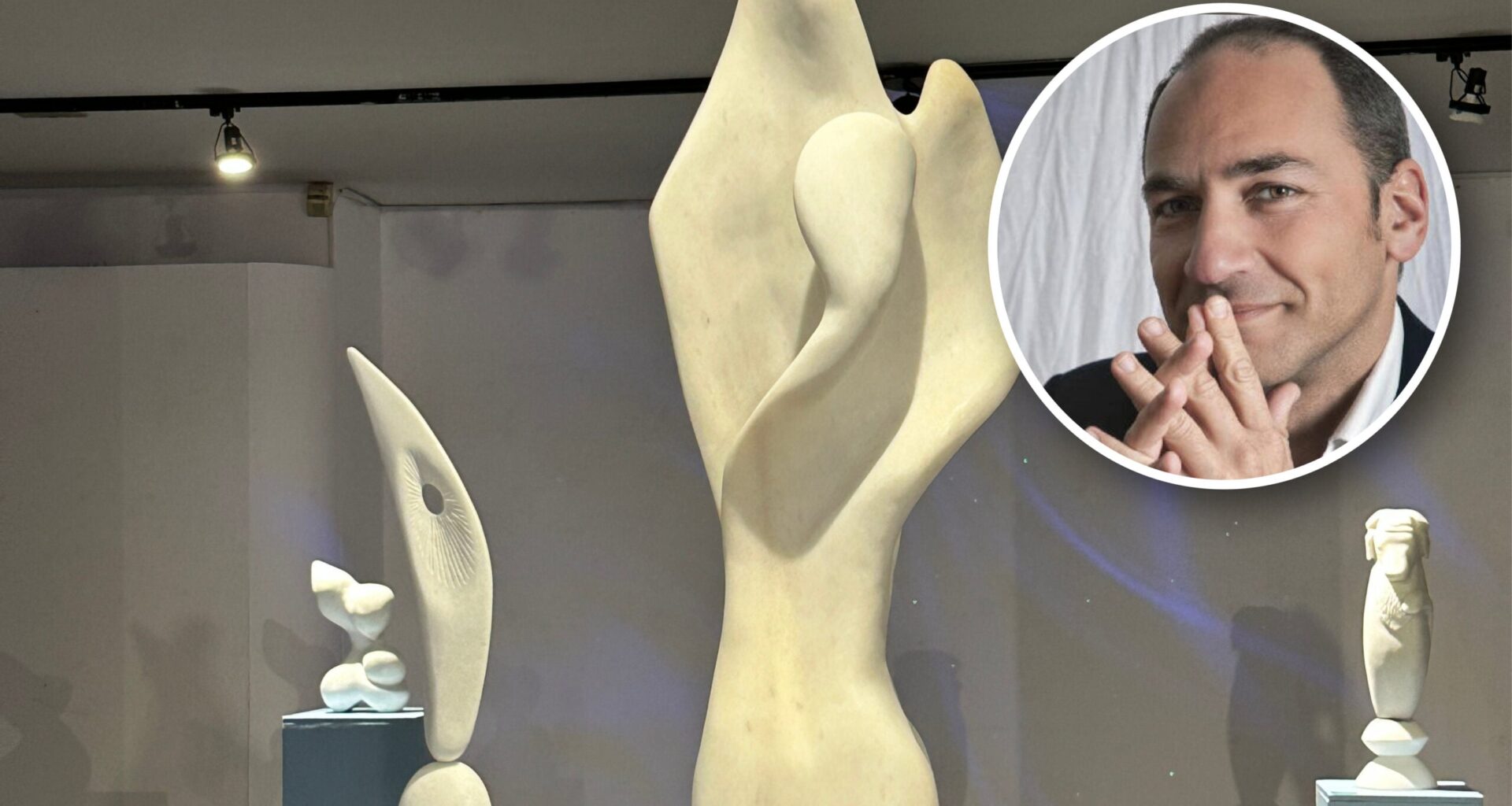
First came the word, then came the thought that expanded the word, and then came the stone that anchored the thought. Nikos Kanakis’s exhibition examines the notion of Gratitude, a word that embodies a concept so mundane that it is rarely given the weight it deserves, until it is rendered in stone, in the pure whiteness of cold Naxian marble.
Gratitude is on at the Melina Merkouri Cultural Arts Centre, Athens where, Kanakis presents a series of new works, the dominant material of which is the Naxian “crystal” marble. For Kanakis, Gratitude proposes a re-evaluation of the essential qualitative elements that lead to inner fulfilment and, by extension, to a sustainable society.
His use of marble, derived from living matter, is the ultimate expression of this principle. Yet because it has been so overused in cemeteries, it carries a different cultural weight. He seeks to liberate it from the calumny of the grave, insisting that marble has a life within it that can be freed. He does this by creating modern forms that conspire with light to either densify the stone or remove its bulk, suggesting rather than fully revealing the figure held within.
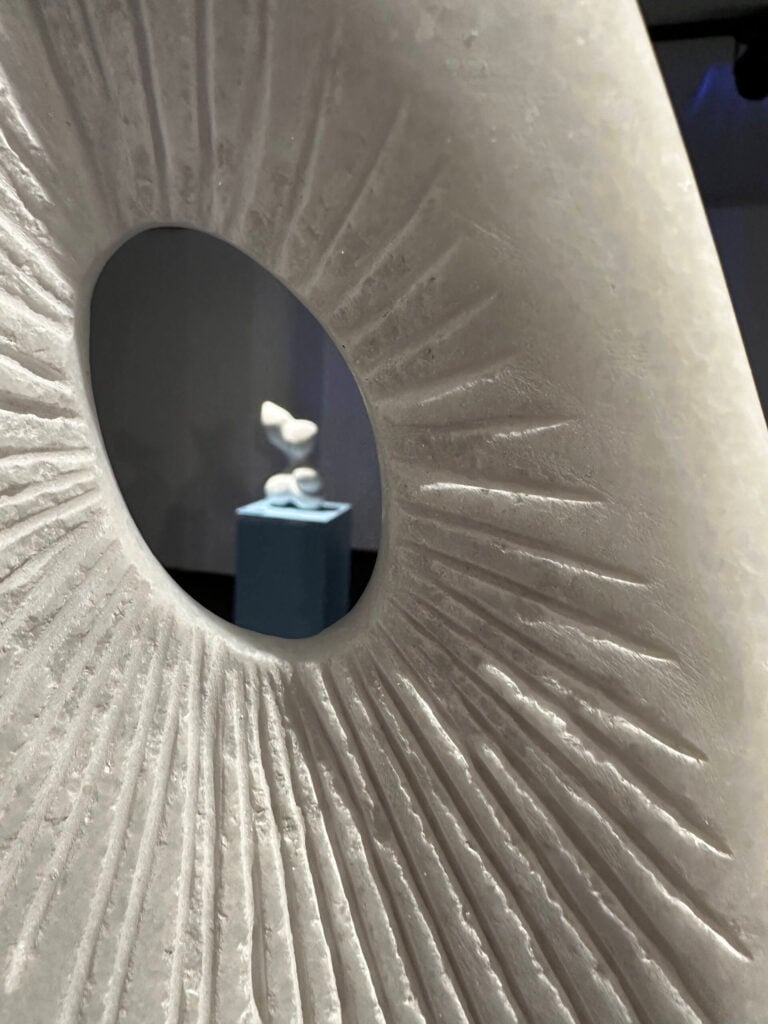 In Gratitude to the Sun, there is greater specificity: the sun rises, not sets, sending arrows of energy to sustain life. Photo: Supplied
In gratitude to honest people, for they teach us to swim in clear water, the edges of a block of marble fade into translucency as the human form emerges. Kanakis is at his most engaged when he describes his process:
“The interesting part of the work is when you see the shape—when you discard the rubbish and see the form grow… that something starts to be alive… and then you must give breath to the skin by slowly, slowly rubbing the body… and you’re ready to play with the light and you see the shadow and you play with the personality.”
Marble becomes the fine texture of youthful skin, a flash of movement, the folds of falling silk, a fleeting expression, or a breeze ruffling a lover’s hair.
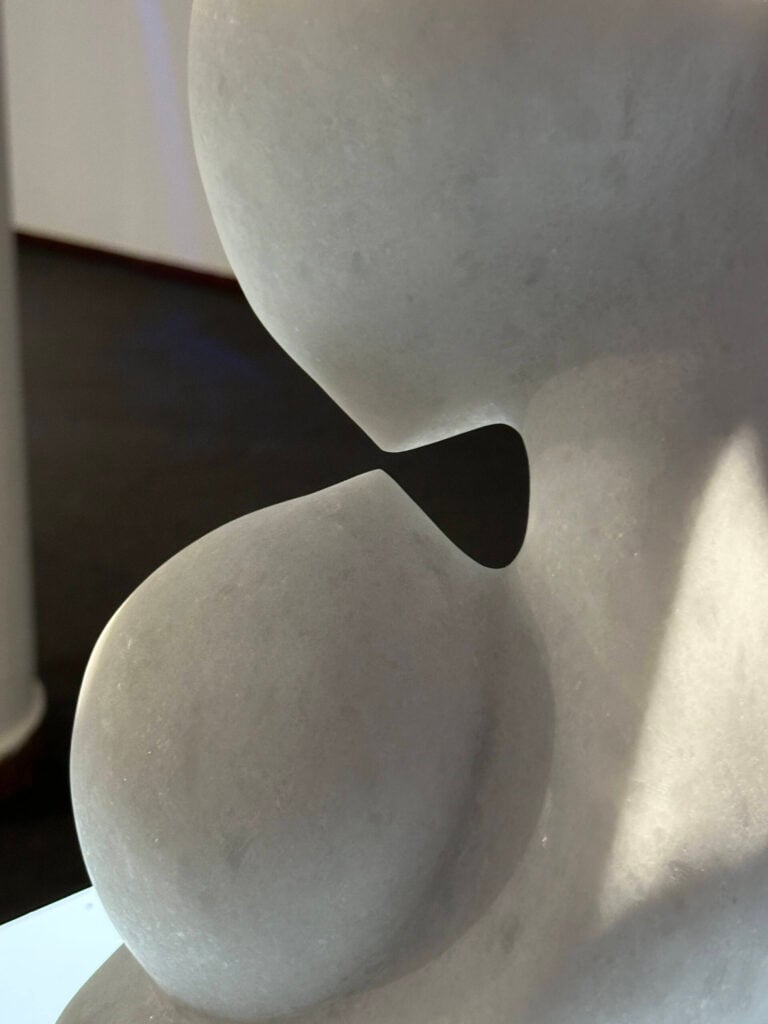 Gratitude to Motherhood is where love and solidarity begin and end. Photo: Supplied
Kanakis renders the substantial ethereal. His forms are simpler, more elemental, like the Cycladic statues he admires. They depend on precision of curve and surface, allowing light to pass through, glide across, or fracture into tiny crystalline reflections, making the work both playful and dynamic.
His gratitude to those who support us most explicitly acknowledges its Cycladic roots, presenting a column of faces with apparent uniformity that recedes into shadow and resolves into individuality and difference. He is meticulous in selecting each block of marble to give material expression to his concepts; the wrong crystal content, he notes, can make it resemble plastic.
One can appreciate this exhibition without being aware of Kanakis’s broader commitment to sustainable practice. He is a vegan—more precisely vegan, not vegetarian—refusing to profit from other living beings: if you love animals, you do not eat them. He even refuses honey, believing it deprives bees of their labour.
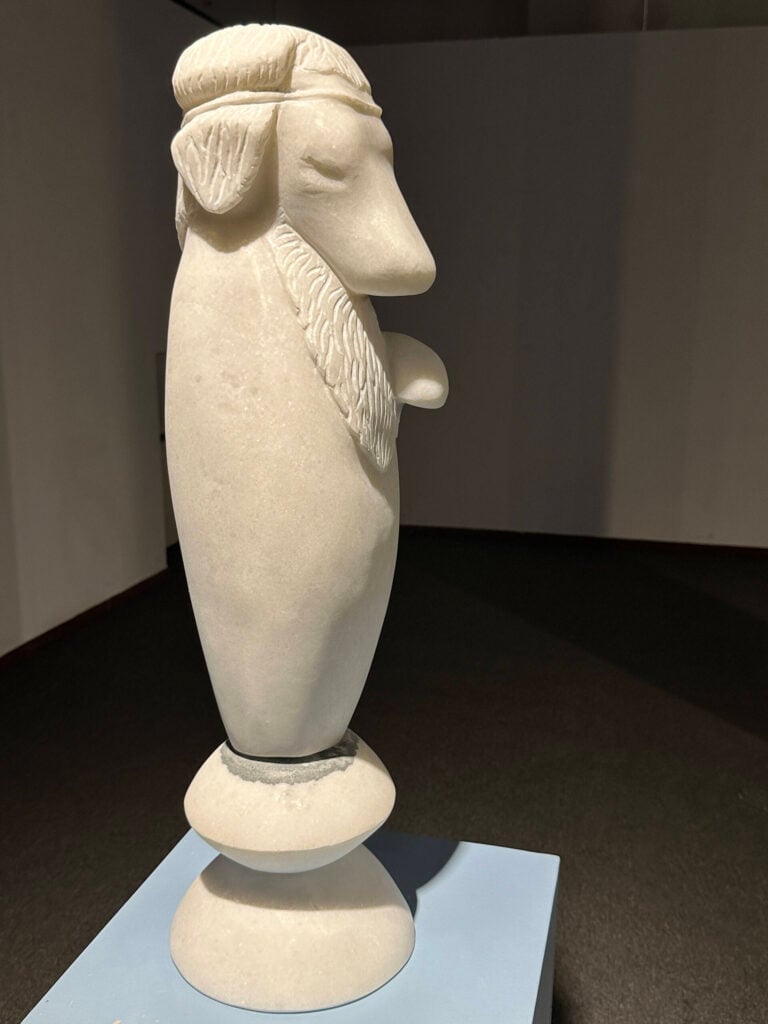 Gratitude to Animals, the exhibition’s only figurative work, carves the head of a cow or bull in stone, evoking both the animal’s solidity and Mesopotamian forms in a call for respect toward other creatures. Photo: Supplied
Gratitude to Animals, the only explicitly figurative work, carves the head of a cow or bull into stone. It conveys both the solidity of the animal and echoes Mesopotamian forms, asking for respect in our relationship with other creatures. His more abstract Gratitude to the High Mountains, for there you discover the freshness within your soul situates the work in a physical and spiritual landscape, requiring an agreement between sculptor and viewer on the truth of metaphor.
Born in Athens, Kanakis has roots in Crete and Naxos, where he maintains his studio and gallery. Trained in art, graphics and decoration, he began his career in advertising as an illustrator and award-winning art director, later founding the Greenmind advertising agency focused on green development and corporate social responsibility. “People need direct contact with nature, purity, innocence,” he says. “The ancient world had all these.” His use of marble becomes a rebellion against the artificiality of the present.
The most moving work is Gratitude to Motherhood, where love and solidarity begin and end. Here, the metaphor is at its most direct: an unambiguous rendering of the mother–child relationship through purity of stone, light and shadow, resulting in unmistakable tenderness. He has no children, something he does not regret saying, “You are not free to say what you want if you have to look after others.”
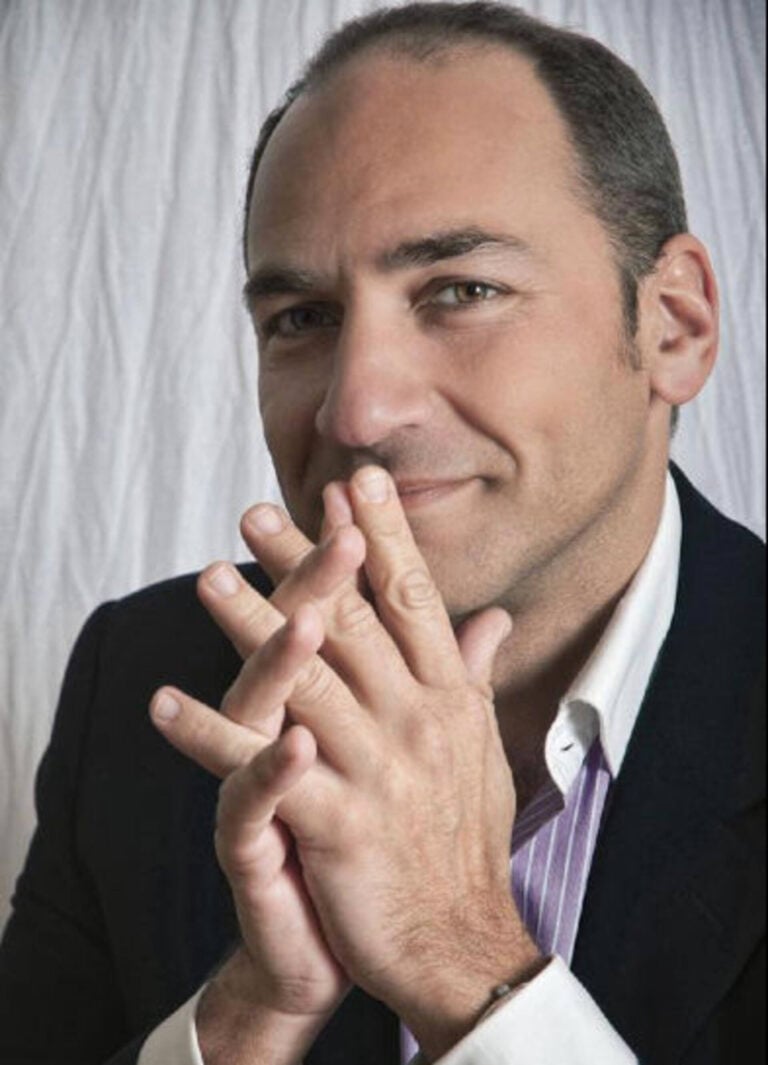 Born in Athens with roots in Crete and Naxos, Kanakis maintains his studio and gallery there. Trained in art, graphics and decoration, he began as an illustrator and award-winning art director before founding the Greenmind advertising agency. Photo: Supplied
Yet there is a quiet yearning in this work, as if for a memory imperfectly preserved. His Gratitude is universal, extending to poets who speak what hearts cannot, to friends who remain when everything collapses, to beauty that gives the eyes purpose, and to love that makes us feel we fly while walking on earth.
This universality becomes literal in Gratitude to the Stars, a mixed-media work placing a figure at the centre of the cosmos, giving gravity to the stars themselves. In Gratitude to the Sun, there is greater specificity: the sun rises, not sets, sending arrows of energy to sustain life.
It is the word, the thought, and the stone that unify this exhibition, celebrating the essential things that sweeten existence and compensate for pain. By carving Gratitude into stone, Kanakis does not seek permanence—because none exists—but to show that life flows through many forms. It leaves the impression that if one could choose a metamorphosis, it might be to become a glint within a grain of marble—alive, breathing, and shining.
Gratitude is currently on at the Melina Merkouri Cultural Arts Centre
*Kiriaki Orfanos is a culture and arts writer, and researcher, based in Sydney, now travelling Europe, and regular contributor to Neos Kosmos.