
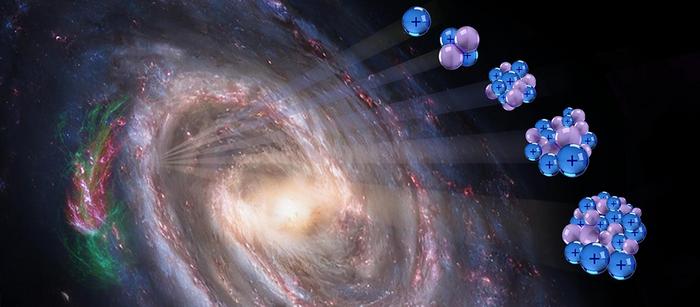
A multinational team of scientists working with the Dark Matter Particle Explorer (DAMPE) space telescope has uncovered a consistent pattern in cosmic rays, offering new insight into their origin and behaviour.
The research, involving experts from the University of Geneva, identifies a shared feature across multiple types of high-energy particles. The findings have been peer-reviewed and published in Nature.
The study focuses on cosmic rays, which are highly energetic particles that travel through space and occasionally strike Earth. Despite being discovered over a century ago, their precise origins remain unresolved.
By analysing detailed measurements from the DAMPE satellite, researchers have now observed a phenomenon known as “spectral softening” occurring consistently across different particle types.
The result is significant: it strongly supports theories that the acceleration and movement of cosmic rays depend on a property called rigidity, rather than energy per particle.
This narrows the field of viable explanations and marks a meaningful step toward understanding how these particles are generated and propagate through the galaxy.
What are cosmic rays?
Cosmic rays are among the most energetic particles known in the Universe. They are primarily composed of protons but also include heavier atomic nuclei such as helium, carbon, oxygen, and iron.
These particles travel at near-light speeds and carry energies far exceeding those produced by human-made particle accelerators.
Scientists believe cosmic rays originate from extreme astrophysical environments, including supernova explosions, rapidly spinning neutron stars (pulsars), and jets emitted by black holes.
However, pinpointing their exact sources has proven difficult due to the way magnetic fields bend their paths through space.
Understanding cosmic rays is critical because they provide indirect evidence about the most violent processes in the Universe.
They also play a role in shaping interstellar chemistry and can impact space weather, which has implications for satellites and astronaut safety.
DAMPE mission delivers high-precision data
Launched in December 2015, the DAMPE satellite was designed to investigate high-energy particles with unprecedented precision. One of its primary objectives is to explore whether dark matter contributes to the production of cosmic rays.
The mission has benefited from significant contributions by the University of Geneva, particularly from its Department of Nuclear and Particle Physics.
The Geneva team developed advanced artificial intelligence (AI) methods to reconstruct particle events and played a key role in analysing proton, helium, and carbon data.
A crucial component of the satellite is the Silicon-Tungsten Tracker (STK), a detector that enables precise measurement of particle trajectories and charge. This technology has been instrumental in identifying subtle patterns within the cosmic rays data.
Discovery of a universal feature
The central finding of the study is the identification of a shared behaviour across all examined cosmic ray nuclei.
Researchers observed that beyond a specific threshold – around 15 teraelectron-volts (TV) in rigidity – the number of particles drops off more sharply than expected.
This effect, known as spectral softening, indicates that the energy distribution of cosmic rays changes in a consistent way regardless of the particle type.
This pattern suggests a universal mechanism governing how these particles are accelerated and transported.
Importantly, the data rules out competing theories that prioritise energy per nucleon as the main factor. The statistical confidence of this conclusion exceeds 99.999%, making it one of the most robust findings in the field to date.
Implications for astrophysics research
This discovery provides tighter constraints on theoretical models describing the origin and propagation of cosmic rays.
It supports the idea that magnetic fields and particle rigidity play a dominant role in shaping their behaviour across the galaxy.
The findings also enhance our understanding of high-energy astrophysical sources and the interstellar medium through which these particles travel.
By refining existing models, researchers can better interpret future observations and design more targeted experiments.
While cosmic rays remain a complex puzzle, the DAMPE mission has delivered a critical piece. The identification of a universal feature moves the field closer to answering long-standing questions about where these particles come from and how they gain such extraordinary energy.