
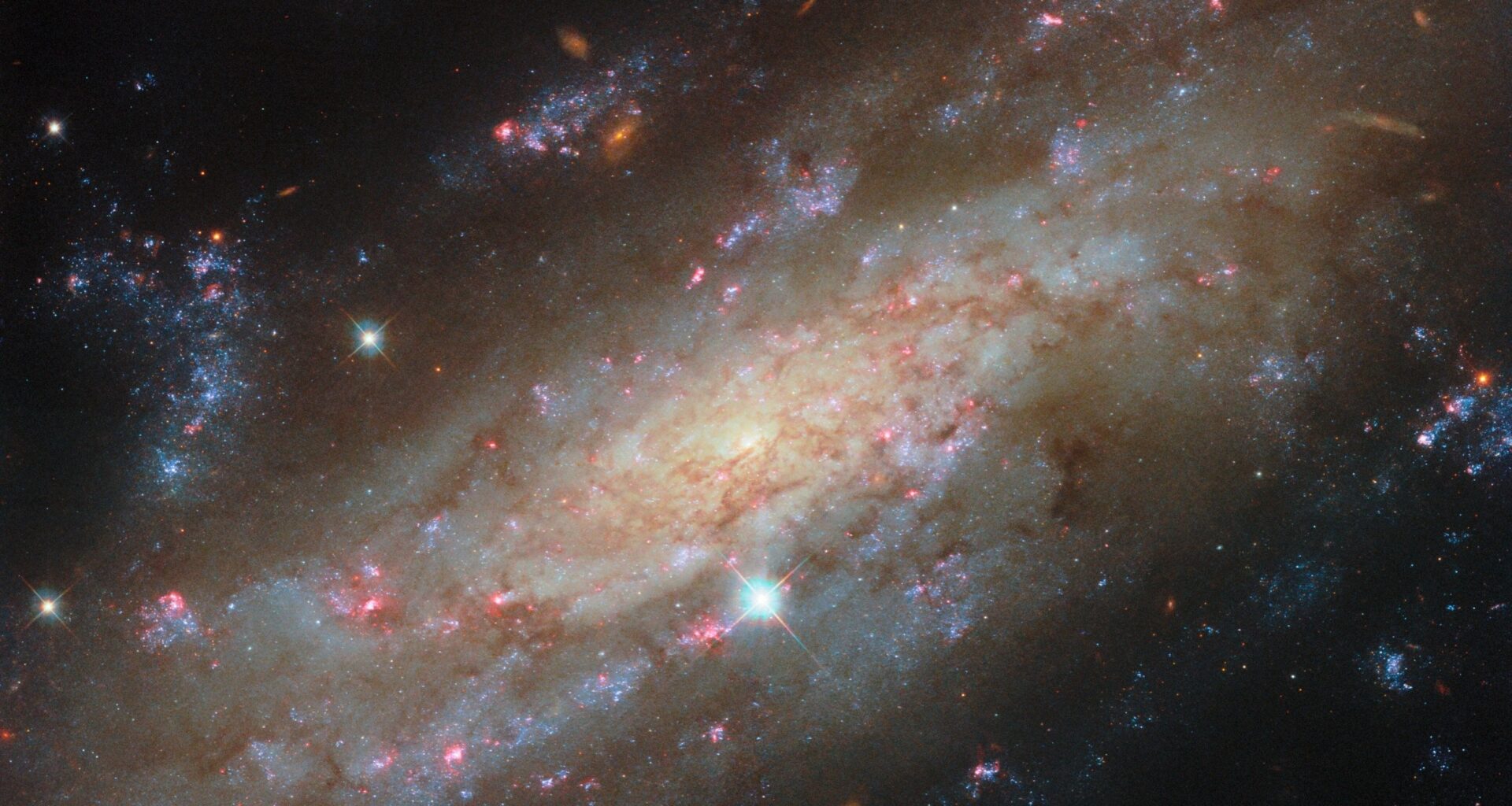
Today’s Image of the Day from the European Space Agency features a spiral galaxy filled with bright star clusters and soft clouds of gas.
The galaxy, known as NGC 3137, sits about 53 million light-years away in the constellation Antlia.
From this distance, the system still appears rich with detail, offering a clear look at how stars are born, evolve, and eventually fade.
A galaxy that mirrors our own neighborhood
Galaxies like NGC 3137 are not just distant lights in the sky. They act as working models for understanding how our own cosmic neighborhood behaves.
Because it is relatively close, this galaxy allows scientists to track patterns that would be harder to see in more distant systems.
NGC 3137 travels through space as part of a small galaxy group that resembles the Local Group – the collection of galaxies that includes the Milky Way.
In both cases, two large spiral galaxies dominate the scene. In our Local Group, those are the Milky Way and Andromeda.
In this distant group, NGC 3137 shares that role with a companion galaxy called NGC 3175.
The role of smaller companions
Smaller galaxies also play a role in shaping these systems.
Astronomers have identified more than 500 possible dwarf galaxy candidates in the NGC 3175 group, although many still need confirmation.
These faint companions may seem minor, but they help control how gas moves, how stars form, and how galaxies grow over time.
Studying this group offers a way to compare and better understand the forces shaping our own galactic home.
Researchers involved in this work are using Hubble observations as part of a broader program that focuses on star clusters across 55 nearby galaxies.
The effort, led by principal investigator D. Thilker, aims to map out the full life cycle of stars in spiral galaxies.
A closer look at structure and motion
The image of NGC 3137 was captured by the Hubble Space Telescope. It reveals a galaxy tilted at an angle, giving a side-on view of its loose, feather-like spiral arms.
This orientation makes it easier to trace the flow of dust and gas through the galaxy’s disk.
Fine, dark clouds wrap around the central region, forming a network that partly hides the bright core. At the center lies a black hole estimated to be about 60 million times the mass of the Sun.
Black holes of this size are common in large galaxies, including the Milky Way, where a similar but smaller object sits at the core.
These central features influence how matter moves and can affect star formation across the galaxy.
The image itself combines data from six different color bands. This method allows astronomers to highlight different physical features, from cooler dust lanes to hotter regions filled with newly formed stars.
A few stars from our own galaxy appear in the foreground, while faint, distant galaxies fill the background.
Star clusters reveal the life cycle of stars
What stands out most in this image is the galaxy’s collection of star clusters. Bright blue clusters mark areas where new stars are forming.
These young stars burn hot and fast, often surrounded by glowing red clouds of gas that have not yet dispersed.
These regions provide direct evidence of ongoing star formation. Over time, the gas will thin out, leaving behind stable clusters of older stars.
Elsewhere in the galaxy, older stellar populations shine with a softer, more even light, showing what these regions will look like millions or billions of years later.
By observing both young and old clusters in the same galaxy, scientists can piece together a timeline of stellar evolution.
This helps answer key questions about how quickly stars form, how long they live, and how they influence their surroundings.
Why nearby galaxies still matter
Even with powerful telescopes that can see across billions of light-years, nearby galaxies like NGC 3137 remain essential targets. They offer a level of detail that distant objects cannot match.
That detail allows astronomers to test ideas about galaxy formation and evolution with greater confidence.
The ongoing Hubble program is building a large, consistent dataset that spans dozens of galaxies. By comparing these systems, researchers can identify patterns that apply across different environments.
Some galaxies form stars rapidly, while others slow down. Some host tightly packed clusters, while others spread their stars more evenly.
NGC 3137 adds another piece to that larger picture. Its mix of young clusters, older stars, and complex structure shows that even a single galaxy can tell multiple stories at once.
Image Credit: European Space Agency
—–
Like what you read? Subscribe to our newsletter for engaging articles, exclusive content, and the latest updates.
Check us out on EarthSnap, a free app brought to you by Eric Ralls and Earth.com.
—–