
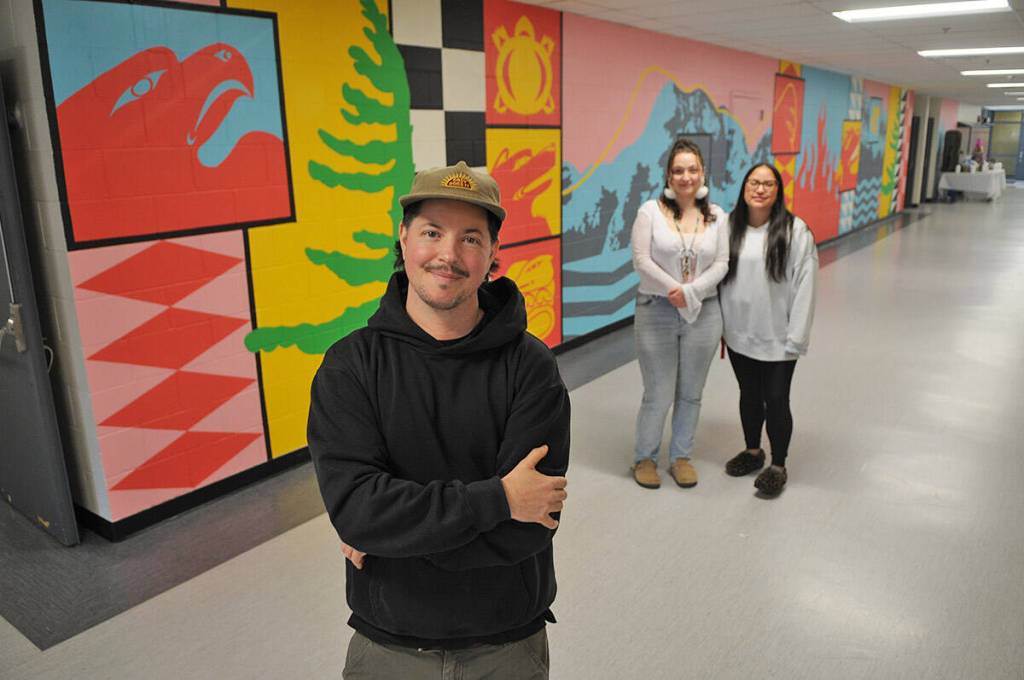
A new mural inside Shxwelis te Ts’qó:ls (Spirit of Hope Secondary School) is bringing art and Indigenous learning to the high school in the form of a “teaching wall.”
The colourful piece was designed and painted by Josh Conrad of Chowéthel (Chawathil First Nation).
“I wanted to showcase that Indigenous people are here now,” he said. “We’re modern people doing modern things and we continue to integrate our traditions and our culture and our stories in new inventive and modern ways. I wanted to represent that through this mural.”
His style features traditional artwork, Salish weaving patterns, geometric shapes and bright colours. Along with water, fire, mountains and trees, he included local animals found in the community like a wolf, beaver, turtle, bear, eagle and salmon.
Standing tall in the centre of the mural is Stámiya (Hope Mountain).
“The largest representation is, of course, Stámiya because it is something that is very important to us. It really keeps us in place of the land we’re walking on right now,” Conrad said.
A yellow line runs through Stámiya and leads to Sásq’ets (Sasquatch), marking his pathway as he walks and finds his way through the mountain range.
The geometric shapes represent the “shared” Salish weaving patterns, Conrad explained.
“We share this, not just with Salish people, but with people all over the world. I feel like this is a talking point as to how we share culture.”
He broke down the different shapes and their meanings: diamonds represent love, eternity and cycles; zigzags represent movement, water and mountains; squares represent strength, stability, family and togetherness; triangles represent mountain ranges; and the checkered pattern represents a sense of community.
The zigzag pattern sits at the base of the mountain, identifying the flowing Fraser River, Coquihalla River, and Suckers Creek where the two rivers meet.
He said a lot of educational events and field trips happen at Suckers Creek.
“I felt like this was a really good way to integrate what we’re learning now about the salmon and their life cycles and their importance to us, as well as the places here in Hope locally where we see those activities happening, and the salmon coming back home to spawn.”
Conrad grew up in Hope, went to Hope Secondary School, and currently lives in Chilliwack. He came back to his hometown to paint the mural and said he feels “really connected” to the cycle of the salmon coming home.
“It was a pretty big, full-circle moment to be able to paint here,” he said.
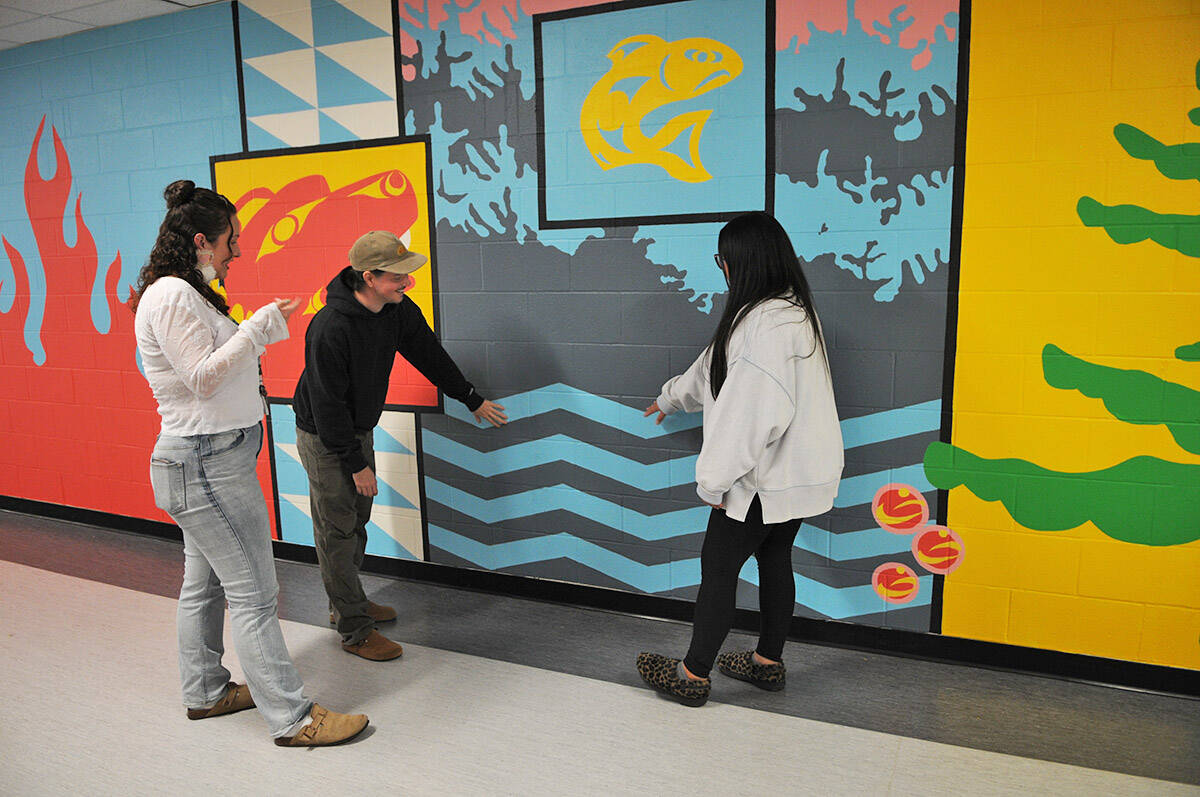
There are at least three stories woven into the piece: one about Stámiya, another about transformation from man to bear, and a salmon/fishing story.
“We’re trying to not just have a mural, we’re trying to bring teachings in,” said Wade Peary, principal of Shxwelis te Ts’qó:ls.
Caitlin Demmitt, Indigenous support worker at the school, said the mural is also a way to “bridge the gap” between the elders and the youth.
She said she was happy Conrad included a cedar tree as it touches on the school’s new name change. ‘Ts’qó:ls’ references a bare or bald tree, as the wind comes up from the river, she explained.
“We were really glad that (the tree) was able to reference the name of our school, which we were able to come up with from the help of elders and community,” Demmitt said.
“The tree is a traditional landmark,” added Kristie Peters, fellow Indigenous support worker. “That’s how we identify where we’re at… because, we didn’t have roads and stuff like that.”
Peters also pointed out another landmark right in the middle of the mountain: a traditional landmark rock, framed by a black square border. It is part of their transformation stories which they value, she said.
“We’re losing our stories. We want to make it modern for the students, so we don’t lose it,” Peters said.
Conrad wore virtual reality goggles to paint the mural. He used an application in VR, specific to generating large-scale imagery.
“To map it out, I actually was able to, in virtual reality, place the digital version of the mural onto the wall, lock it onto the wall and then be able to trace my drawing onto the wall.”
He said VR has been “instrumental” in various mural pieces. It scans the wall and then the artist can make adjustments while they’re in the application.
Their big goal is to bring in elders, record their stories, and share them via augmented reality. People would be able to scan a QR code with a smartphone, turning the mural into a “living piece” by way of adding digital elements like images, text and 3D models onto the wall itself, Peary said.
It would allow kids and the community to learn what different parts of the mural mean, and how to pronounce the words in Halq’eméylem.
Funding from the Indigenous Education Council at Fraser-Cascade School District made the project possible.
Peary called Conrad’s work “phenomenal.”
He was one of few staff members who knew about the mural, as they kept it a surprise to both staff and students. Conrad painted it over eight days, with help from his wife Natalia Gudumac, during spring break.
Demmitt said the reaction from everyone when they returned to school and saw the artwork was “amazing.”
“They recognize that we’re doing it for multiple lessons and teachings, but also to bring a sense of welcome and belonging to our students and our community,” Demmitt said.