
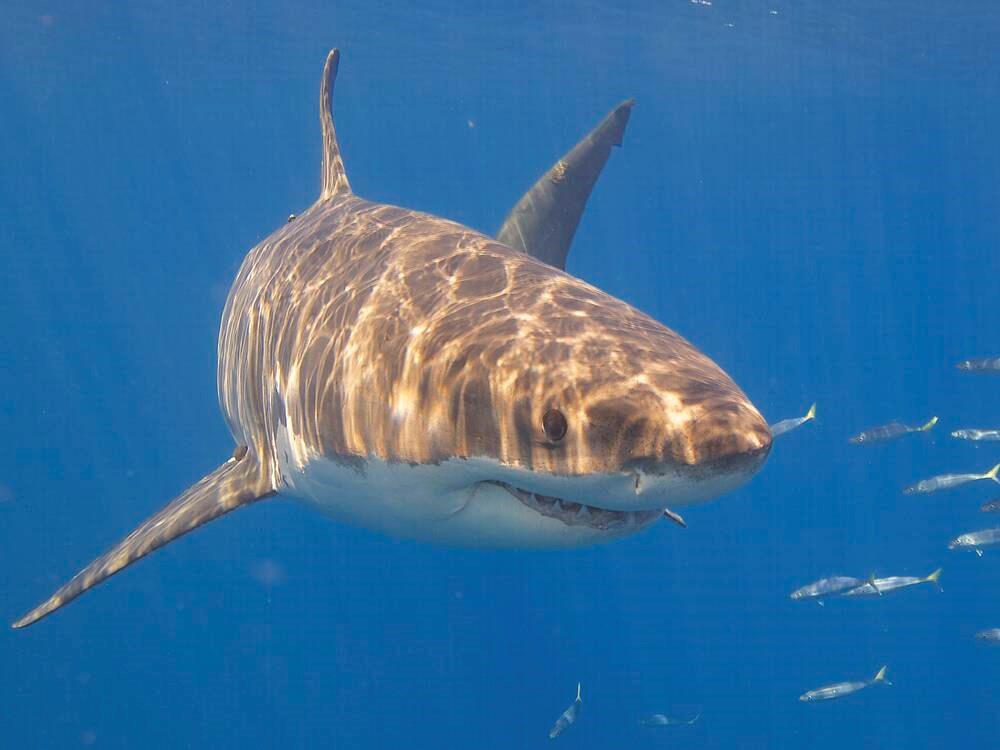
The shark, dubbed Kara, was tracked swimming in the area on April 24, following a previously logged visit on March 9.
A great white shark tagged by researchers in California has returned to the waters off Vancouver Island for the second time in two months — and she might be pregnant.
The shark, dubbed Kara, was tracked swimming in the area on April 24, following a previously logged visit on March 9.
The whale’s route is tracked via an app, Expedition White Shark, that follows adult white sharks in real time worldwide and is run by the non-profit Marine Conservation Science Institute, which works to protect and restore ocean ecosystems.
A tracking device attached to the tip of the shark’s dorsal fin “pings” when the shark surfaces for several minutes, providing an approximate location.
British Columbians who have the app received pings beginning on March 9, indicating that the great white known as Kara was just south of Vancouver Island.
Kara had travelled the Oregon coast, then down to Eureka, California, before heading up the Oregon coast again and reaching Vancouver, according to the app’s data.
Most recently, the satellite-tagged female, estimated to be nearly five metres long, pinged off San Francisco on March 22 before showing up off the coast of Northern California. After going quiet for a spell, she reappeared near Vancouver Island.
Michael Domeier, the president and executive director of the Marine Conservation Science Institute, said in an Instagram post that the shark may be pregnant.
“We don’t know for certain, but if she is, her movements could be tied to something even more significant… something we still don’t fully understand, like where these sharks gestate or give birth,” he wrote.
“When you look at this through an ecological lens, her movements make sense. Large marine predators move with their food. For great whites, that often means following pinniped populations along the continental shelf.”
With the March sighting, the number of quality position estimates confirmed Kara is the first great white tracked in B.C. waters, Domeier noted on Instagram.
That doesn’t mean that no other shark was tracked there — it just means there is no dataset recorded this far north.
“That kind of movement doesn’t match the patterns scientists have documented over the past 30 years. And that’s exactly why this matters and why the research is being done,” he said.
“These sharks are being tracked because we recognize how much we don’t know about them. Kara is a real-time reminder of that.”
Based on previous research, Domeier noted that a “shark like Kara would likely be halfway to Hawaii by now.”
Great white sharks capture the imagination, and for good reason. The apex predators grow to an average of between 11 and 16 feet (three to five metres) long, although some have been recorded over 19 feet (six metres).
But their numbers are relatively low in B.C.’s waters because it’s more of a tropical shark species that prefers warmer water, according to UBC professor William Cheung, Canada Research Chair for Ocean Sustainability and Global Change.
A form of cold-water adaptation might explain why they’ve started showing up on Canadian shores.
Great whites’ circulatory system conserves heat when they contract their swimming muscles. The heat created from that process circulates through their body and warms critical regions.
Their ability to regulate their body temperature is limited. But as ocean temperatures rise due to global warming, more warm-water species like great whites might turn up in B.C waters.
Cheung noted that temperature also affects distribution of the species that great whites prefer to eat. “The prey species also depends on the environment, so these are direct and indirect factors that affect their distribution.”
Other species that typically prefer warmer waters, such as albacore tuna and sunfish, have been showing up on the B.C. coast more frequently, Cheung said.
Sharks can kill humans — according to the California Department of Fish and Wildlife, there have been 188 incidents involving great white sharks in the state since 1950.
But shark attacks on people are “very rare events globally,” Cheung said, adding Kara is still a “rare” sighting, outside the shark’s primary habitat.
— With files from the Times Colonist