
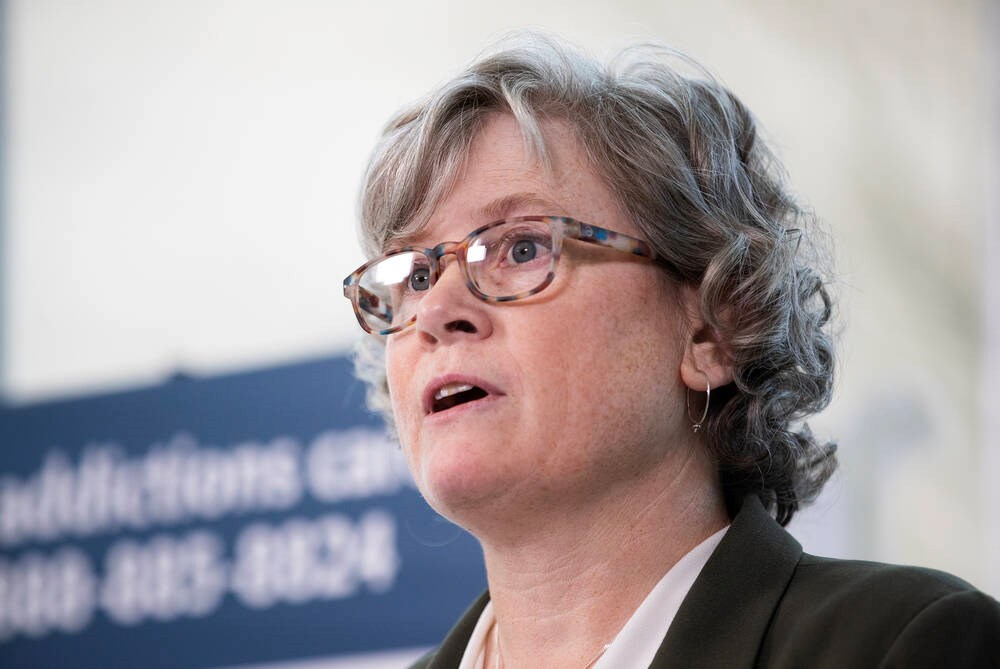
Josie Osborne said the province is doing everything it can to attract new health-care professionals, “and to have this happen by some kind of bureaucratic mess at the federal level, it’s just unacceptable.”
Health Minister Josie Osborne says a “bureaucratic mess” that resulted in a Scottish midwife’s post-graduate work permit request twice being rejected can’t be allowed to happen again.
Heather Gilchrist had been working for a Victoria midwife collective for seven months when she was given 90 days to leave the country by Immigration, Refugees and Citizenship Canada in March.
She told the Times Colonist on Saturday that she won’t return to Victoria from Scotland, saying restrictions around the new work permit she’s been offered are far too limiting.
In a scrum on Monday at the B.C. legislature, Osborne said she shares Gilchrist’s frustration. “I am so disappointed to learn that she’s made the decision not to come back to B.C., and this cannot happen again.”
Osborne said the province is doing everything it can to train and attract new health-care professionals, “and to have this happen by some kind of bureaucratic mess at the federal level, it’s just unacceptable.”
Gilchrist, who has a master’s degree and 10 years of experience in midwifery in Scotland, graduated from a nine-month Internationally Educated Midwives Bridging Program through the University of B.C.
She was registered with the B.C. College of Nurses and Midwives, granted hospital privileges at Victoria General Hospital, and nominated by the province to work here.
But federal immigration officials initially denied her a post-graduate work permit, saying it hadn’t received the results of her English-competency exam, then rejected her a second time, saying her UBC certificate wasn’t eligible for a work permit.
Osborne said what Gilchrist went through was “absolutely ridiculous.”
UBC said its bridging course for internationally educated midwives, launched in 2015, was designed to meet federal immigration requirements and the vast majority of graduates obtained their work permits and are working in Canada. It called Gilchrist’s situation a first.
Osborne said she’s writing to the federal health and immigration ministers to ask them “to make it very clear” that the course to allow midwives to work in B.C. “does meet the needs” of a post-graduate work permit and that “any application that is in process right now will benefit from that clarification.”
She is also asking the federal ministers to work with the provinces and territories to identify any other type of equivalency test or bridging program where there may be “something out there lurking that we don’t know about that’s going to create this kind of problem for people.”
Gilchrist, who arrived in Canada in 2024, headed back to Scotland on April 4.
When she landed, she received correspondence from Immigration, Refugees and Citizenship Canada offering her an employer-specific work permit, valid until April 2029, that would only allow her to work for a specific collective in a specific region.
Under the post-graduate work permit, she would have had the flexibility to work as a midwife anywhere in B.C.
UBC has said it is working with Immigration, Refugees and Citizenship Canada “to understand their needs” and support “all of our current learners and recent graduates.”
The Midwives Association of B.C. says the province is facing a critical shortage of maternity-care providers, including midwives.