
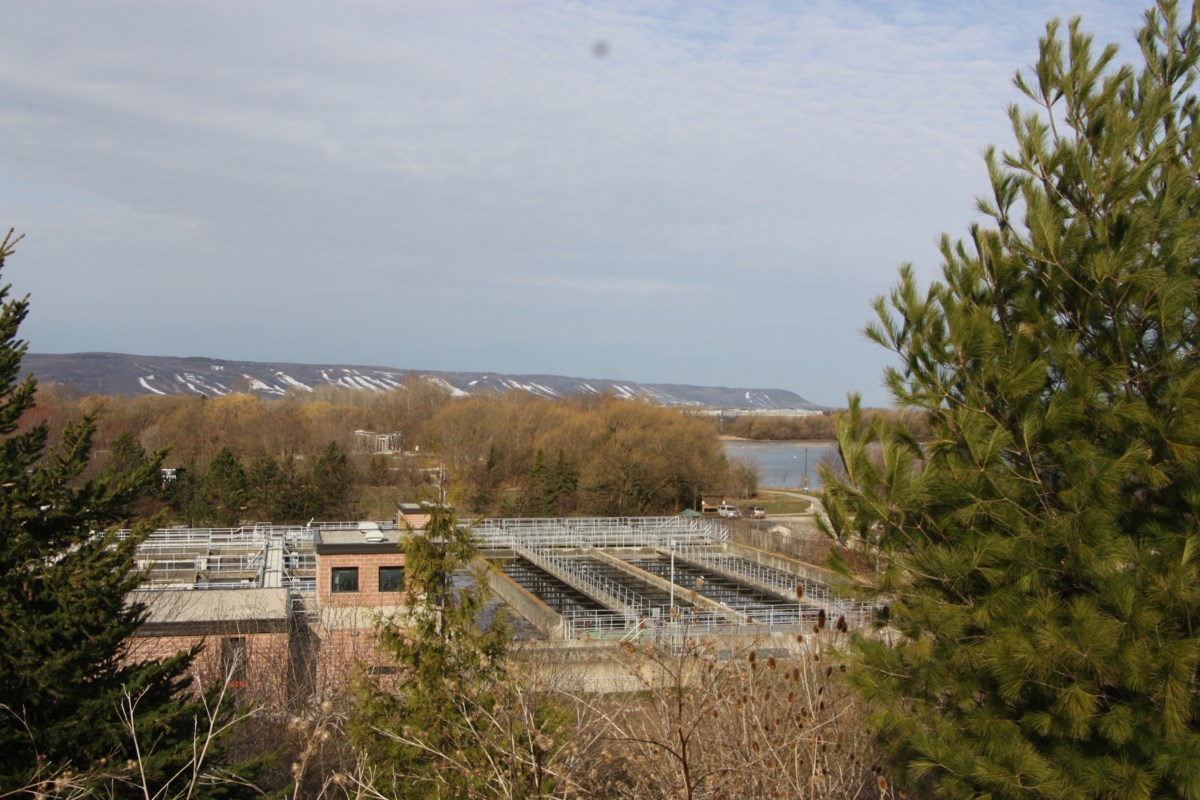
‘If there were a public health concern, the health unit would share the information or require the municipality to report publicly,’ says town official
During two rainy days this month, 10,000 cubic metres of untreated and partially treated wastewater overflowed into Georgian Bay, something Collingwood residents can help prevent in future.
Another 121,800 cubic metres of wastewater did get treated as the Town of Collingwood reported the overflow at the wastewater treatment plant on April 14 and 15.
While rainwater is not supposed to flow into the wastewater treatment plant, a combination of accidental or illegal private sump pump or downspout connections and aging, leaky pipes in the ground contribute to the gush of water overwhelming the system.
Despite these events, the town’s wastewater treatment plant runs at about 70 per cent of its designed capacity most days. The overflow events occurred during atypical peak-flow days because of stormwater getting into the sanitary system.
The town’s treatment plant is designed to allow wastewater to overflow if the inflow exceeds the plant’s capacity. Otherwise, wastewater could back up into people’s homes.
On days when there are significant rainfalls or snow melts, or both, the wastewater flowing into the plant can exceed the plant’s capacity.
“During major rain and snowmelt events, the town’s sanitary sewer system experiences inflow and infiltration – extra water that enters the system and can overwhelm pipes, pumping stations, and the Collingwood Wastewater Treatment Plant on Birch Street,” explained the town’s manager of water and wastewater, Peggy Slama.
Inflow refers to stormwater that gets into the sanitary system via sump pumps, downspouts or foundation drains that connect directly to the sewer. These connections are not allowed, but they do exist.
Infiltration refers to ground water that seeps into old sewer pipes, cracks, joints and down manholes.
Slama confirmed 6,683 cubic metres of untreated wastewater overflowed from the Minnesota Street pumping station and the main treatment plant and into Georgian Bay on April 14 and 15. Another 4,179 cubic metres of partially treated wastewater bypassed some of the process and discharged into the bay.
About double that amount of wastewater overflowed and bypassed all or part of the system during another heavy rainfall on March 7 and 11, according to Slama.
Slama acknowledged the bypass events can be concerning for homeowners and taxpayers.
While rare, there were overflows and partial bypass events last year too, on March 29, April 1, and April 3, 2025. In total, 21,000 cubic metres of wastewater overflowed from the treatment plant into Georgian Bay in 2025.
“Overflows and bypasses require immediate notification to Spills Action, the health unit, and the Ministry of the Environment, Conservation and Parks,” stated Slama in an email. “Sampling, testing, and reporting are required.”
She confirmed the town is not obligated to report bypasses and overflows to the public, but the Town of Collingwood does notify residents during every full and partial bypass event via a news release and posts to the town website and social media.
“If there were a public health concern, the health unit would share the information or require the municipality to report publicly,” said Slama.
The town is working to reduce the amount of water from inflow and infiltration.
Slama said there are regular sewer inspections and rehabilitation work done to reduce the amount of groundwater that gets into the system. The town also regularly upgrades the treatment plant, pumping station and underground pipes to keep up with a growing population.
The plant capacity is monitored and regularly reported to make sure the town is not allocating more servicing capacity than is available.
Slama said the town also continuously evaluates long-term capacity needs for plant upgrades and/or replacement. This work includes an environmental class assessment for an upgrade to the plant, which is required to determine what expansion is needed.
The town’s wastewater treatment plant on Birch Street was built in 1958, expanded in 1968 and a secondary treatment added in 1981.
The design capacity is for 24,548 cubic metres a day, with a maximum, or peak flow, capacity of 62,522 cubic metres in a day.
The annual average daily flow at the plant is 17,087 cubic metres per day, according to the 2025 wastewater performance report.

Graphic from 2025 wastewater performance report
The monthly influent flows for the Collingwood plant are highest in March and April, which brought flows between 18,465 cubic metres in a day (minimum) to 62,522 cubic metres in a day in April 2025. This was the highest recorded influent flow all year.
The lowest average for influent flow was recorded in August and September, which averaged out to 12,849 and 12,245 cubic metres in a day.
The lowest recorded flows all year happened in November, when the influent flow dropped to 7,894 one day.
The annual wastewater performance report is available from the town by request.
Slama said Collingwood’s residents can help the town’s wastewater treatment capacity by checking where their roof leaders and sump pumps drain.
“This should be to overland flow on your property, directed to your road or street, where it can flow with the stormwater system, or connected to the stormwater system,” she said.
The town also asks residents to limit showers, and use of dishwashers and washing machines during bypass events to ease the burden on the wastewater treatment plant.