
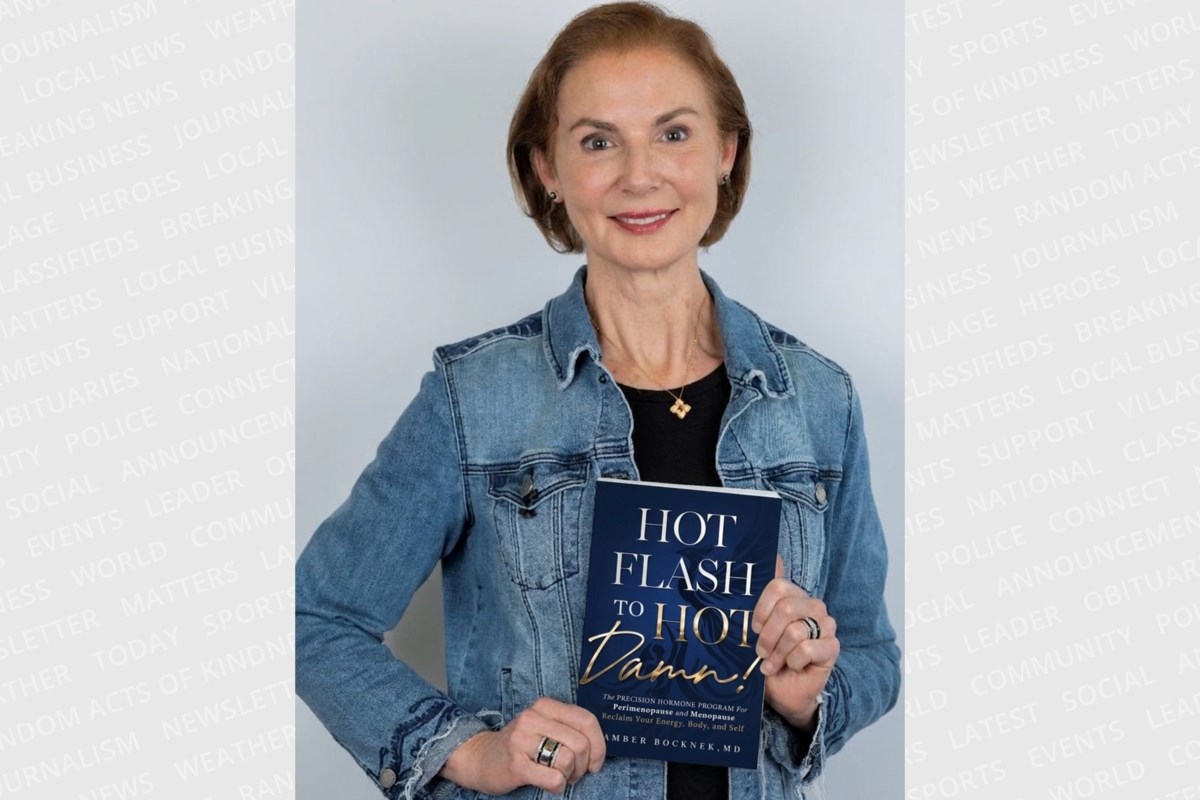
‘Every woman is going to go through this. We’re all going to do it a little bit differently, but it’s a shared experience we all have,’ says Dr. Amber Bocknek
A Barrie‑born physician has released a new book aimed at helping women navigate perimenopause and menopause — and she says it was written with readers in communities like Barrie, Innisfil, Orillia and Alliston in mind.
Dr. Amber Bocknek (née Brown), who attended Portage View Public School and Barrie Central before leaving the city for her medical training, now practises in Aurora and Newmarket.
Despite moving out of Simcoe County, she says her ties to home remain strong: members of her family still live locally and she sees patients from Barrie and across the county in her clinic almost every week.
Those ongoing connections, she says, are part of what motivated her to write a resource specifically for women in communities like the one she grew up in.
Her new book, Hot Flash to HOT DAMN!, is described as a plain language guide based on 25 years in family practice and her work as a certified menopause practitioner.
She says she deliberately set the book in Alliston, hoping to ground it in the everyday experiences of women living outside major urban centres.
Another reason for setting it in small-town Simcoe County was due to the challenge in accessing health care based on where you live.
“In smaller suburban and quasi-rural settings, it can be very difficult to access health care in particular. These things happen to women everywhere, but the ability to access health care varies greatly by region,” said Bocknek.

Dr. Amber Bocknek, who grew up in Barrie, recently released her book titled Hot Flash to HOT DAMN! | Image supplied
Bocknek has worn many hats over the course of her career, all of which she says have shaped the way she now approaches women’s health.
“I’ve done clinical practice that’s office‑based. I’ve worked in emerg. I did about a decade as a hospitalist in Alliston, as well as in Newmarket and Toronto,” she said.
And throughout those years, she says she always maintained a “health and wellness” practice in the background.
In more recent years, as she’s gone through the same life transitions that many middle-aged women experience, she says her interest in hormone health has only deepened.
She also faced her own hormone‑related health issues, which she says took her “down the rabbit hole of functional medicine.”
“I have one foot in both camps. I very much am a conventionally trained physician and wholeheartedly believe in all the good things that conventional medicine has to offer, but I’ve added to it,” said Bocknek.
She describes her current work as a “hybrid practice” that blends both conventional medicine and functional approaches.
“It’s like cherry-picking the best of both fields. That’s where I find myself now,” Bocknek said. “We do a lot of health and wellness around hormone health and trying to have the best kind of go‑forward health span.”
Bocknek also describes her new book as a “hybrid” — part novel, part self‑help and part how‑to guide.
“It’s a shared life experience, self‑learning advocacy book that has a companion workbook to do a lot of self-study and work on the side to help women advocate for their health,” she said.
That kind of advocacy, Bocknek added, is especially important in a health-care system that is stretched to capacity and often struggles to manage complex or overlapping issues.
“It’s a difficult environment to navigate, so it’s a combination,” she said. “I’ve incorporated a little bit of my own personal story, plus clinical vignettes of patients, plus self-advocacy work for women who are going through the same life journey I am, to help them get the help they need.”
Bocknek says the motivation for the book comes directly from the same place that led her to incorporate functional medicine into her practice.
“It was my own personal life experience,” she said. “I wish I could say I had enough medical foresight to have been interested, motivated and aware — to the level I am now — of these women’s health issues before things happened to me. But I think so many of us are experiential learners.”
When Bocknek began developing health issues that the medical system couldn’t fully explain or address, she says she was pushed to look further. Even with her training, knowing the language of medicine and how to navigate it, she found herself running into barriers she didn’t expect.
“It really made me keenly aware of how difficult this is for everybody,” she said. “That’s really where I thought something needs to be put out there to help people find their path in a quicker, more direct line than what I found on my own.”
She hopes the book will be a “good starting point” — something that helps women understand what they’re going through, gives them the language to talk about it, and points them in the right direction.
“Wherever your own experience takes you, you’ll have some tools and evidence‑based information to guide you,” Bocknek said. “Every woman is going to go through this. We’re all going to do it a little bit differently, but it’s a shared experience we all have.
“I’m really hoping that the messaging at the end of the book leaves the reader feeling just more aspirational, more content in self and like there’s a a better, brighter future ahead that she absolutely should demand and go for.”