
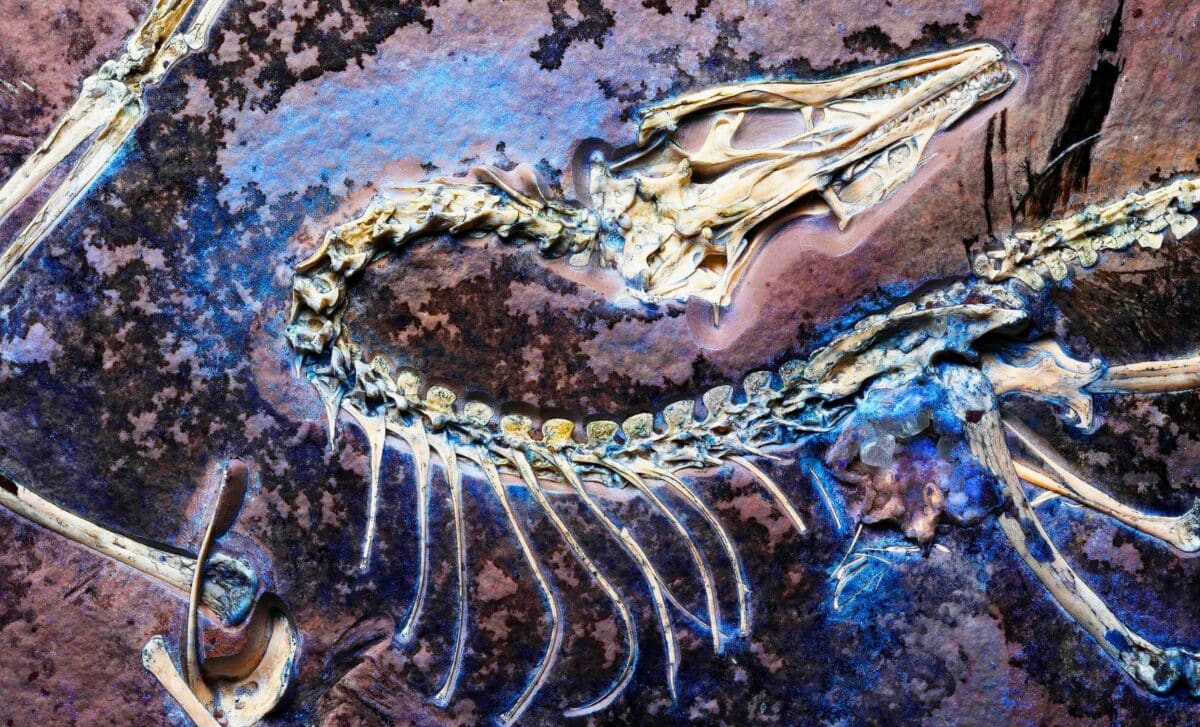
Less than two years after Charles Darwin published On the Origin of Species, quarry workers in Germany unearthed a creature that seemed to prove his theory correct. It had feathers like a bird and teeth like a lizard. More than 160 years later, the smallest and one of the most complete specimens of that same animal has surfaced, and it is rewriting what scientists know about the origin of flight.
The fossil, called the Chicago Archaeopteryx, arrived at the Field Museum in 2022 and went on public display in 2024. At roughly the size of a pigeon, it is the tiniest of the 14 known Archaeopteryx specimens. But what sets it apart is not its size, according to a study published in Nature. It is what the rock preserved that every previous fossil missed.
“When we first got our Archaeopteryx, I was like, this is very, very, very cool, and I was beyond excited,” said Jingmai O’Connor, the museum’s associate curator of fossil reptiles and the study’s lead author. “But at the same time, Archaeopteryx has been known for over 160 years, so I wasn’t sure what new things we would be able to learn.”
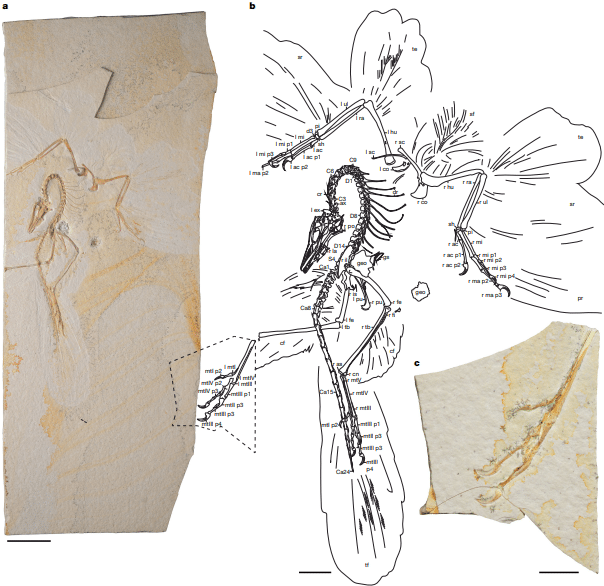 Photograph and interpretive line drawing of Archaeopteryx. a, Main slab. b, Interpretative line drawing. c, Left foot, main slab (marked by dashed outline in b). Credit: O’Connor, J., Clark, A., Kuo, PC. et al.
Her skepticism faded fast. Encased in hard Solnhofen limestone, the skeleton came with traces of soft tissue that earlier preparation methods, cruder and less patient, had scraped away from other fossils. The Chicago team spent more than a year on the work, guided by micro-CT scans and ultraviolet light, which makes the chemical signature of the ancient tissue glow.
Feathers That Made Flight Possible
The single most important discovery sits on the wings. The fossil preserves long tertials, a specialized set of feathers on the upper arm. In living birds, tertials close the gap between the body and the flight feathers. Without that seal, air rushes through, lift collapses, and sustained flight becomes a physical impossibility.
Previous Archaeopteryx specimens had hinted at these structures, but none showed them clearly. The Chicago Archaeopteryx displays them on both wings. Their presence ends a debate that has divided paleontologists for generations: this animal could fly.
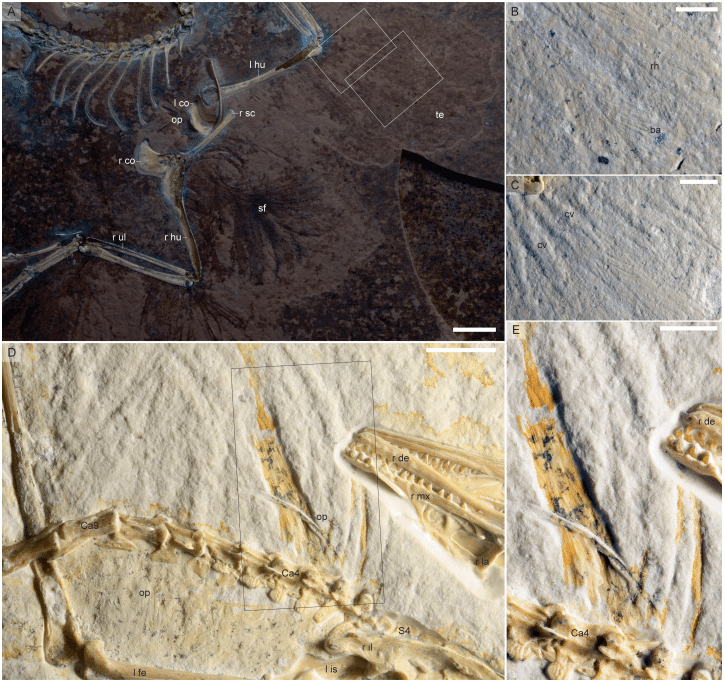 Plumage details in Archaeopteryx. a, scapulars and left humeral and ulnar tertials; b, c, close up of the left tertials showing the preservation of barbs, rachises, and vane symmetry; d, open pennaceous body feathers preserved dorsal to the proximal caudal vertebrae and projecting off the left femur; e, close up of the open pennaceous feathers preserved in (d). Credit: O’Connor, J., Clark, A., Kuo, PC. et al.
“Our specimen is the first Archaeopteryx that was preserved and prepared in such a way that we can see its long tertial feathers,” O’Connor said. “That tells us… Archaeopteryx could fly.”
The finding also reinforces a broader and more provocative idea. Because non-avian dinosaurs closely related to Archaeopteryx lack these feathers, the evidence points toward flight evolving more than once across the dinosaur family tree.
A Delicate Extraction Under UV Light
Preparing the fossil demanded technology that no previous research team had applied to a complete Archaeopteryx. The bones and the surrounding rock share nearly the same color. Without imaging, a preparator cannot see where one ends and the other begins.
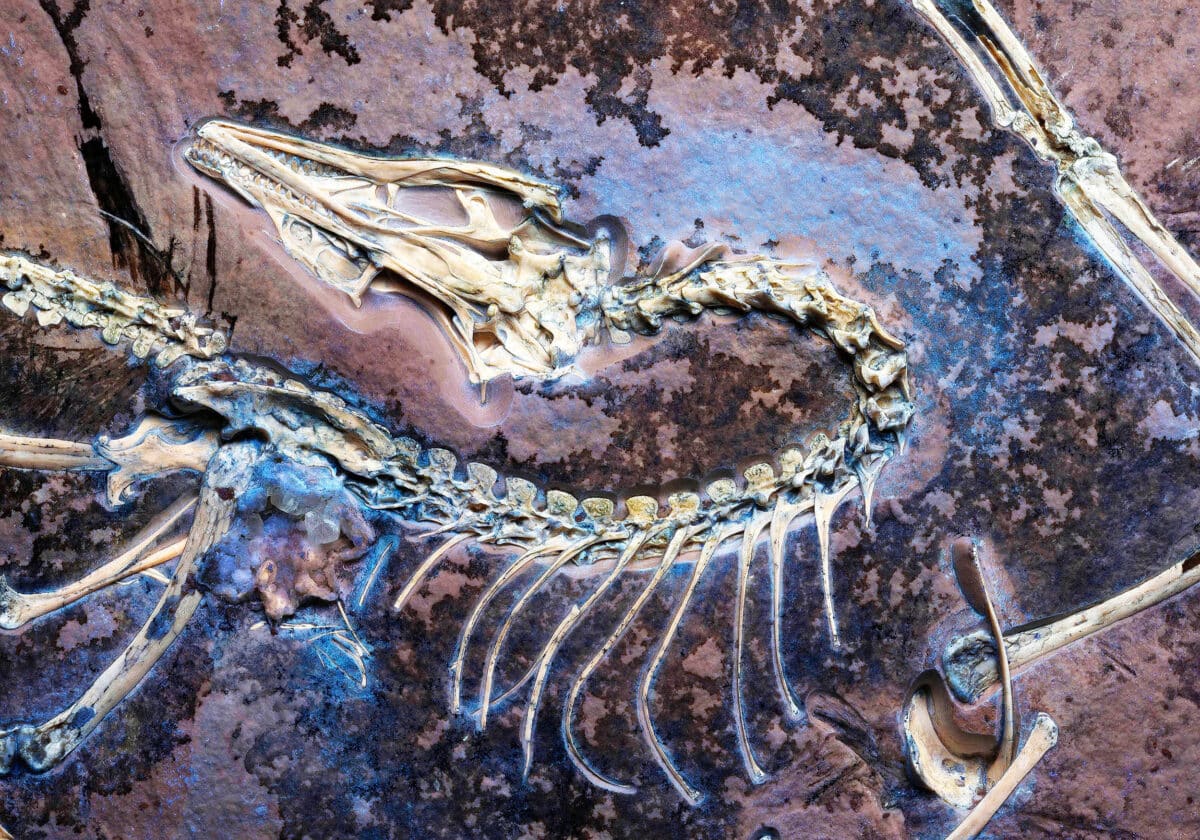 Chicago Archaeopteryx under UV light to show soft tissues alongside the skeleton. Credit: O’Connor, J., Clark, A., Kuo, PC. et al.
A CT scanner, which builds a three-dimensional map from a series of X-rays, gave the team a subsurface view. UV light, meanwhile, caused the soft tissue to fluoresce. The preparators worked under that glow repeatedly during the year-long process, checking that they were not about to scrub away invisible anatomy. This is the first time a full Archaeopteryx has received CT scanning and had the resulting data released publicly.
A Skull Poised Between Two Worlds
While the feathers settle the flight question, the skull fills in a different chapter of evolution. The palate bones are visible from a ventrolateral angle that no other specimen offers. Their structure sits squarely between those of troodontid dinosaurs and the more advanced birds of the Cretaceous. This intermediate architecture illuminates the slow assembly of cranial kinesis, the jointed skull that lets a modern bird raise its upper beak independently from its brain case.
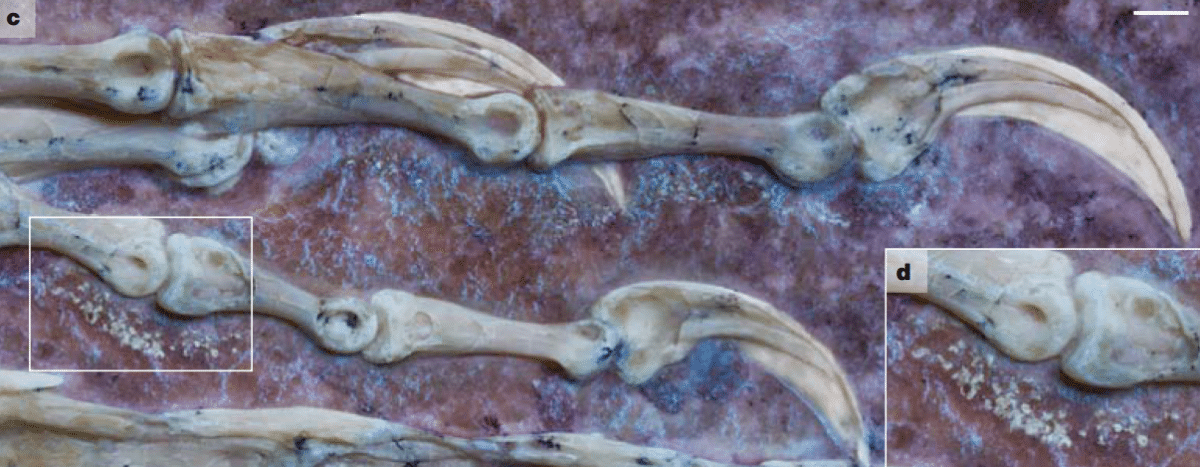 Detail photograph of preserved skin tissue in the Chicago Archaeopteryx. Credit: O’Connor, J., Clark, A., Kuo, PC. et al.
Soft tissue traces on the feet point toward a ground-dwelling lifestyle, not a raptorial one. The skin preserved on the hand suggests a mobile digit that earlier reconstructions had fused into the wing. Both details sharpen the portrait of an animal that walked on land and launched itself into the air.
Why a 19th-Century Prediction Still Holds
When the first Archaeopteryx surfaced in 1861, it landed in the middle of a fierce argument about natural selection. Darwin himself had predicted that transitional forms would appear in the fossil record, and this one seemed custom-made for the role. It had feathers, wings, and a wishbone, but also a bony tail, claws, and a mouth full of teeth.
The Chicago specimen does not alter that basic picture. It adds precision. Archaeopteryx was not the first feathered dinosaur. It was not the first to grow wing-like limbs. It may, however, be the earliest that could use those feathers to power itself through the air.
“We think it’s the earliest known dinosaur that was able to use its feathers to fly,” O’Connor said. He also said that the paper is a beginning, not an endpoint. “We’re learning something exciting and new from just about every part of the body that we have preserved. And this paper is really just the tip of the iceberg.”