
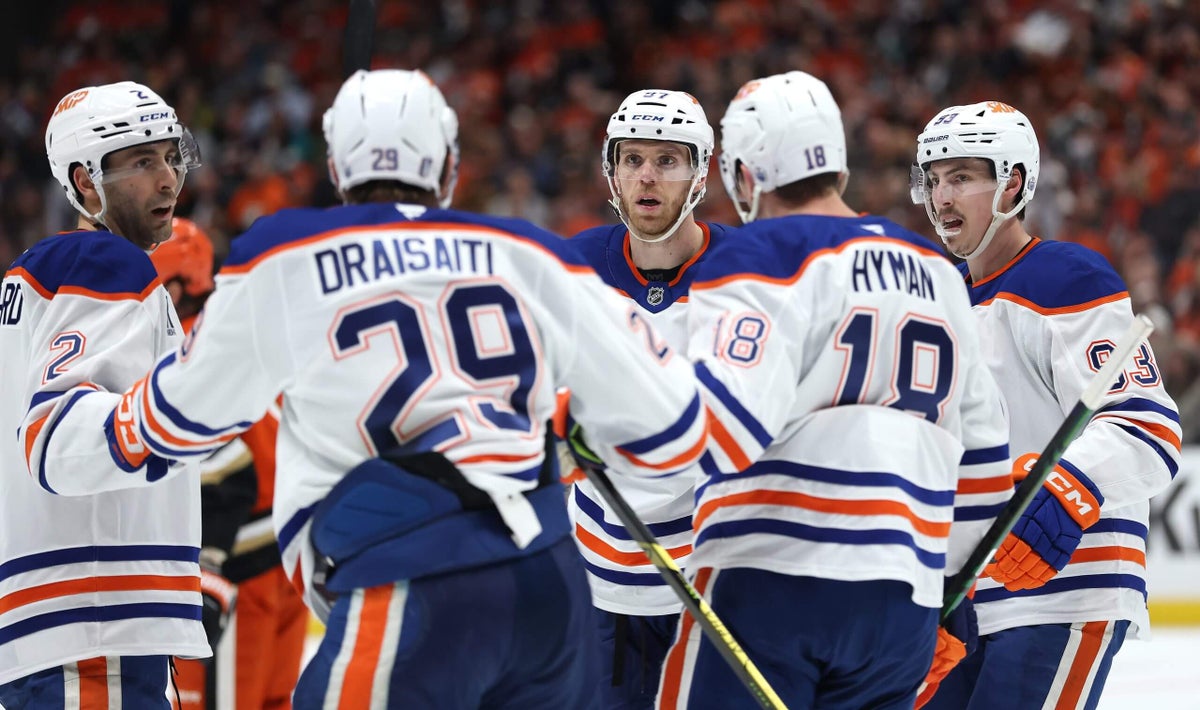
The Edmonton Oilers’ season ended early this spring, and that could be a blessing in disguise. Since the start of 2023-24, the club has played in 299 total games. The Anaheim Ducks, who ended Edmonton’s season last week, have played in only 252 games. Among a fairly lengthy list of reasons the Oilers stumbled early this year, surely fatigue is a prominent one.
The summer will be spent dealing with real roster issues. First, the coaching staff will need to be addressed, and there’s a chance Kris Knoblauch will be dismissed. Fans have settled on Bruce Cassidy, recently fired by the Vegas Golden Knights, as the prime candidate to replace Knoblauch, but as of today, no decision has been made. Knoblauch signed a three-year extension last fall, so he’s under contract through the end of the 2028-29 season. There may be tweaks to the coaching staff under Knoblauch in the weeks to come.
No matter who is coaching the Oilers in 2026-27, there are areas to prioritize. Here are the main issues, with some possible solutions.
Buy in from everyone
No one knows everything that goes on behind closed doors. That understood, the players acquired by the general manager have to be deployed by the coach in the way intended. On the eve of the regular season, Knoblauch announced Connor McDavid and Leon Draisaitl would play on the same line at five-on-five. After an entire preseason where the two men centre separate lines, it cooked the summer acquisitions on the spot. If the owner is willing to open up the pocketbook to bring in expensive help, that help should be given an opportunity to play to their strengths.
Next year’s coaching staff will need to have an effective game plan and have the entire roster adhere to the structure. After this season, no player can credibly argue against it. We know the on-ice product looked disconnected. The stretch passes that resulted in icings or turnovers in the neutral zone. The gap between forwards and defence on breakouts, a problem that saw its genesis in the Stanley Cup Final last spring against the Florida Panthers.
The result was a ball of confusion, with McDavid trying to score while going one-on-four (and doing it at times, incredibly) and the opposition looking to pick off errant passes in the neutral zone.
Management and coaches need to be on the same page before summer procurement. Fairly obvious, but after last fall’s change of heart just before opening night, it’s worth mentioning.
Penalty kill
The Oilers had a strong penalty kill. In 2022-23, the team allowed 8.52 GA-60 when short-handed, and improved to 7.55 GA-60 the following year. Edmonton would make it all the way to Game 7 of the final with a strong penalty-killing unit. There was some falloff in 2024-25 (7.94 GA-60), but the team rode that PK unit to the final again.
In 2025-26, Edmonton’s regular season PK posted 8.16 GA-60, below the peak of the previous seasons but still in the realm of respectable (21st in the NHL). In the series against Anaheim, Edmonton’s PK unit surrendered an outrageous 22.0 GA-60. It was a key factor in the playoff loss.
Edmonton’s centres all had various injuries, so the club was forced to use players who aren’t normally in the PK rotation. That kind of roster stretch means less effective play.
Experts tell me that personnel matters in every part of the game, but a quick rookie player with an active stick can play effectively if the defensive structure (designed by the coach) and the goaltending can hang together. That did not happen against the Ducks, and it must be a priority in roster construction.
During the regular season, the most effective forwards (40 or more minutes) were, in order: McDavid, Adam Henrique, Kasperi Kapanen and Matt Savoie. Henrique and Kapanen are free agents this summer.
Goaltending
The Oilers are in a tough spot in goal. Stan Bowman turned over the entire depth chart during the season, moving Stuart Skinner and demoting Calvin Pickard to the AHL in favour of Tristan Jarry and Connor Ingram. The result was more future assets out the door, a restricted salary cap moving forward, and proof that the NHL has a massive middle ground of goaltenders who are differing shades of grey. None stand out.
Ingram looks like he could be a find, and it would be wise for the team to sign him and run all of next season with Ingram playing in 45-plus games. Jarry could back up, and if he regains his confidence and form, perhaps emerge as a starter again.
The Oilers are usually aggressive in net, and often find goalies not in the team’s employ to be more attractive than the incumbents. If there’s an upgrade out there (like Filip Gustavsson of the Minnesota Wild) that is available, it behooves Bowman to make a sustained attempt to acquire him.
Chances are the team will make a goalie deal this summer, and the change will not result in material improvement in net. There are very few true difference-makers at the position.
Offensive winger
The Oilers tried all year to find enough depth scoring to ice an effective No. 3 line. Jack Roslovic scored 21 goals, a quality total for a player who didn’t spend the entire season on a feature line. However, he was inconsistent and not strong enough in puck transporting to make the line complete. Roslovic’s passing and scoring were quality, but consistency and ability to gain the offensive blue line under control were not strong. The Oilers haven’t employed a winger who can do it on demand since Taylor Hall.
There could be an opportunity this summer. In mid-April, Jeremy Rutherford at The Athletic wrote about the St. Louis Blues’ offseason priorities and mentioned Jordan Kyrou as a possible exit option. Kyrou, 27, could be a perfect fit for the Oilers and give the team a feature player who isn’t yet 30. For an aging roster, that’s an attractive option.
Cap balance
PuckPedia has the Oilers with $16.5 million in available cap space as the offseason begins. There will be a few signings from last year’s roster to be announced in the next couple of months. Restricted free agents Spencer Stastney, Colton Dach, Roby Jarventie, Owen Michaels and Connor Ungar have a good chance to receive contracts.
Ingram, a pending UFA, should be a signing priority. UFAs Connor Murphy and Jason Dickinson will be at the top of Edmonton’s list, too. Henrique, Roslovic, Kapanen and Curtis Lazar have value, but the organization may not have cap room to bring them all back. There’s also a desire to get younger, and that will impact negotiations. Among depth players, James Hamblin and Max Jones are valuable to the organization.
Blue-chip prospect
The winter top-20 prospect list housed two top-drawer prospects in Savoie and Ike Howard. Savoie has now graduated, and Howard has played 29 games with the Oilers. The rest of the prospect pool has some promising players, but none who are a lock for a feature role in the NHL.
Bowman did nice work in procuring Josh Samanski, Quinn Hutson, Damien Carfagna and others last year, but the need is great for another impact prospect in the system.
How does that happen? Good scouting and some luck. Edmonton signed 2020 fifth-round pick Maxim Berezkin in April, and he has an interesting resume. A skill winger with a power forward’s body, he could be the big story among rookies at training camp. The Oilers usually have bad luck with Russian players (Alexei Mikhnov took forever to get to NHL training camp, only to discover his eyesight was poor), so it’s best not to get hopes up early. Based on Berezkin’s KHL resume, though, he could be a plug-and-play.
Bottom line
This is guaranteed to be a summer of loud noises for Oilers fans. Phones could start buzzing any minute and keep going until September. Change is in the air. After 11 years of getting it wrong, all fans want is management, coaching and players marching in lock step and with a game plan that works for the players procured. The Oilers owe that much to them after a decade of darkness that was followed by a decade of dissatisfaction. How hard can it be to win with McDavid and Draisaitl? Turns out, it’s been impossible. So far.