
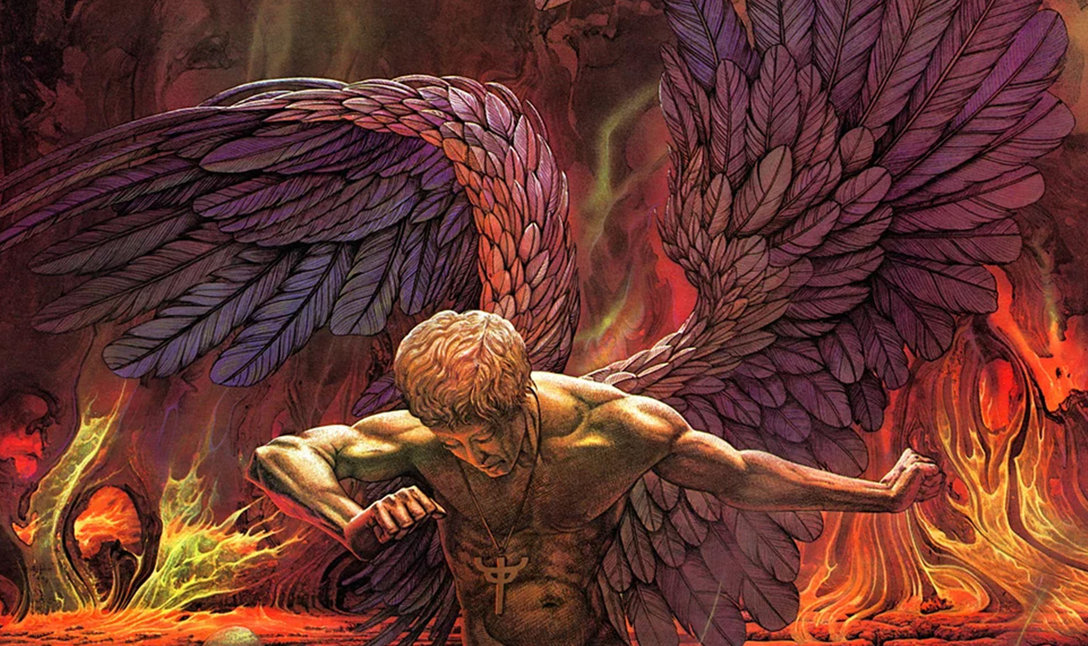
Judas Priest’s “Sad Wings of Destiny” Turns 50
By
·
May 04, 2026
Despite its tritone-heard-round-the-world reputation, Black Sabbath’s “Black Sabbath” didn’t start a revolution. How could it? Birmingham’s working-class Prometheans were out so far ahead of the pack when they wrote that song that they couldn’t even keep up with themselves. Just listen to the rest of Black Sabbath: It has its share of profoundly heavy moments, to be sure, but it’s still basically blues-based rock music. Sabbath didn’t even like the term “heavy metal,” preferring to call themselves a “heavy rock” band and challenging journalists who tried to foist the label on them. Nor were any of Sabbath’s peers (Deep Purple, Led Zeppelin) or early followers (Budgie, Dust) categorically metal. “Black Sabbath” was the opening salvo in a battle that wouldn’t be fought in earnest for another half-decade.
The members of Judas Priest were mostly in their late teens when Black Sabbath released their debut album, and like every other long-haired, guitar-wielding kid in the world who heard that music, they were utterly transformed. Unlike most of those kids, they were from Birmingham, which meant they had a front-row seat to Sabbath’s rise. Rob Halford writes in his 2020 memoir Confess about going to see Earth—as Sabbath were called until 1969—at the rock club Mothers, in the Birmingham suburb of Erdington. Priest even got one of their early rehearsal rooms after Sabbath vacated it. That handoff proved symbolic. For the first half of the 1970s, Sabbath ran the heavy metal (or heavy rock) game, largely without competition. Judas Priest would be the first band to truly take their torch somewhere new.
First, they had to get through their growing pains, which manifested as 1974’s Rocka Rolla. Priest’s debut isn’t a bad album, but as its title indicates, it’s much more of a rock ‘n’ roll record than a true step forward for metal. Its heaviest moments (“Never Satisfied,” “One for the Road”) still sound like they’re laboring in Sabbath’s shadow, and while there are hints of what Glenn Tipton and K.K. Downing’s disciplined, dueling guitar work would one day sound like, they’re still tentative in their steps beyond the blues-rock template. “Cheater,” an afterthought of a song tacked onto the “Winter/Deep Freeze/Winter Retreat” suite, anticipated new wave, not the New Wave of British Heavy Metal. (Halford wrote “Cheater,” and as far as I can tell, he was never awarded a share of the credit for The Knack’s “My Sharona,” but the similarities are striking.) To me, Rocka Rolla is a lot like the self-titled Rush album: another promising but derivative 1974 debut that sounded like a precursor to real self-discovery. Just as Rush would add Neil Peart and evolve into a terrifying new beast on sophomore LP Fly by Night, Priest would come into their own with the 1976 release of Sad Wings of Destiny.
I’ve long harbored the take that Sad Wings of Destiny is the secret first metal album, in the sense that it was the first album to knowingly engage with heavy metal as an art form. In his crucial 2003 book Sound of the Beast, Ian Christe writes that “Judas Priest made no bones about openly proclaiming its goal: to be the world’s ultimate heavy metal band.” Where Sabbath rejected the heavy metal tag, Priest embraced it, and that distinction got into both their songwriting and their fundamental sense of self. Following the false start of Rocka Rolla, Sad Wings became a watershed moment for the genre—an album that, far more than Black Sabbath, divides metal history into a before and after.
It doesn’t take long for Sad Wings of Destiny to reveal its hand. The opening track, “Victim of Changes,” begins with Tipton and Downing’s guitars, glimmering in harmony, slowly growing louder in the mix as though they were cresting a distant hill. Next, a sinewy, power-chord-based riff ups the ante, with both guitarists moving in relentless, metronomic lockstep, a contrast to the open-ended structures then favored by Sabbath. Then, the showdown: “Whiskey woman, don’t you know that you are driving me insaaaaaane?” Rob Halford comes screaming into the picture with a panache he never fully revealed on Rocka Rolla. With that first vocal line, he became heavy metal’s premier singer, a title he arguably hasn’t relinquished in the 50 years since. Halford writes in his memoir Confess that “Victim of Changes” was in fact a mashup of two songs Priest were kicking around at the time, “Whiskey Woman” and “Red Light Lady.” The alchemy it took to smash them together pushed the band to heavy metal’s new vanguard.
“Victim of Changes” might be the most musically ambitious piece on Sad Wings of Destiny, but its lyrics belong to the Rocka Rolla era. Even a dud line like “You been foolin’ with some hot guy” sounds cool as hell coming out of Halford’s mouth, but the rest of his lyrics for Sad Wings confirm that his mind was already elsewhere. (This narrative distance is not least of all because he was working his way up to navigating band life as an openly gay man; his Priest bandmates soon knew, but the world at large would have to wait until he came out on MTV in 1998.) Isaac Asimov’s writing inspired the muscular “Island of Domination,” while “The Ripper” gave its serial killer narrative a shocking first-person perspective. Other songs grappled with philosophy, history, and current events. In Sound of the Beast, Christe points out that Priest’s “Genocide” came out during the worst year of Pol Pot’s ethnic cleansing campaign in Cambodia, a point Halford punctuates with a reference to “flashing senseless sabers [that] cut us to the ground.” Pot’s troops were notorious for carrying out their killings with blades to preserve ammunition.
As singular a presence as Halford carved as a singer and lyricist, Tipton and Downing’s guitar interplay was the molten core of this newly mature metal sound. Heavy rock forebears Sabbath, Purple, Zeppelin, and Rainbow all relied on a single guitar player, affording them enormous amounts of sonic space to dominate. Priest looked instead to influences like Wishbone Ash and Thin Lizzy, bands that boasted two guitarists and didn’t restrict them to rhythm and lead roles. Tipton and Downing had heavier, crunchier tones than those players, and they made more sophisticated use of both harmony and counterpoint. “Victim of Changes” was a showcase for their individual personalities, with a pair of show-stopping yet pointedly distinct solos. “The Ripper,” with its scant, sub-three-minute runtime, showed what they could do as a laser-focused team, its concentric harmonized riffs honed as sharp as Jack’s knife. Nobody was playing guitar like Tipton and Downing before Sad Wings, but they’d soon have a litany of disciples.
Perhaps the strongest evidence for Sad Wings of Destiny’s epoch-making influence is the fact that the New Wave of British Heavy Metal kicked off in earnest immediately afterward. The youth-driven movement, whose name was coined in a 1979 issue of Sounds, was the first real regional metal scene to have an impact beyond the local clubs, and Priest’s signature sound was stamped all over it. 1977 saw the recording debuts of Diamond Head, Quartz, and Urchin, with Samson, Saxon, Girlschool, Witchfynde, Bliztkrieg, Satan, Angel Witch, Def Leppard, and Iron Maiden all soon to follow. (Motörhead, whose debut LP also came out in 1977, started their own school of influence, separate from the deluge that Priest wrought.) Ultimately, it was Maiden, borrowing Priest’s twin-guitar harmonies, piercing vocals, dramatic lyrics, and flair for stage magic, who would carry the flame lit by Sad Wings out of the NWOBHM underground and into the mainstream. Priest took Maiden on their first major tour in 1980, and the two bands struck up a friendly rivalry that has endured ever since.
The long arm of Priest’s influence also reached across the ocean, dredging up a wave of American bands who would take metal to its next frontier. Slayer’s Kerry King and Jeff Hanneman would take the dual-guitar attack of Tipton and Downing to its logical, fretboard-eviscerating extreme, warping the melodies and imagining an alternate-universe Priest that only preached evil. Cirith Ungol, stalwarts of the California underground who stumbled out of the gates in the early 1970s, had a life-changing encounter with Rob Halford at Priest’s first-ever Los Angeles show. In Mark Rudolph’s graphic-novel tribute to Priest, Metal Gods, Ungol drummer Robert Garven remembers working his way to the barricade with singer Tim Baker just in time for the climactic scream in “Victim of Changes”: “Rob reached up, Tim reached down. Their forearms interlocked, as if in a dying embrace, during his final shriek!” That shriek must have been what powered Baker’s unhinged performance on 1981’s Frost and Fire.
Some foundational albums end up sounding like rough drafts when revisited across the decades. Not Sad Wings of Destiny. It’s been 50 years, and while metal certainly got more extreme, I’m not convinced it ever got significantly more metal. “Victim of Changes,” “Deceiver,” “The Ripper,” “Tyrant,” “Genocide,” and “Island of Domination” are heavy metal incarnate, and the less obviously metallic “Dreamer Deceiver” and “Epitaph” are two of the best off-speed pitches a metal band ever threw. Metal vocalists are still ripping off the way Halford sings here, his clarion-clean articulation and vertiginous, piercing falsetto, and guitar duos are still trying to tap into Tipton and Downing’s generational mind-meld. Listening to Sad Wings of Destiny doesn’t feel like homework now because it’s not homework. Five decades on, it’s still one of the most purely pleasurable ways to pass 39 minutes that I know.