
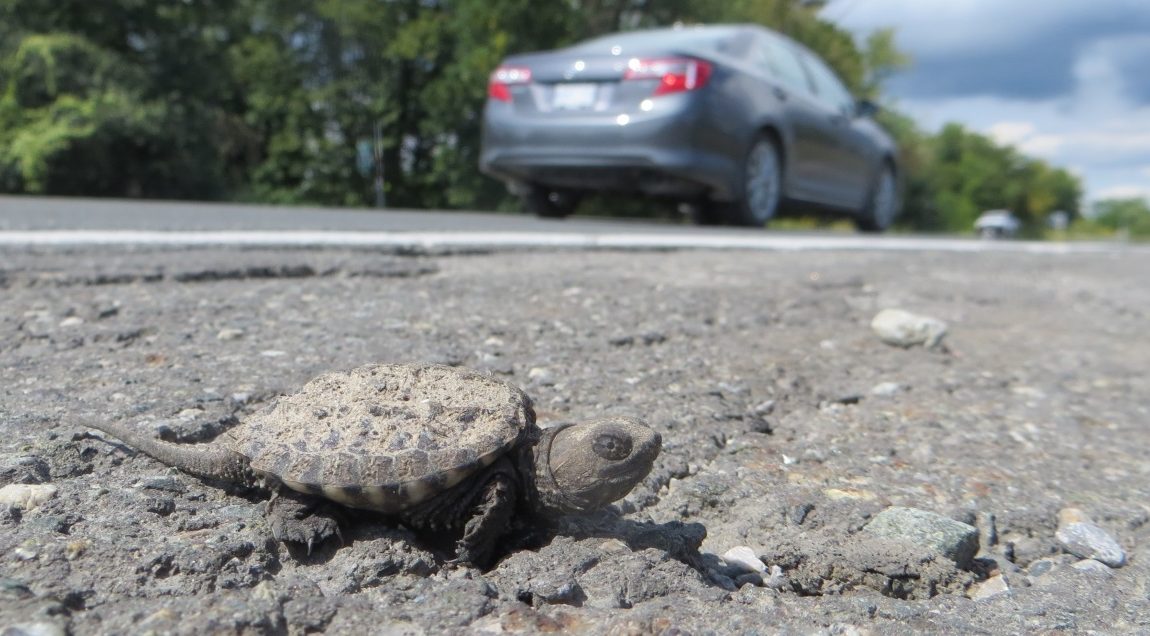
A baby snapping turtle is seen crossing a roadway in this file photo. (Photo: Toronto and Region Conservation Authority)
Turtles, salamanders and other wetland wildlife at risk from crossing a busy Brampton street will get additional protections through a $1.6 million funding boost.
Back in 2024, Brampton City Council approved plans to support a city-wide road ecology program with a focus on Heart Lake Road, which is in a “provincially significant wetland” and home to numerous frogs, turtles, snakes and avian species.
Some of the animals include at-risk species, like the Jefferson Salamander and the endangered five-lined skink (Ontario’s only native lizard), and new funding from Ontario’s Wetlands Conservation Partnership Program will aim at better protections for the impacted critters.
The $1.65 million in funding will support stormwater infrastructure improvements, wetland restoration works and road ecology enhancements
along the Heart Lake Road corridor, with $1.19 million coming from the WCPP and $460,000 from the city.
Another $231,000 will come from the Toronto and Region Conservation Authority, which will act as the construction manager for the project.
“City staff, in collaboration with the TRCA, are currently advancing detailed design and permitting, with construction anticipated to commence in June 2026,” a report to Brampton City Council reads.
Many native wildlife species need to move between habitats (such as forests and wetlands) throughout the year to breed, forage, or hibernate. But roads and railways not only reduce habitat size but also act as barriers, making it difficult for wildlife to travel between natural greenspaces.
“This habitat fragmentation limits their access to essential resources and can isolate populations,” the TCRA says.
There are an estimated 1.2 million wildlife-vehicle collisions within TRCA’s jurisdiction between May and September every year, with nearly 90 per cent involving amphibians and reptiles, which are especially vulnerable due to their slow movement.
Salamanders travel at an average speed of just 35 cm per minute, “making it nearly impossible for them to avoid fast-moving traffic,” the TCRA says.
The TRCA recommends fencing to prevent wildlife from entering roadways, wildlife tunnels for safe passage, creating breeding or nesting habitats in safer areas, and seasonal road closures to protect vulnerable species.
The TRCA conducts field surveys to track wildlife movement and identify high-risk road crossings in priority areas, including near Heart Lake Road in Brampton, Stouffville Road in Richmond Hill, Happy Valley in King Township, and High Park in Toronto.
INsauga’s Editorial Standards and Policies
Last 30 Days: 43,984 Votes
All Time: 1,321,466 Votes
4443 VOTES
Do you think cell phones should be banned at schools in Ontario?
WIN A $100 GIFT CARD
Subscribe to INsauga’s daily email newsletter for a chance to win a $100 Amazon gift card.