
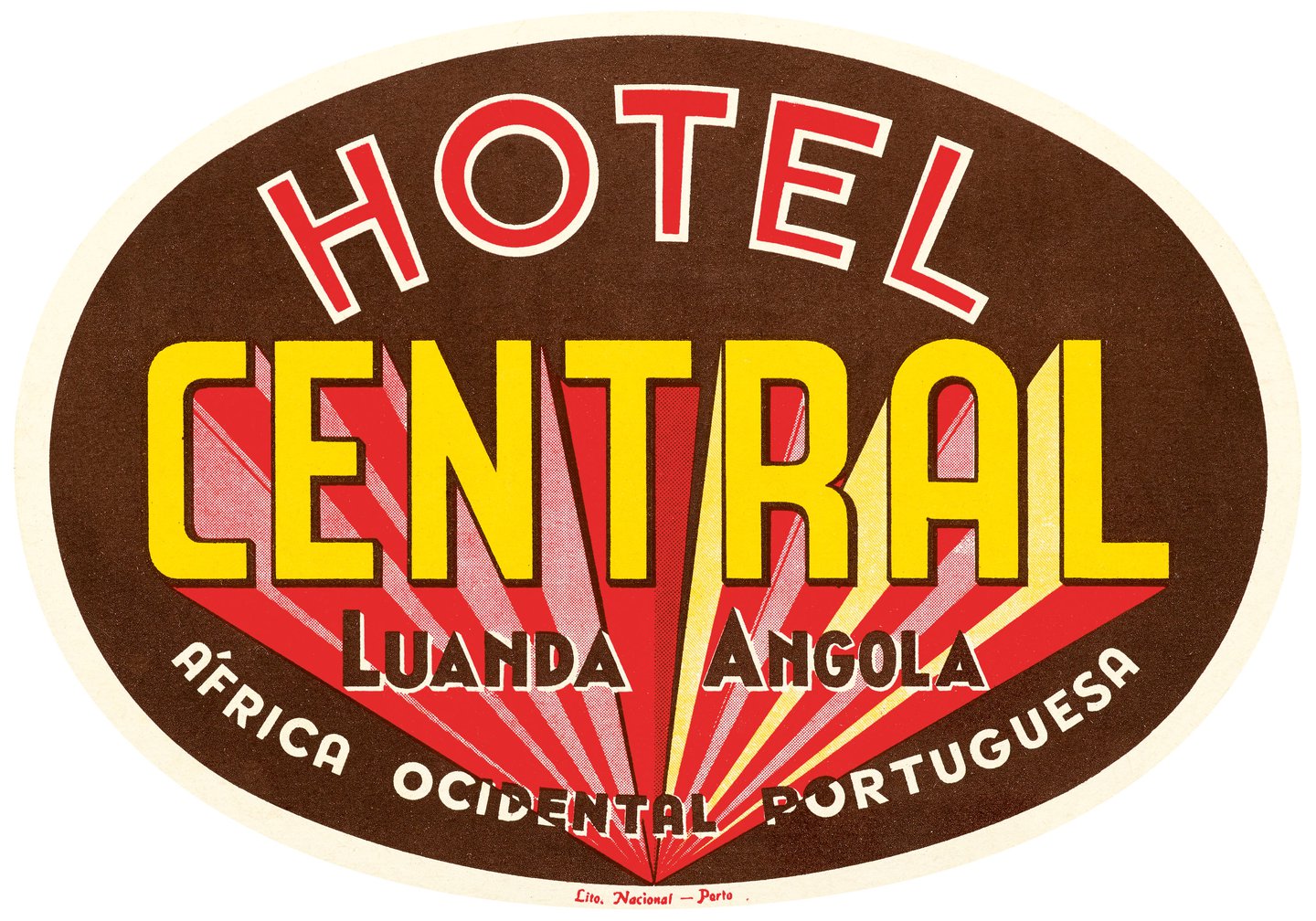
These stickers are not only miniature relics from a history of design – tracing visual developments from art deco to Swiss minimalism – they also evidence “a parallel boom in print ephemera, when advances in chromolithography allowed commercial artists to translate their talents to mass production for the first time”, Lucie shares. Produced before the invention of the computer, each miniature design object is an original artwork and shows the hand of artists, illustrators and printers alike – many boasting incredibly beautiful typographic solutions for stamps just a few inches wide.
While some stickers “owe their success entirely to their letterforms”, Lucie says, several hotels saw this as an opportunity to nod to the artistic legacies of their regions in their labels, “such as Delphi’s Hotel Vouzas, with its ancient ruins and Greek-inspired lettering, Kyoto’s Miyako Hotel, with an illustrative scene reminiscent of traditional Japanese woodcuts and the Hotel Alhambra Palace in Granada, whose label’s lettering incorporates the arches and geometric motifs of a local wonder of Moorish architecture.”
The challenge for the publisher was finding examples of the luggage label trend from every continent. The graphic craze started in Europe in the late 1800s and spread across the globe, which is why Letterform Archive’s collection contains such a far-ranging series of adhesive artefacts, “sweeping from the Americas to Africa and Asia to Oceania,” Lucie says. “But the bulk of our labels did originate in Europe, so we strategically sought out additions from areas like the Middle East and Indonesia to tell a well-rounded story.”
In the process, the team encountered all the regular restrictions that come with working with archival material, except things were, let’s say, a bit more sticky… than usual. Many of the luggage labels were stuck to cases or backing boards, housed by previous collectors that had to be carefully removed by the team for the purpose of digitisation before each individual design could be reproduced in print for the book.
Now the book is finally on shelves, Lucie hopes that the pages don’t stay intact for too long. She wants the stickers to end up in all kinds of places, as these original touring designs once did. “We just suggest that folks buy two copies: one to joyously use up – spreading stickers on surfaces far and wide – and one to keep intact for their own reference,” she ends. “It’s been an honour and a privilege to usher these artefacts out of the library stacks and make them available again in their original ephemeral form.”