
There’s a scene from an NBA team’s front-office meeting that I was once told about. It happened more than a decade ago, but the outlines will be familiar to many people in the business, and it is still relevant to a present-day discussion.
In this meeting, a team’s GM was sketching a particularly convoluted get-rich-quick transaction scheme that seemed both incredibly risky and unlikely to be particularly fruitful (both turned out to be true), when a lower-ranking staffer asked a simple question: “What if we just try to add good players and build the team?”
The staffer, of course, was laughed out of the room, but that question still gets short shrift when we talk about teams’ approaches to rebuilding.
For the most part, we’re in a different, smarter era, but the draft lottery remains the ultimate schemer’s scheme. Just debase yourself for half a decade or so with a full-on teardown that involves at least three years of going 18-64, and maybe the league will hand you Victor Wembanyama as a reward.
What’s funny is that, San Antonio Spurs aside, the tankers haven’t exactly taken over the league. That is one reason I’m extremely bullish on the league’s proposed lottery reform, which will vaporize any tanking incentives and revitalize what had become an atrocious on-court product for the final two months of the season.
The cost is that some front offices feel like a tool has been taken away: the ability to brazenly tank into position to select an elite talent. Some have argued that this would hit small markets particularly hard, as they are not free-agent (or, more realistically, “trade demand before free agency”) destinations.
So, before we talk about the NBA’s lottery reform, let’s talk about the 2025 NBA Finals. It featured two of the smallest, least glitzy markets in the league … and it was also a matchup that relied very little on tanking or high draft picks to reach its outcome.
The best player on the court was Shai Gilgeous-Alexander, who was the 11th player taken in the 2018 draft and was traded both on draft night and again one year later.
The second-best player on the court was Tyrese Haliburton, who was the 12th player taken in the 2020 draft and was traded less than two years later.
The third-best player on the court was Jalen Williams, who was the 12th player taken in the 2022 draft after his own team picked Ousmane Dieng 11th and was selected with another team’s pick.
The fourth-best player on the court was Pascal Siakam, the 27th player picked in the 2016 draft, who was also acquired in a trade.
While the Oklahoma City Thunder did indeed benefit from one eye-rolling tank year that netted them Chet Holmgren, the bulk of their roster was built with deft trades, smart late picks, “body snatching” free talent such as Lu Dort and Isaiah Joe and cap management that let them snag Isaiah Hartenstein in free agency. That’s how they went 68-14 in a season in which Holmgren only played 32 games.
So, yeah, I’m not that worried about the impact on small markets. And the rest of this is amazing. I love it.
I’ll talk about some of the minutiae further down, but I am sooooo excited to look at the schedule on a random night in March and not write off half the games as a charade with a predetermined outcome. It also has the added benefit of taking the league out of the fake-injury enforcement business. If you want to shut down Trae Young, that’s your business, but if you finish in the bottom three, you won’t get rewarded for it.
The formula the league came up with does a great job of eliminating overt, “The Process”-style tanking incentives while also managing “cliffs” where teams might be incentivized to stage-manage their positioning.
The biggest potential downside is that it removes the tanking option from front offices. I’m sorry, are we seriously calling that a negative? Let’s call it what it really is: a hallelujah.
News flash: Somebody will still get to pick first in a year with a generational talent; they aren’t canceling the draft. In the meantime, however, how about “make good moves and build your team” as a coping strategy?
Again, what strikes me most about the hand-wringing about the proposed lottery reform is the underlying presumption that tanking is the only means for a small-market team to contend with the big boys. Yes, the current system definitely incentivizes that approach, and it’s certainly the most expedient way to have a shot at generational talent.
But the presumption that elite talent requires a team to luck into a top-three pick on lottery night doesn’t exactly have overwhelming recent evidence in its favor. Six of the last seven MVP awards were won by players selected outside the top-10 picks; only Joel Embiid’s win in 2023 broke the streak, which is about to go to 7-of-8 if Gilgeous-Alexander repeats.
We can also take our 2025 finals exercise a lot further.
The two best players for the 2024 champion Celtics were Jayson Tatum and Jaylen Brown, both of whom Boston acquired with draft picks from the Brooklyn Nets.
The best player on the court in the 2023 finals was Nikola Jokić, who was the 41st pick in 2014. The second-best player was Jimmy Butler, the 30th pick in 2011. Miami’s top eight had no players who were selected in the top 10.
The best player on the court in the 2022 finals was Steph Curry, who was the seventh pick in 2008. The next-best players after Tatum and Brown were Draymond Green, who was the 35th pick in 2012, and Klay Thompson, who was the 11th pick in 2011.
The best player on the court in the 2021 finals was Giannis Antetokounmpo, who was the 15th pick in 2013. The small-market Bucks only got minutes from one player selected in the top 14 picks in the draft en route to winning the title; that player, Brook Lopez, was the 10th pick by Brooklyn 13 years prior.
The second-best player in the series was Devin Booker, who was the 13th pick in 2015. Yes, there was one top overall pick in that series — Deandre Ayton, whom the Suns traded two years later.
The best players in the 2020 finals were LeBron James and Anthony Davis … both of whom were the No. 1 pick in their respective drafts, but neither of whom was selected by the Lakers. Their opponent, Miami, had no players drafted in the top 10.
The best player in the 2019 finals was Kawhi Leonard, who was the 15th pick by the Spurs in 2011. He was also the only player on Toronto’s entire team picked in the top 20; the Raptors’ fourth-leading scorer in the finals, Fred VanVleet, was an undrafted free agent.
You have to go all the way back to the 2015 through 2018 NBA Finals between Cleveland and Golden State to find a real impact for tanking, as the Cavs’ winning lotteries for Kyrie Irving, LeBron James (setting up his return) and Andrew Wiggins (setting up the trade for Kevin Love) undoubtedly were the primary factors in their success.
So, yes, landing a top pick can work as a catalyst for an organizational rebuild. Higher is definitely better, sometimes dramatically so.
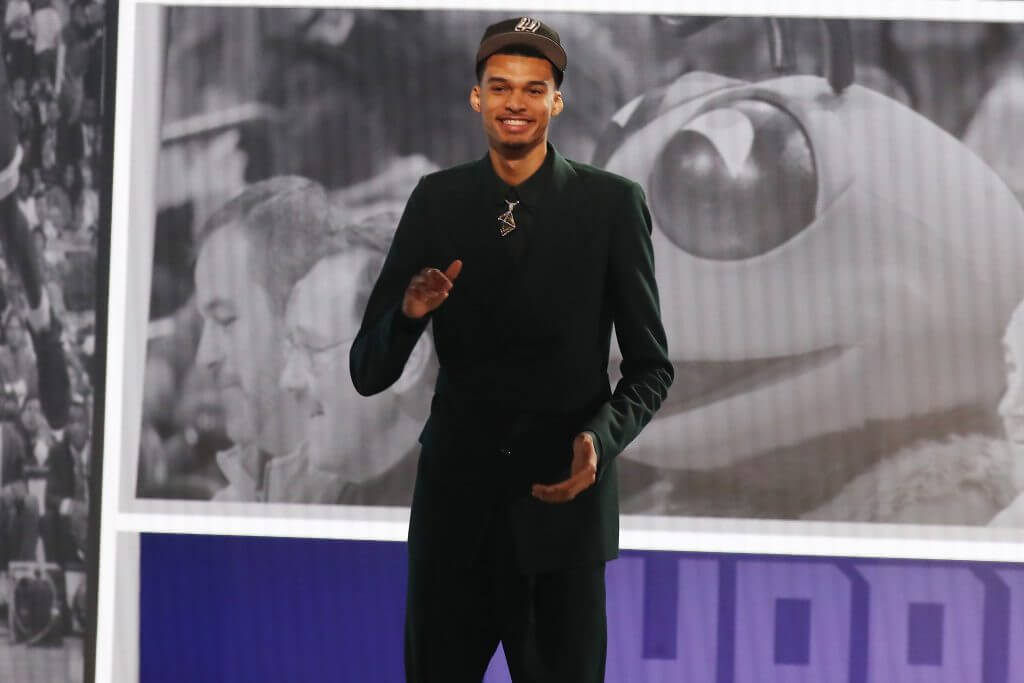
Yes, landing a top pick is still very helpful for a rebuild. Just ask the Spurs and Victor Wembanyama. (Wendell Cruz / USA Today Sports)
What’s clear, however, is that it is far from the only way to build a good team, and it’s not totally clear that the pain is even worth the reward. To use one example: The Utah Jazz just set four years of an All-Star player’s prime on fire, and the best thing they have to show for it is a guy they took 16th.
So, at this point, I should probably talk about the actual lottery reform. I think the biggest thing to emphasize is that bad teams will still, by and large, have the best odds at getting the highest picks. They just won’t have to spend half the season manipulating the process.
How does this work?
In what the league has proposed as the “3-2-1” lottery, 16 teams will participate in the lottery and get either three balls, two balls or one ball in the lottery drawing.
The bottom three teams in the standings will get two balls
The other teams that don’t make the Play-In will get three balls
The four teams in the 9-10 Play-In games will get two balls
The losers of the 7-8 game in each conference will get one ball
Additionally:
All 16 spots in the lottery (not just the top four) will be randomly drawn
The bottom-three teams can’t pick lower than 12th
Pick protections in trades can’t be top 12 through top 15
Teams can’t pick No. 1 in consecutive years
Teams can’t have top-five picks three straight years
What do the odds look like?
In years when the final two bullets above don’t apply, a “three-ball” team has an 8.1 percent chance at the top pick, a “two-ball” team is at 5.4 percent and a “one-ball” team is at 2.7 percent.
At the margins, it’s possible for the fourth-worst team to pick 16th (3 percent) or for the 7-8 Play-In loser to pick first (2.7 percent) or for the three worst teams to pick 10th, 11th and 12th (10.2 percent). Yeah, that’s a bad beat.
On average, however, it’s pretty fair across the spectrum: A bottom-three record only loses 0.7 spots in average draft position compared to the other “three-ball” teams and is still 1.0 spots better than the other “two-ball” teams. The “one-ball” teams, on average, pick 12th; maybe they get lucky and move up, but 60 percent of the time they pick 13th or later.
Lottery reform pick odds (%)
FirstTop 3Top 5Top 10Average
Three worst teams
5.4
16
28
61
8.1
“Three-ball” teams
8.1
24
39
73
7.4
9-10 seeds
5.4
16
28
59
9.1
7-8 losers
2.7
8
15
35
11.7
Those averages change slightly if other teams are ineligible. For example, if we were doing the lottery this year, the Dallas Mavericks would be ineligible to win it, which would raise the odds of each of the other lottery balls being No. 1 by about 0.2 percent. If it were 2025 under this system, San Antonio would have been ineligible to win the second pick (or any of the top five spots), and that would have raised the top-five odds of every other lottery ball by about 1 percent.
In terms of tanking, one might fret over a theoretical (and highly unlikely) example where five bad teams are also ineligible to land in the top five because they were the same ones from the previous two lotteries, thus creating a rush of enthusiasm for other teams to finish in the bottom 10. Otherwise, it’s hard to find many edges to gaming the system.
Why drag the bottom teams?
The motivation for knocking down the lottery odds for the worst three teams is to improve the product on the floor. Put simply, there is a huge difference between “trying to win” and “not overtly trying to lose,” and the league is trying to eliminate that by making, say, an April game between Utah and Memphis still matter and have ramifications. I think it’s pretty clear this will make for a better product than watching Bez Mbeng go for a triple-double against randomly selected civilians who were issued Grizzlies uniforms.
Additionally, the so-called “relegation games” at the bottom of the standings are likely to provide another layer of late-season entertainment, although they will matter less for teams that already traded unprotected picks. (Hi, Pelicans!)
The unfortunate side effect will be the badge of shame that comes with a bottom-three finish. Realistically, execs and coaches will need a lot of internal equity to survive such a season. I get why there is some trepidation about this part.
While this perhaps feels slightly unfair to the league’s bottom-three teams, let’s keep first things first there. The larger aim is that the league has to protect the product, and nudging the bottom teams’ lottery odds down feels like a fairly essential component in pulling that off.
Will teams tank out of seventh, or out of the Play-In?
Based on recent evidence, I highly doubt it. Losing the 7-8 game gives you a 2.7 percent chance at the top pick and an 11 percent chance at landing in the top four. Crashing out of the top 10 adds another 2.7 percent to the odds of the top pick and another 11 percent to the odds of a top four.
The argument is that a team could lose the 7-8 game but still have a good chance of making the playoffs by winning the next one at home; or, alternatively, that a club in Play-In contention could not bother trying to finish 10th to increase their odds by a similar amount. I think this is unlikely to happen in reality, because the league has made the “cliffs” here just small enough to reduce the temptation.
Most notably, two teams faced similar odds-improving propositions this year and never even considered punting.
Both Golden State and Portland entered the Play-In in a situation where crashing out would have landed them similar odds adjustments to those above. The Warriors landed a 2.0 percent chance at the top pick and a 9.4 percent chance at the top four when they eventually lost, but not before rallying from 13 down in the fourth to beat the LA Clippers in the 9-10 game. Golden State’s likely pick improved four spots, from 15th to 11th, when the Warriors lost.
Portland, meanwhile, would have inherited those same odds and lost its pick entirely if it won, and yet the Blazers still marched into Phoenix and smoked the Suns in the 7-8 game. (Portland owed a top-14 protected pick to the Bulls.)
While these examples aren’t entirely similar because they involved missing the playoffs entirely, I think they illustrate the difficulty of an organization losing a playoff game to gain a still-small probability advantage in the draft lottery; falling out of 10th moves the average draft pick only 1.7 spots.
Losing a 7-8 game, meanwhile, improves the average pick six spots, which is not inconsequential. But that also comes with a heightened risk of missing the playoffs entirely and a lower probability of advancing once there; again, Portland’s example of going from 11th to zilch is instructive.
Why can’t picks be protected 12 through 15?
Again, this is to shenanigan-proof things. A team with a top-12 protected pick (or 13, 14 or 15) could theoretically stage-manage its record to land in the bottom three and thus ensure it keeps the pick. Conversely, a top-11 protected pick is only 75 percent guaranteed even if the team lands in the bottom three, but 77 percent if the team finishes as a “three-ball” team, which should remove any tanking incentive. And a top-16 protected pick is 100 percent guaranteed only if a team fails to finish in the top seven.
Aren’t they changing the value of picks that were already traded?
Yes, but one can argue it’s happened in a much fairer way, especially for teams that essentially bet against bad front offices by acquiring their unprotected picks. Those acquiring teams (such as Atlanta this season) were basically blocked from having the best lottery odds for those picks because the teams that sent the pick (such as New Orleans this season) had no tanking incentive and kept on playing.
Thus, a team such as Houston — sitting on two plush unprotected future picks from Phoenix — probably isn’t too upset by these changes. They still have No. 1 upside and are relatively likely to land two mid-lottery picks, although perhaps a bit less likely to land a Tatum-and-Brown type windfall like the Celtics reaped from Brooklyn’s foolishness.
In fact, the tanking incentive almost flips in these cases. Would a front office decide to soft tank to reduce the odds that it gets the embarrassment of handing over a top pick in a loaded draft?
What about expansion?
While the league’s proposal didn’t specifically mention expansion, there is an underlying presumption that it would create two new “three-ball” teams and shift everyone else’s odds accordingly.
Having 18 teams rather than 16 in the lottery will shift all the odds and might necessitate some other small recalibrations (such as the trade-protection rule above, for instance, or the bottom three teams having a floor at No. 12), especially in the first season when the expansion teams are likely to be automatically slotted into positions in the middle or late lottery.
What about ties in the bottom three?
While not specifically addressed in the league’s proposal, the theoretical situation where two teams are tied for the third-worst record has multiple possible solutions. One is to effectively split their lottery odds by having a coin flip for the third lottery ball, while another is to apply postseason tiebreakers.
What about the second round?
This wasn’t specifically addressed yet, but there’s a decent chance the second round could change, too.
Right now, teams pick in reverse order of record, which might still preserve a mild tanking incentive (at least in a theoretical environment where every second-round pick under the sun hasn’t already been traded five times), but there’s no guarantee things continue that way. One possibility, for instance, would be to reverse the lottery order in the second round.
If a team that can’t win the lottery is picked first, what happens?
Finally, one last piece of arcane lottery minutiae is what happens when a team’s lottery ball is picked if they aren’t eligible to pick first because they won the previous year. There are two possibilities.
The first is that the ball is returned; the second is that the team is automatically placed into the second position, and those two methods return different odds for the ineligible team.
The example the league sent to its general managers uses the latter example, which is much gentler on the ineligible teams. For example, a team such as San Antonio in 2025 would have been ineligible for the top five but had a 47 percent chance of picking sixth … instead of 8 percent.