
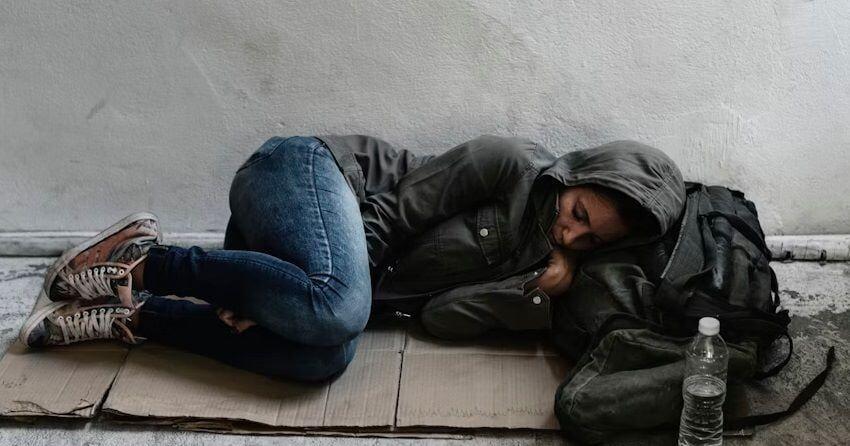
There’s a sentence in this debate that people are afraid to say out loud. It sounds cold. It sounds harsh. But it’s starting to feel unavoidable:
What if we’re approaching homelessness completely the wrong way?

A person shelters on a Winnipeg sidewalk as debate grows over sanctioned encampments and the city’s new homelessness approach. (Winnipeg Sun)
A recent case out of Vancouver should be a wake-up call for every city in this country, including Winnipeg. A hotel purchased for $55 million during the pandemic to house homeless individuals has now been reduced to near ruin. Fires. Flooding from putting out those fires. Vandalism. Neglect. Within a year, the building was effectively destroyed. And yet much of the coverage framed the story as a tragedy for the residents.
That’s where the conversation starts to break down. Because at some point, we have to be honest about cause and effect. If a facility is repeatedly damaged by the very people it’s meant to help, is the system failing them, or are we refusing to acknowledge a harder truth about who we’re dealing with?
Not everyone in homeless encampments is the same. Lumping everyone together under one banner has led to blunt, ineffective policy. In reality, there are at least four distinct groups.
There are people struggling with addiction.
There are people dealing with serious mental health challenges.
There are criminals who exploit the environment.
And there are people who have simply fallen on hard times and need a hand up.
Only one of those groups can reliably transition out of homelessness with basic housing support alone. And we’ve seen that locally. Marion Willis and Street Links have built a track record on exactly that point. When someone wants help, when they’re ready to stabilize, when they’re capable of maintaining housing, they can and do succeed. That model works. It deserves more funding and more support.
But it works because it’s targeted. The problem is what happens when that same approach is applied to people who are not in the same place, people deep in addiction, in the grip of untreated mental illness, or actively engaged in criminal behaviour. That’s where things start to fall apart.
The allegedly failed protocol has led to residents reporting increased drug use and sexual exploitation in areas such as a community garden on 609 Langside, West End. These issues persist despite the area theoretically being classified as a Priority 1, highlighting a possible lack of action from city officials.
Housing alone does not treat addiction.
Housing alone does not stabilize severe mental illness.
Housing alone does not stop criminal activity.
And pretending otherwise is not compassion. It’s avoidance. If someone is cycling from one high to the next, that is not a housing problem. That is an addiction crisis. And the answer isn’t to hand over keys and hope for the best. But leaving them there, cycling through the same crisis every day, as the current leadership has chosen to do is not the answer. either. The answer is treatment, real, structured, long-term recovery.
Facilities like the Bruce Oake Recovery Centre exist for a reason. They focus on getting people clean, keeping them clean, and giving them a path forward. That’s where investment should be going, into expanding capacity, reducing wait times, and ensuring people can actually access help when they’re ready.
The same goes for mental health. There are individuals living on the streets who are simply not capable of managing independent living without significant support. Leaving them in tents or unstable housing situations is not kindness. It’s abandonment dressed up as empathy. They need safe, structured care with follow-up that doesn’t lose them the moment they fall through a bureaucratic crack.
Then there’s the piece no one likes to talk about. Crime. Encampments are not just communities of vulnerable people. They are also environments where exploitation happens, where drug dealers operate, where violence occurs, where chaos becomes normalized. Allowing that to continue unchecked undermines every effort to help the truly vulnerable.
If we’re serious about solving this, that element needs to be confronted directly. Not ignored. Not excused. That means enforcement. It means removing criminal actors from these spaces. It means targeting the supply chains that keep addiction entrenched.
And yes, that makes people uncomfortable. But so should the alternative. Because the alternative is what we’re seeing play out in places like Vancouver, massive public spending with little accountability and even less long-term success. Buildings destroyed. Communities frustrated. Cycles repeating.
Winnipeg is not immune to that outcome. We are already having the same conversations about managed encampments, temporary housing, and emergency responses. And while those ideas may be well-intentioned, the risk is clear: if we don’t address the root causes, we will simply be managing decline instead of solving anything.
Throwing money at the problem without a strategy is not compassion. It’s negligence. What’s needed is a two-tiered approach.
First, aggressive investment in treatment, addiction recovery, mental health care, and long-term support systems that actually change outcomes.
Second, strong enforcement that targets crime within encampments, dismantles drug networks, and protects vulnerable individuals from exploitation. At the same time, we continue supporting proven outreach efforts that help those who want a way out.
Because that’s the final, uncomfortable truth. You cannot force someone to change who doesn’t want to change. And building policy around the hope that everyone will eventually choose help is not a plan, it’s wishful thinking. If we don’t start being honest about that, we’re going to keep repeating the same cycle. More spending. More damage. More frustration. And eventually, more headlines we could have seen coming.