
Published on May. 5, 2026, 5:24 PM
The comet doesn’t return for decades, but tonight is one of our two yearly reminders that it’s out there!
Eyes to the sky in the hours before sunrise, Wednesday morning, to spot tiny fragments of Halley’s Comet streaking by overhead!
Every year, from April 19 through May 28, our planet passes through a stream of dusty debris in space, left behind by Comet Halley, probably the most famous comet in the world. As we cross through this debris, the bits of dust and ice, collectively known as ‘micrometeoroids’, get swept up by Earth’s atmosphere. Since they are travelling at a relative speed of around 100,000 kilometres per second when they hit the top of the atmosphere, these micrometeoroids produce brief flashes of light in the sky. We call those flashes meteors.
Since each meteor from this particular stream of debris appears to originate from a point in the night sky near the constellation Aquarius, and more specifically the star eta Aquarii, astronomers named this annual event the eta Aquariid meteor shower.
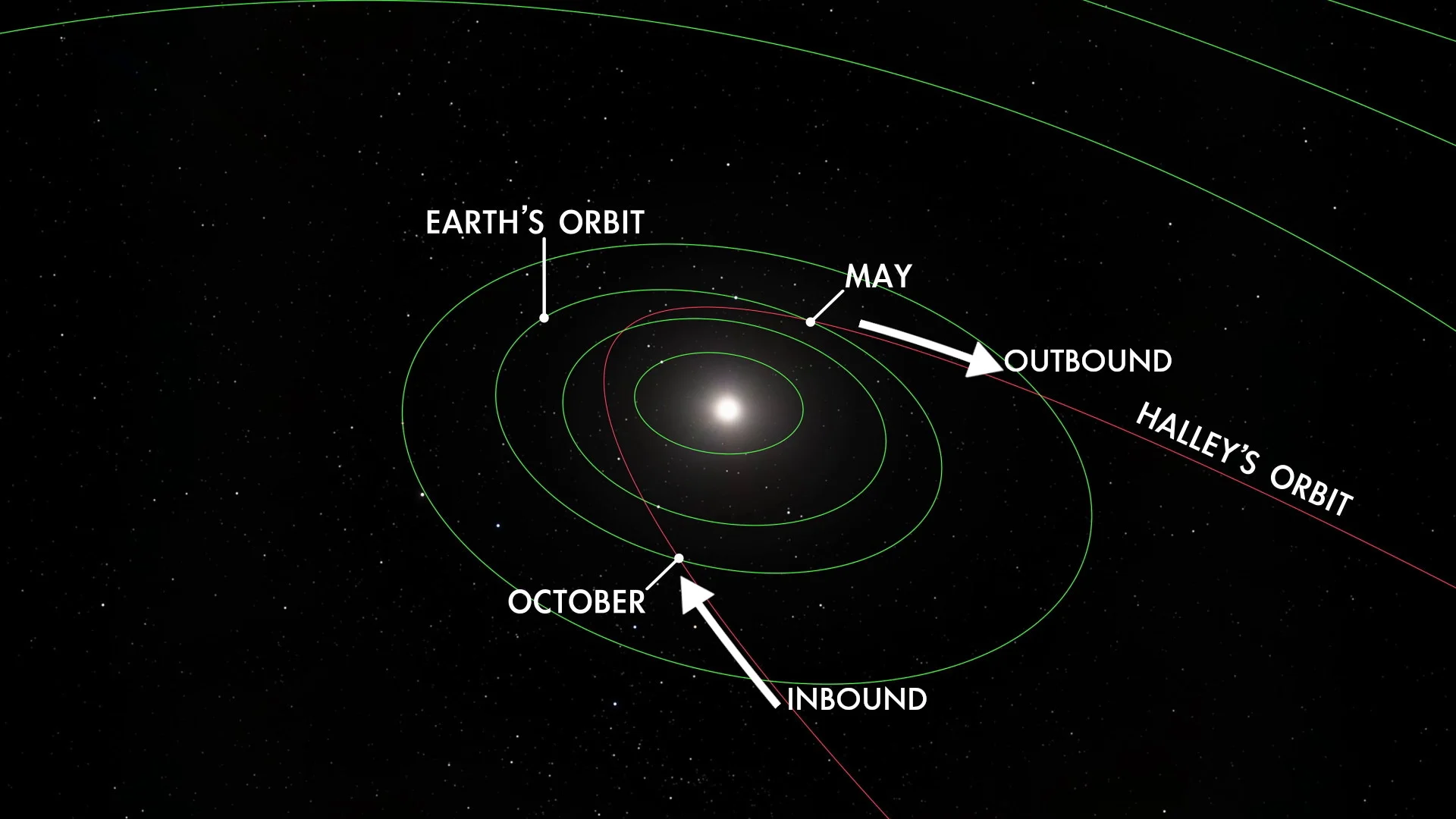
The path of Halley’s Comet and its debris stream through the inner solar system, which Earth crosses twice each year — the outbound part of the stream producing the eta Aquariids in April and May, and the inbound part causing the Orionids in October. (NASA/JPL/Scott Sutherland)
What’s up in May night skies? Halley’s Comet meteors, clustered planets, and a rare Blue Moon
Now, Halley’s debris stream is somewhat unique, at least with respect to us, as it is the only comet debris stream that we cross twice, each year.
The first time, in April and May, we cross the ‘outbound’ portion. Since the bits of dust and ice in the stream fly at us from the direction of the Sun, this particular meteor shower is only seen in the hours prior to sunrise.
The radiant of the eta Aquariids only rises around 3 a.m., local time.