
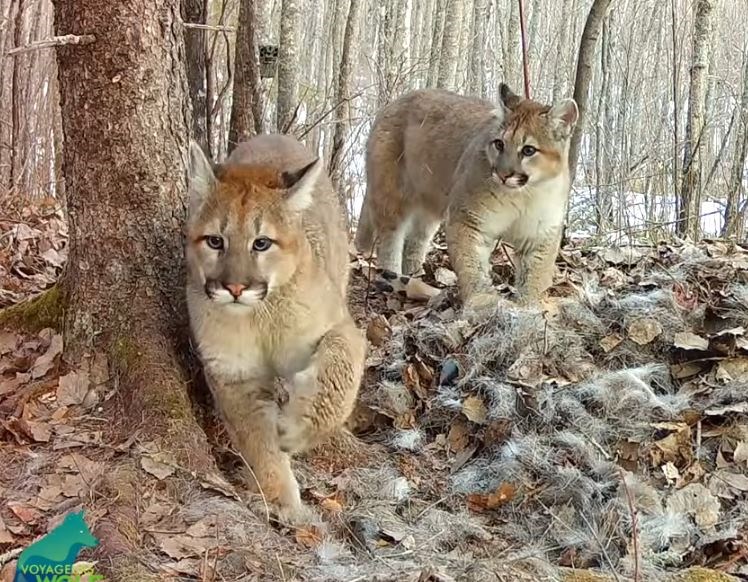
‘We feel incredibly fortunate to capture such a wild moment,’ researcher says.
ELY, Minn. — For the first time in over a century, there’s evidence of cougars reproducing in northeastern Minnesota, not far from the Ontario border.
Video captured by researchers with the University of Minnesota’s Voyageurs Wolf Project shows an adult female cougar with three large kittens.
The research team has recorded footage of lone cougars on eight occasions since 2023, but the video taken on March 25 was the first time images of kittens were found.
The video was captured with two cameras the researchers had placed over a GPS-collared deer which they suspected a cougar had killed.
“Looking at the footage was, and still is, surreal,” said Thomas Gable, the project lead. “In total, we captured around four hours of footage of this cougar family at the kill, and it was fascinating to see and hear their interactions — the mother grooming her kittens, the kittens growing and hissing at each other. We feel incredibly fortunate we were able to capture such a wild moment in such detail.”
The Minnesota Department of Natural Resources estimates the kittens are about eight months old.
Multiple sightings of wandering adult cougars have occurred in recent years both in Minnesota and in Northwestern Ontario — including the Thunder Bay area — but until now there has been no evidence of a reproducing population in the region.
However, in December 2025 two kittens were observed with their mother in Michigan’s Upper Peninsula.
John Erb, a research biologist with the Minnesota DNR, said the discovery in the Voyageurs National Park area is an important starting point for potential population establishment in the state.
He cautioned, though, that predicting the future is difficult.
“These kittens might not survive, potentially getting killed by wolves, a male cougar or vehicles. They may also become part of the founding catalyst for a slow but steady increase in numbers. Time will tell, but we are clearly nearing a point where the probability of a self-sustaining population has increased.”