
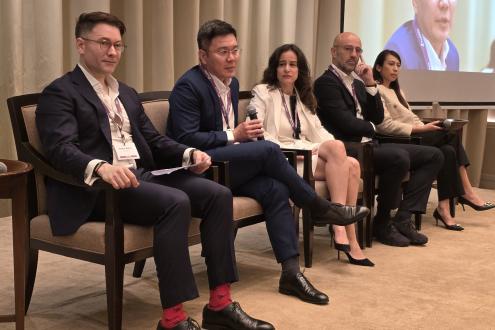
At the Hubbis Independent Wealth Management Forum – Singapore 2026, industry leaders examined whether independent wealth managers in Singapore are truly delivering better outcomes for clients, or whether the sector is simply offering a more flexible version of the traditional private banking model. The discussion explored how independent firms define alignment, how they approach portfolio construction, and how they are responding to rising client expectations, cost pressures, technology adoption, and the growing need for integrated family advice.
The panel also highlighted the continued evolution of Singapore’s independent wealth ecosystem, which has grown significantly over the past 15 years. As client needs become more complex and the operating environment becomes more demanding, independent wealth managers are being challenged to demonstrate not only independence, but also discipline, scale, infrastructure, and long-term value creation.
Chair: Rafael Weber, Deputy Chief Executive Officer, Swissquote
Speakers
Bernard Ong, Partner & Senior Wealth Advisor, Azimut Investment Management
Chiara Bartoletti, Managing Partner & Chief Operating Officer, Eightstone
Urs Brutsch, Managing Partner & Founder, HP Wealth Management
Jolene Tan, Executive Director – Managing Partner, SingAlliance
Key Takeaways
Singapore’s independent wealth management sector has expanded significantly, moving from a small group of EAMs to a broader ecosystem of EAMs, MFOs, and independent advisory platforms.
Independence is increasingly defined by open architecture, alignment of interest, and the ability to build customised portfolios rather than simply by separation from a private bank.
Robust portfolio construction now requires greater emphasis on liquidity, risk management, and resilience amid more frequent market drawdowns.
Integrated advice remains important, but firms differ on whether succession, governance, tax, and estate planning should be delivered in-house or through specialist external partners.
Scale is becoming a defining issue, as rising costs in compliance, cybersecurity, technology, insurance, and talent continue to pressure margins.
Technology and AI are becoming essential tools for operational efficiency, portfolio management, client communication, and institutional resilience.
The winning firms are likely to be those that can combine relationship trust, advisory discipline, technology, and commercial scale without losing the client alignment that defines the independent model.
Independence Is Moving From Concept to Operating Discipline
Panellists noted that Singapore’s independent wealth management industry has changed substantially over the past decade and a half. What was once a relatively small group of external asset managers has evolved into a larger and more sophisticated ecosystem, with Singapore now home to a sizeable number of EAMs, MFOs, and independent advisory businesses.
This growth reflects both client demand and structural change. Clients are increasingly looking for advice that is less product-led and more closely aligned to their objectives, while advisers are seeking platforms that allow them to deliver open architecture solutions across multiple custodians, products, and service providers.
“Independence is not simply a label – it has to be reflected in how portfolios are built, how providers are selected, and how decisions are made in the client’s interest,” a panellist observed.
The discussion also made clear that independence should not be judged only by whether firms outperform traditional private banks. Several panellists argued that the more relevant measure is whether independent firms can deliver advice that is genuinely tailored to the client’s objectives, risk profile, family circumstances, and long-term priorities.
Alignment Is the Core Differentiator
A recurring theme was that independent wealth managers do not necessarily claim to be structurally superior to banks in every area. Rather, their proposition rests on alignment. Without proprietary product pressure, internal sales targets, or bank-led distribution priorities, independent firms are able to sit more clearly on the same side of the table as their clients.
Panellists stressed that this alignment is particularly important in a market where clients are more informed, more demanding, and more willing to challenge advice. The ability to decline inappropriate products, avoid conflicted recommendations, and build portfolios around client objectives remains central to the independent model.
“The point is not that independents automatically do a better job than banks – it is that their survival depends on doing the right job for the client,” a panellist said.
This alignment also changes the nature of the client relationship. Rather than seeing clients through the lens of product revenue or short-term transaction flow, independent firms seek to build long-term advisory relationships based on trust, continuity, and shared interests.
Portfolio Construction Must Be Customised, But Also Robust
The panel discussed whether independent wealth managers can deliver better portfolio outcomes, particularly in an environment marked by global volatility, market drawdowns, and growing exposure to alternatives.
Panellists argued that robust portfolio construction is no longer only about asset allocation. It must also incorporate liquidity management, downside resilience, and the ability to withstand more frequent stress events. Recent market conditions have reinforced the need for portfolios that can absorb drawdowns without forcing clients into poor decisions or distressed liquidity events.
“Risk management and liquidity management are now inseparable – a portfolio may look sophisticated, but if it cannot withstand stress, it is not robust,” a panellist noted.
At the same time, independent firms face a practical challenge. Customisation is one of their key strengths, but it is also operationally demanding. A truly customised strategic asset allocation across multiple banks, currencies, mandates, and family needs is difficult to scale without strong systems and disciplined processes.
From Product Advice to Family-Level Value Creation
The conversation moved beyond portfolio management to the broader question of whether independent firms can deliver integrated advice across succession, governance, structuring, tax, philanthropy, and family continuity.
Panellists agreed that clients increasingly expect advice that goes beyond investments. Wealth management is becoming more closely linked to life-stage planning, intergenerational wealth transfer, liquidity needs, estate planning, and the broader purpose of family capital.
However, there were differing views on how this should be delivered. Some panellists argued that independent firms can provide integrated advice if they have the right expertise internally or access to trusted external specialists. Others cautioned that firms should focus on what they know best and avoid trying to become experts in every discipline.
“Integrated advice does not mean doing everything in-house – it means knowing what the client needs and coordinating the right expertise around them,” a panellist said.
This distinction is becoming increasingly important as families seek advice not only on investment returns, but also on legacy, governance, philanthropy, impact, succession, and the long-term architecture of wealth.
Scale Is Becoming a Strategic Requirement
The economics of the independent wealth model were a major focus of the discussion. Panellists noted that while revenues are typically linked to management fees and therefore market levels or client acquisition, many costs are fixed or rising. Compliance, cybersecurity, technology, rent, salaries, insurance, and operational infrastructure continue to increase, placing pressure on margins.
This dynamic is pushing the sector towards greater scale. Larger firms are better placed to absorb infrastructure costs, invest in systems, access private markets, support more sophisticated advisory capabilities, and maintain institutional-grade operating standards.
“The only certainty is that costs will rise – revenue growth depends on markets, clients, and new business, but the cost base moves regardless,” a panellist observed.
The panel suggested that the winners over the next decade are likely to be firms with sufficient scale to serve clients across both public and private markets, while continuing to invest in compliance, cybersecurity, technology, and talent.
Consolidation Is Logical, But Difficult
Given these pressures, consolidation was discussed as a likely path for the sector. Panellists noted that organic growth remains difficult in a relationship-driven business where client acquisition is slow, trust-based, and difficult to forecast. As a result, acquiring teams, merging with other firms, or pursuing strategic consolidation can offer a faster route to scale.
However, the panel also stressed that consolidation is complex. Independent wealth management is a highly people-centric business, and successful mergers require cultural alignment, similar client philosophies, compatible fee models, operational fit, and trust between principals.
“Mergers make strategic sense, but in this industry they only work when the people, culture, clients, and economics are genuinely aligned,” a panellist noted.
The process can also be lengthy. By the time firms complete due diligence, review books, align stakeholders, and structure a transaction, the underlying business may have changed. This helps explain why consolidation is often discussed but only selectively executed.
Technology Is Now Essential to the Independent Model
Technology was identified as a critical enabler for the next phase of growth. Panellists noted that independent firms cannot ignore AI, digital workflows, portfolio systems, compliance tools, onboarding infrastructure, and operational automation. These tools are increasingly necessary both to manage costs and to deliver consistent client service.
Technology is also central to scaling customised advice. Independent firms often work across multiple custodian banks, asset allocations, and client mandates. Without effective systems, executing changes consistently across portfolios becomes difficult and inefficient.
“Technology is no longer just a support function – it is what allows customised advice to be delivered at scale,” a panellist said.
Panellists also pointed to technology’s role in institutional continuity. Data that once sat in the heads of individual advisers can now be captured, organised, and shared across the firm, reducing key-person risk and improving the resilience of the business.
AI Is Changing Client Behaviour and Communication
The panel also considered the impact of AI on client conversations. Clients now have access to more information, more tools, and more apparent expertise than ever before. This can improve engagement, but it also creates new challenges around misinformation, shallow understanding, and overconfidence.
Panellists noted that AI does not necessarily make client conversations harder, but it does change the way advisers need to communicate. Clients may arrive with more questions, more opinions, and shorter attention spans. Advisers therefore need to explain complex issues more clearly, contextualise information, and help clients distinguish between data, insight, and advice.
“AI can make clients more informed, but not necessarily wiser – the adviser’s role is to turn information into judgement,” a panellist observed.
The implication is that education must become a more explicit part of the independent wealth proposition. This applies not only to clients, but also to advisers, who need continuous upskilling to remain relevant in a more transparent and competitive environment.
Advice Must Be Monetised Carefully
The discussion also addressed whether independent firms can monetise advice beyond investments. While clients increasingly need support across tax, estate planning, governance, structuring, and succession, panellists warned against assuming that every advisory need should become an in-house revenue line.
Some firms prefer to focus on investment management and act as coordinators of external expertise. Others see broader advisory capabilities as a point of differentiation. In both cases, the challenge is to ensure that advice remains credible, relevant, and delivered by suitably qualified specialists.
“The temptation to do everything can be dangerous – clients need access to the best advice, not necessarily advice manufactured inside one firm,” a panellist said.
For independent firms, the commercial opportunity lies in orchestrating advice around the client while maintaining clarity over the firm’s own areas of competence.
Trust Remains the Non-Scalable Asset
Despite the focus on technology, scale, and consolidation, panellists repeatedly returned to the central importance of trust. Client relationships remain highly personal, and trust cannot be manufactured through systems or acquired instantly through platform growth.
This is especially relevant when onboarding relationship managers or acquiring teams. Firms may be able to provide infrastructure, investment capabilities, and an independent platform, but the client relationship still depends heavily on the adviser’s credibility and history with the family.
“Platforms can scale, but trust does not scale in the same way – it has to be earned relationship by relationship,” a panellist noted.
This creates both an advantage and a constraint for the independent wealth sector. The personal nature of the model is a major reason clients value it, but it also limits how quickly firms can grow without diluting culture or service quality.
The Next Phase Will Require Discipline, Agility, and Clear Identity
In closing, panellists agreed that Singapore’s independent wealth sector is well positioned, but the next phase of growth will demand greater discipline. Firms must be clear about where they add value, how they manage conflicts, how they build portfolios, and how they support families through increasingly complex wealth needs.
The sector’s future will likely be shaped by a combination of scale, technology, advisory sophistication, and client alignment. Firms that can invest in infrastructure while preserving the independence, flexibility, and personal trust that define the model will be best placed to succeed.
“The independent model will not win by trying to look exactly like a private bank – it will win by being clear about where it is different, and by delivering that difference consistently,” a panellist concluded.
As Singapore continues to strengthen its position as a global wealth hub, independent wealth managers will play an increasingly important role in serving UHNW families, entrepreneurs, and globally mobile clients. The challenge is no longer simply to prove that independence has value. It is to demonstrate that this value can be delivered with scale, consistency, governance, and measurable client relevance.