

Listen to this article
Estimated 4 minutes
The audio version of this article is generated by AI-based technology. Mispronunciations can occur. We are working with our partners to continually review and improve the results.
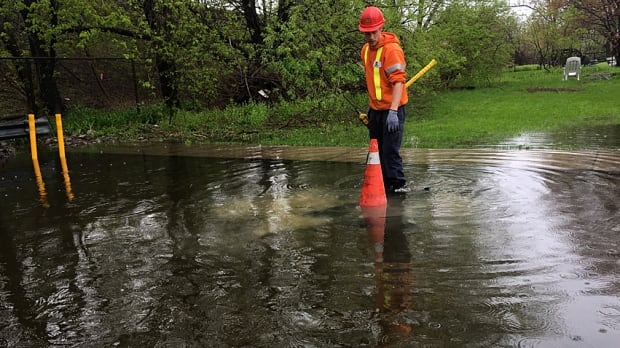
The City of Hamilton is warning residents of Beach Boulevard and beyond to prepare for potential flooding and mitigate risk on their properties due to high Lake Ontario waters.
In a news release issued Wednesday, the city advised people to consider “moving basement furniture, electronics and valuables to higher levels,” and temporarily sealing basement floor drains.
When asked whether this advice applies to homes beyond the beach strip, city spokesperson Lauren Vastano did not specify how far the flood risk extends.
“It is absolutely important information for everyone to know — but as we mention, those in the Beach Boulevard and surrounding area should take caution,” she said in an email.
Jonathan Bastien, manager of water resources engineering at the Hamilton Conservation Authority (HCA), says the lake is about 35 centimetres higher than the average for this time of year, but well below the record high levels experienced in 2017 and 2019.
Residents concerned about potential flooding should make sure their sump pumps are working and not expelling water into a drain or sink, as that increases the risk of sewer backup, the city release says.
Downspouts should be directed onto lawns and gardens when possible, but can also be directed onto the road in the Beach Boulevard area “due to the unique exposure to fluctuating lake levels,” the city says.
“To help protect residents from flooding, the city has increased inspections at pump stations affected by high water levels. Additionally, drainage assets, including catch basins and ditches are being inspected and cleared to reduce impacts to residents, properties and communities.”
According to the city, people who experience flooding should photograph the affected areas and damaged belongings, contact their insurance company immediately and stay away from anywhere with potential electrical hazards. Those experiencing sewer backup and flooding should call the city at 905-546-2489.
Some areas more prone to overflows: city
CBC Hamilton previously reported that most flooding within the municipality happens in Wards 1, 2 and 13 — downtown, the west end and Dundas.
Most of the lower city and a section of the Mountain, north of Mohawk Road, have combined sewer and stormwater infrastructure, meaning “these sewer systems have one pipe that collects both the wastewater from our homes and businesses, and stormwater from rain or melted snow,” according to a city web page.
Those systems are more likely to overflow than separated sewers, which exist in the newer parts of the city. This underscores the importance of directing rainwater and sump pumps into places where water can be absorbed into the ground, instead of into drains, the city says.
“In cases with a lot of rain or melting snow, the additional volume of water in the combined sewers can exceed the capacity of the system,” it says, noting too much water in the sewer system can lead to sewage overflows into the harbour.
“If the combined sewer system didn’t have the designed overflow option to release wastewater to the harbour, large areas of Hamilton would experience flooding, which would impact homes, business, roadways, public spaces and public health.”
Bastien, from the conservation authority, says the creeks in the HCA watershed are well below thresholds that would trigger flooding concerns further inland from the lake.
“Current creek levels range from slightly above baseflow levels in some creek reaches to elevated but below thresholds for significant water safety concerns,” he wrote in an email on Wednesday. “HCA staff continue to monitor creek conditions closely, and would issue flood messages as required.”