
When Connor McDavid signed an extension that was only for two years (and kicks in next season), the Edmonton Oilers were officially on the clock. It’s simple: you have two years to figure this out before you either convince your franchise superstar, who left plenty of money on the table on this deal, to stay or make a difficult decision.
After a disappointing first-round exit at the hands of the Anaheim Ducks, the Oilers are careening toward the latter. Once again, Edmonton failed to build a championship-caliber team despite having the consensus best player on the planet and another forward who’s not that far behind him. After losing in the Stanley Cup Final in back-to-back seasons, the Oilers were dispatched in six games by a team that hadn’t won a playoff series in nearly a decade.
It’s hard to know where to start with the Oilers because it’s not like the Kings, who went into a tailspin this year after a summer of disastrous decisions. It’s years and years of mismanagement that have mostly been paved over by McDavid, Draisaitl and Evan Bouchard bailing out the front office.
There’s letting Dylan Holloway and Phillip Broberg leave on offer sheets that sent them to the Blues for just a second-round pick and a third-round pick. Holloway has turned into a solid top-six option in St. Louis, while Broberg became a shutdown top pairing defenseman.
There’s shipping out Ryan McLeod to Buffalo for Matt Savoie. McLeod has been a quality center for the Sabres, while Savoie had his struggles driving play this year. Savoie is only 22, but it’s a weird move for a team that’s trying to win right now. At the very least, Edmonton might not have had to give up a first-round pick for Jason Dickinson to shore up its center depth if McLeod was still around.
Then there’s their drafting. Since 2019, the Oilers have selected two players who have appeared in at least 50 games: Holloway and Broberg. It’s hard to find star players when you’re drafting late in the first round (or trading first-round picks), but you have to at least find a way to draft players who can be cheap, quality depth players.
The Penguins won back-to-back Stanley Cups in part because they found the likes of Bryan Rust, Jake Guentzel and Matt Murray later in the draft. Same goes for the Lightning, who found Nikita Kucherov, Anthony Cirelli, Mathieu Joseph, Brayden Point and Ondrej Palat all after the first round. When you’re paying McDavid and Draisaitl a combined $26.5 million per year, you have to find talent in the draft to help fill out the rest of the roster.
McDavid’s supporting cast gets a lot of criticism, and it’s warranted. When McDavid and Draisaitl were both off the ice at five-on-five in the regular season, the Oilers had a 48.2 percent expected goals share while getting outscored 86-55 for a putrid goals-for percentage of 39 percent. Sure, shooting just under seven percent without McDavid and Draisaitl might be a little unlucky, but you can’t stock your bottom six with Trent Frederics and be surprised when you don’t have enough skill.
During the Oilers’ trips to the Stanley Cup Final, they found a way to survive whenever McDavid and Draisaitl were off the ice. During those two runs, their 46.6 percent expected goals share in the playoffs without those two wasn’t pretty, but they managed to still have a plus-two goal differential. However, their depth’s inability to drive play is ultimately what did them in against Florida both times.
But figuring out what exactly went wrong against Anaheim is a little more complicated. Without McDavid and Draisaitl, their 47.6 percent expected goals share was suboptimal, but they were also a plus-three in goal differential. Problem is, with both McDavid and Draisaitl banged up, Edmonton had its struggles at five-on-five, outside of a couple players. Edmonton’s top six players in icetime at five-on-five all had expected goals shares below 50 percent. Edmonton finished the series with a 47 percent expected goals share at five-on-five, though it was still a plus-three in actual goals, thanks to a 12.1 percent shooting percentage.
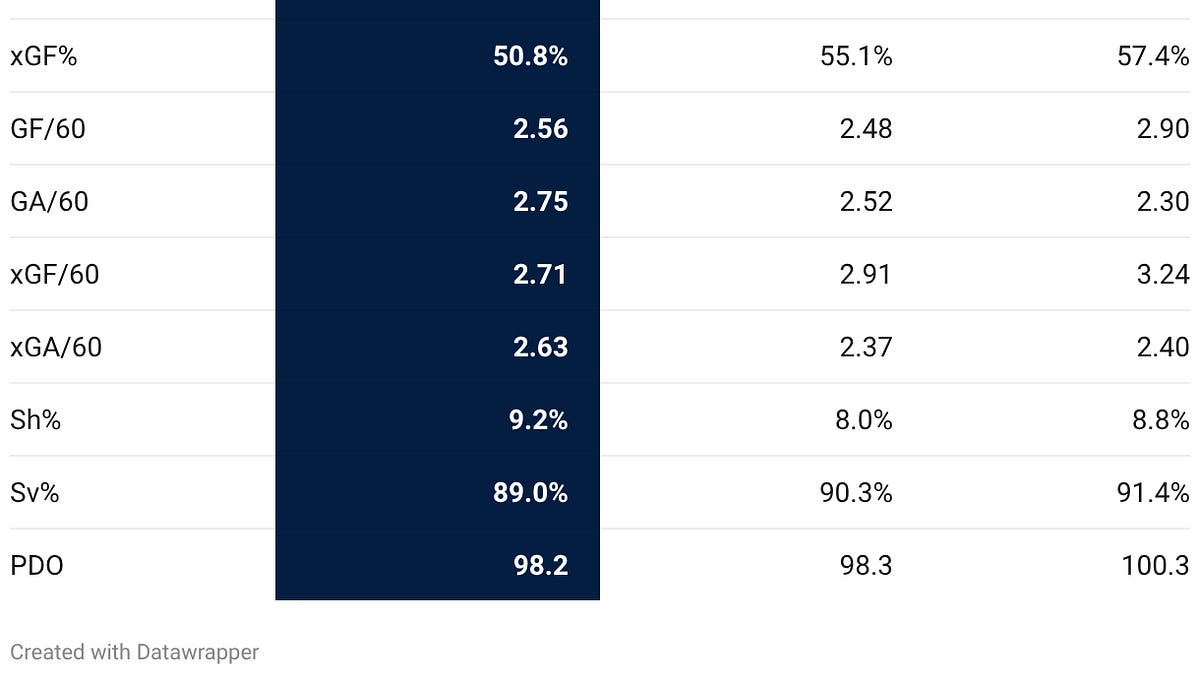
That wasn’t a one-off for Edmonton, either. A worse supporting cast for McDavid and Draisaitl meant way worse results for the Oilers at five-on-five. Per Hockey Stats, Edmonton posted five-on-five expected goal shares in the regular season of 57.4 percent in 2023-24 and 55.1 percent last season, making them one of the league’s best teams in driving play. That number fell all the way to 50.8 percent this season. The 2025-26 Oilers were clearly not on the same level of the teams that went to the Stanley Cup Final, and it showed in the playoffs.
The five-on-five struggles in the postseason were compounded by a leaky penalty kill. The Oilers’ power play did its job, but they finished the series with a 50 percent penalty kill percentage. The Ducks scored eight times with the man advantage, which brings us to the Oilers’ biggest shortcoming: goaltending.
Heading into the offseason last summer, goaltending was an obvious need for the Oilers. Edmonton couldn’t afford to ride the Stuart Skinner rollercoaster again and needed some insurance at the position as the bare minimum. The big goaltending move didn’t come until December, when the Oilers pulled the trigger on bringing in Pittsburgh’s Tristan Jarry while shipping out Skinner and defenseman Brett Kulak along with a second-round pick. The Oilers’ big goaltending move was for a guy with no track record of success in the playoffs and carried such an albatross of a contract that nobody claimed him when the Penguins waived him last season.
The trade so far has been a disaster for Edmonton. Not only do the Oilers have to pay Jarry $5.375 million annually for another two seasons, but he hasn’t benefitted from a change in scenery at all. In just 19 games, Jarry sported a minus-11 Goals Saved Above Expected. He lost the starting job to Connor Ingram, and Edmonton again went into the postseason with major concerns in the crease.
The goaltending situation once again blew up in Edmonton’s face. Ingram started five of the six games and finished the series allowing 6.7 goals more than expected, which is currently the worst in the league in the playoffs this year. Jarry had the other start and allowed four goals on 2.65 expected. Edmonton finished the series with an .866 team save percentage. The goaltending struggles were magnified on the penalty kill, where those eight Anaheim goals were scored on five expected.
Edmonton has to head back to the drawing board because clearly it has taken a few steps backward since the back-to-back Stanley Cup Final losses. Most importantly, it has to convince McDavid that the front office has what it takes to give him the best chance at winning a Stanley Cup. McDavid isn’t getting any younger, and he’s only under contract for a couple more years. The clock is ticking, and it doesn’t look like Edmonton has any answers as it currently stands.
Stats are via Natural Stat Trick unless otherwise noted