
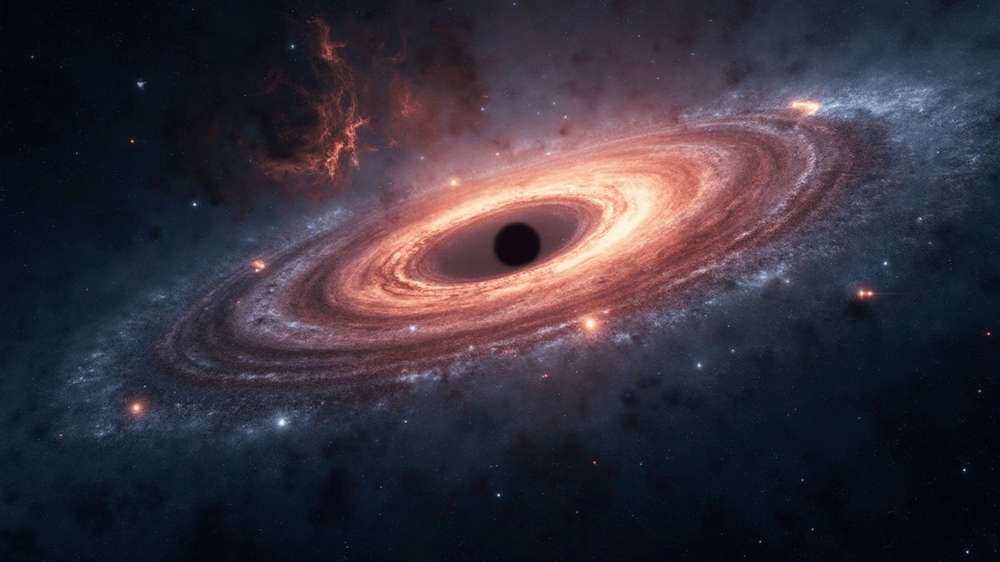
A new study has found that there are two distinct black hole populations- those formed by the established stellar collapse model, and those formed as a result of repeated, violent mergers in dense star clusters.
The largest black holes in the Universe, detected through the ripples they create in spacetime, are not formed directly from collapsing stars, according to new research led by Cardiff University. Instead, these cosmic giants grow through a series of repeated, violent mergers within densely populated star clusters.
The study analysed version 4.0 of the Gravitational-Wave Transient Catalog (GWTC-4), compiled by the LIGO–Virgo–KAGRA collaboration, which includes 153 confidently detected black hole mergers. The research team aimed to investigate whether the heaviest black holes observed are actually second-generation objects—formed when smaller black holes merge and then merge again within the dense cores of star clusters, where stars are packed up to a million times more tightly than in the Sun’s neighbourhood.
Published in Nature Astronomy, the findings reveal two distinct black hole populations. Lead author Dr Fabio Antonini from Cardiff University’s School of Physics and Astronomy explained, “Gravitational-wave astronomy is now doing more than counting black hole mergers. It is starting to reveal how black holes grow, where they grow, and what that tells us about the lives and deaths of massive stars. This is exciting because we can use the information to test our understanding of how stars and clusters evolve in the Universe.”
The team identified from the gravitational-wave data:
A lower-mass population consistent with black holes formed by ordinary stellar collapse
A higher-mass population exhibiting spins characteristic of hierarchical mergers in dense star clusters
Dr Isobel Romero-Shaw, co-author and Ernest Rutherford Fellow at Cardiff University, noted, “What surprised us most was how clearly the high-mass black holes stand out as a separate population. Unlike the lower-mass systems, which were generally slowly spinning, the higher-mass systems have more rapid spins oriented in seemingly random directions. This is the exact signature you would expect if black holes were repeatedly merging in dense star clusters. That makes the cluster origin much more compelling than it was with earlier catalogues.”
The study also provides the strongest evidence yet for a “mass gap”—a range of black hole masses predicted to be absent due to the pair-instability phenomenon. This theory suggests that extremely massive stars explode catastrophically rather than collapsing into black holes, creating a forbidden mass range for black holes formed directly from stars.
The team identified this mass gap starting at around 45 times the mass of the Sun. Dr Antonini said, “We find evidence for the long-predicted pair-instability mass gap—a range of masses where stars are not expected to leave behind black holes at all. Gravitational-wave detectors have found black holes that appear to sit in or near that gap, which we identify at around 45 solar masses.”
Re-examining stellar evolution models
He added, “The key question now is: are these black holes telling us that our models of stellar evolution are wrong, or are they being made in another way? The biggest black holes in the current sample seem to reflect cluster dynamics, not just stellar evolution. Above about 45 solar masses, the spin distribution changes in a way difficult to explain with normal stellar binaries alone but naturally explained if these black holes have already merged earlier in dense clusters.”
Additionally, the team used this transition to explore an important nuclear reaction involved in helium burning inside massive stars. Co-author Dr Fani Dosopoulou, a research associate at Cardiff University, remarked, “In the future, gravitational-wave data may help scientists study nuclear physics, because the mass limit set by pair instability depends on the nuclear reactions taking place in the cores of massive stars.”
This research marks a significant advance in understanding the growth and origins of the Universe’s most massive black holes, highlighting the dynamic environments of star clusters as key sites for their formation.