

interspecies collaboration
As designboom explores the Radical Softness of repair and coexistence, we look to the works of Aki Inomata, an artist known for her interspecies collaborations. Hermit crabs carry translucent city shells across aquarium floors. Oysters slowly coat miniature sculptures in nacre over the course of months. Octopuses settle into reconstructed ammonite forms based on extinct marine life. Across her practice, living systems shape the work alongside the artist herself.
The Tokyo-based artist has spent years building projects around exchange between humans, animals, technologies, and environments. Her installations rarely feel static. Instead, they evolve through occupation, growth, erosion, or biological activity. This gives the work an unusual sense of temporality. Materials shift over time while authorship remains distributed between multiple participants, many of them nonhuman.
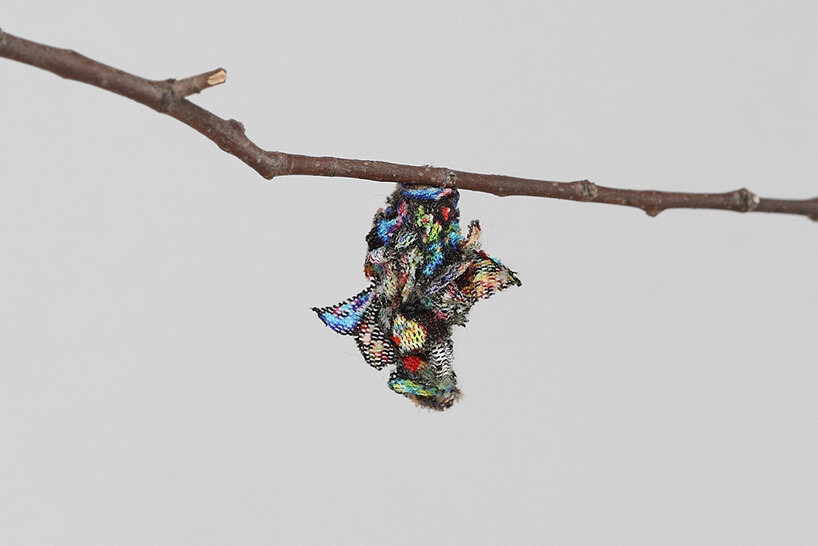
girl, girl, girl…, Aki Inomata, 2012 / 2019
shells and temporary architecture
One of Aki Inomata’s most widely recognized works, Why Not Hand Over a ‘Shelter’ to Hermit Crabs?, began with a simple observation about territorial exchange. Hermit crabs regularly swap shells with one another as they grow, passing homes between bodies without conflict or permanence. The artist translated this behavior into a series of transparent 3D-printed shells modeled after city skylines including New York, Paris, and Tokyo.
Inside aquariums, the tiny structures become moving architectures. As the crabs migrate between shells, entire city silhouettes drift slowly across sand and water. The project carries political undertones connected to borders and national identity, though its strongest moments remain spatial and physical. The transparent shells expose the crab beneath while simultaneously functioning as portable shelter. Architecture becomes lightweight, temporary, and continuously exchanged between inhabitants.

Why Not Hand Over a ‘Shelter’ to Hermit Crabs? -Border-, Aki Inomata, 2009- (ongoing)
living with extinct forms
Questions around habitation continue through Think Evolution #1: Kiku-ishi (Ammonite), where octopuses occupy reconstructed shells based on fossilized ammonites. The forms are produced through scans of ancient spiral fossils before being fabricated as functional shelters for living creatures.
Watching the octopus move across the surface of the shell creates a strange overlap between geological time and present-day biology. The work connects extinct marine life with contemporary animal behavior through direct physical occupation. Inomata avoids framing the piece as scientific reconstruction. The emphasis stays on shelter, adaptation, and continuity between species separated by millions of years.
Think Evolution #1: Kiku-ishi (Ammonite), Aki Inomata, 2016-2017
Another project, Satoyama, moves outward into broader ecological relationships. Referencing the Japanese concept describing managed landscapes shared between humans and ecosystems, the work examines how environments are sustained through reciprocal maintenance over long periods of time. Here, the artist’s interest shifts from individual organisms toward systems of coexistence shaped gradually through cultivation and environmental attention.

video still from Why Not Hand Over a ‘Shelter’ to Hermit Crabs? -Satoyama-, Aki Inomata, 2018
biological labor and systems of value
Many of Inomata’s projects also examine how value is produced. In Memory of Currency, small currency-like objects are placed inside oysters, where they slowly become coated in nacre through the animal’s natural biological processes. The transformation takes place gradually as layers accumulate over time.
The finished forms resemble pearls, though traces of their original manufactured geometry remain visible beneath the surface. Economic symbols become entangled with marine labor and biological time. The work quietly questions how value is assigned, accumulated, and transformed through living systems. Its power comes from patience and process. Nothing appears immediate.

In Memory of Currency, Aki Inomata, 2018- (ongoing)
This sensitivity to collaboration extends into works involving digital fabrication and machine processes as well. In How to Carve a Sculpture, Inomata studied the marks left by beavers chewing wood before translating those forms through scanning technologies and CNC carving systems. Animal behavior, machine reproduction, and artistic intervention intersect within the same sculptural process.