
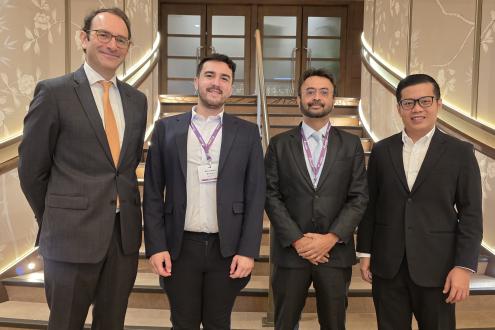
At the Hubbis Independent Wealth Management Forum – Singapore 2026, industry leaders examined how AI is reshaping the independent wealth management model, from RM productivity and client engagement to enterprise adoption, operational efficiency, cybersecurity, and revenue growth. The discussion focused not only on the potential of AI as a cost-saving tool, but also on its role in helping independent firms deepen client relationships, increase share of wallet, and build more scalable advisory businesses.
The panel also highlighted the practical constraints facing EAMs, MFOs, and independent wealth platforms. While AI is becoming more accessible, firms still need to define their proposition clearly, identify the specific workflows they want to improve, manage regulatory and data-security risks, and ensure adoption across the organisation. The message was clear: AI will not replace the relationship-led nature of independent wealth management, but it will increasingly determine how effectively that relationship model can scale.
Chair: Andrew Hendry, CEO Asia and Senior Managing Director, Head of Asia Client Group, Janus Henderson Investors
Speakers
Alexander Kearns, CEO & Co-Founder, DataDasher
Jackson Ng, Chief Operating Officer, Chief Technology Officer (Singapore), and Head of Fintech (Asia), Azimut Group
Hrishikesh Unni, Managing Director, Client Investments, Taurus Wealth Advisors
Key Takeaways
Independent wealth management remains fundamentally a people and relationship business, but AI is becoming a critical tool for improving RM productivity and client service.
Firms need to define their proposition clearly before adopting AI, ensuring that technology supports the specific client segments, workflows, and outcomes they are targeting.
The sector is moving from experimentation to execution, with growing emphasis on enterprise AI, application layers, and operational systems rather than isolated individual use.
AI adoption should be evaluated against tangible business objectives, including time saved, cost reduction, revenue generation, client engagement, and share-of-wallet expansion.
Build-versus-buy decisions are becoming more important, as firms may underestimate the cost, maintenance burden, and iteration cycles required to develop AI tools internally.
Cybersecurity, data confidentiality, regulatory compliance, and governance must be built into any AI strategy from the outset.
Cultural adoption is not purely a generational issue; successful AI implementation depends on leadership, firm culture, institutional context, and clarity around benefits.
The firms most likely to benefit from AI are those that use it to enhance relationship management, strengthen operational resilience, and deliver better client outcomes at scale.
Panellists repeatedly stressed that independent wealth management remains a people business. EAMs, MFOs, and family offices are built on relationships, trust, judgement, and continuity. AI may transform how work is done, but it does not remove the central importance of the adviser-client relationship.
This point is especially important for independent firms, whose proposition often rests on personalised advice and close alignment with the client. Technology adoption therefore cannot be treated as an abstract exercise. It must support the firm’s underlying client promise.
“AI should not be adopted because it is fashionable – it should be adopted because it helps the firm deliver more of what the client actually came for,” a panellist said.
The discussion suggested that firms should begin by identifying who they are, what kind of clients they serve, and what type of value they are trying to deliver. Only then can AI be assessed as a tool to support that proposition. For some firms, the priority may be RM productivity. For others, it may be portfolio workflows, reporting, prospecting, compliance, or client communication.
The Sector Is Still Early, But Momentum Is Building
Several panellists noted that many independent wealth firms are still in the early stages of AI adoption. For smaller EAMs and MFOs, the current approach is often to test off-the-shelf tools, assess what works, and remain alert to regulatory expectations, particularly around MAS risk and compliance guidelines.
At the same time, the conversation made clear that experimentation is no longer enough. The market is moving quickly, and firms are increasingly being pushed to convert pilot projects into practical execution.
Panellists described this as a shift from individual experimentation to institutional adoption. Individual advisers may already be using tools such as ChatGPT, Claude, or other AI platforms, but that does not mean the firm has a coherent AI strategy. Enterprise-level implementation requires shared context, governance, workflows, controls, and integration into business processes.
“Using AI individually may improve productivity at the margins, but enterprise AI is what turns scattered usage into institutional capability,” a panellist observed.
This distinction matters because uncoordinated AI use can create inconsistency. Different advisers may prompt tools differently, receive different outputs, and develop different interpretations. Without common context and firm-level guardrails, AI can widen internal gaps rather than strengthen organisational alignment.
From AI Capability to Business Application
A recurring theme was that AI capability alone does not create value. Firms need an application layer that turns the technology into usable workflows, revenue impact, and operational improvement.
Panellists argued that many AI tools are powerful in isolation, but fail to translate into business outcomes because they are not embedded properly into the daily work of advisers, investment teams, operations, compliance, or management. The issue is not simply whether a tool can produce an answer. It is whether it solves a specific problem inside the firm.
This requires firms to move away from broad, unfocused testing. Rather than trying to “boil the ocean”, panellists suggested that independent wealth managers should identify defined workflow problems and set clear success metrics.
“What matters is not whether a firm is using AI, but whether it knows what winning looks like for each AI use case,” a panellist said.
Success could mean saving adviser hours, reducing manual work, increasing client engagement, improving response times, creating more consistent reporting, supporting compliance, or generating revenue. The key is to define the business problem before selecting the technology.
RM Time Is the Scarce Resource
The panel returned several times to the cost and productivity of relationship managers. In independent wealth management, senior adviser time is one of the most valuable and least scalable resources. Yet RMs often spend a significant portion of their week on non-revenue-generating activities.
This creates a clear use case for AI. If tools can reduce administrative work, improve preparation, streamline meeting follow-up, support portfolio reviews, or enhance client communication, they can help advisers spend more time on the activities that drive trust, revenue, and retention.
Panellists also noted that many of the best growth opportunities are not necessarily from new clients, but from better engagement with existing clients. The lower half of a client base may receive less proactive attention, even though it may hold meaningful consolidation potential.
“RM time is finite, and misallocating it is one of the hidden costs in the advisory model,” a panellist said. “The real opportunity is using technology to make every client feel more actively covered.”
This is particularly relevant in a market where UHNW and HNW clients often maintain relationships across multiple banks and advisers. AI-enabled engagement can help firms identify under-served clients, spot consolidation opportunities, and deliver a more consistent level of service across the book.
AI Is Not Only About Cost Reduction
While much of the AI discussion in financial services focuses on efficiency, the panel also highlighted its revenue potential. AI can support prospecting, client segmentation, engagement planning, service consistency, and share-of-wallet growth.
One panellist pointed to research suggesting that a meaningful proportion of UHNW clients are considering consolidating more assets with a primary provider. If independent firms can use AI to engage clients more intelligently and consistently, they may be better placed to capture that consolidation rather than lose assets to a competitor.
This changes the investment case for AI. The question is not only whether a tool saves cost. It is whether it helps a firm win more business from existing clients, protect relationships, and increase relevance.
“AI should be seen not just as an efficiency tool, but as a revenue-enabling layer across the client base,” a panellist noted.
For smaller and mid-sized independent firms, this could be especially important. They may not have the scale or headcount of larger institutions, but they can use technology to increase the productivity of existing teams and improve coverage without simply hiring more staff.
Build, Buy, or Partner Must Be Assessed Realistically
The panel also addressed the build, buy, or partner decision. For most independent wealth managers, building proprietary AI infrastructure from scratch is unlikely to be the practical route. Development can become expensive quickly, and the cost does not stop at launch.
Panellists warned that firms often underestimate the maintenance burden, implementation complexity, and speed of iteration required. AI tools are evolving rapidly, and firms that build internally must be able to keep pace with technology companies that are constantly improving their models, interfaces, and capabilities.
Even examples that appear to be internal builds may involve significant external partnerships. This makes the partner route particularly relevant for independent wealth managers that want tailored solutions without taking on the full burden of internal technology development.
“The cost of building is not just the first version – it is every version after that,” a panellist said.
For smaller firms, buying or partnering may be the more realistic path. The commercial comparison should not only be against the current technology budget, but also against the cost of hiring additional people to perform the same work manually.
Technology Budgets Need to Reflect Strategic Importance
When asked how much independent wealth firms should be spending on AI, panellists avoided a single fixed number but suggested that firms should think seriously about increasing their technology budgets. For workflow productivity tools, the relevant comparison may be the cost of an additional assistant, operations resource, or RM support function.
The argument was not that every firm should spend aggressively without discipline. Rather, AI should be assessed in terms of what it replaces, enhances, or enables. If it saves meaningful adviser time, improves client engagement, or increases revenue opportunities, the budget should reflect that strategic value.
For small firms, panellists suggested that a meaningful increase in technology spend may be justified if the use cases are clear. For larger firms, the focus may be on implementation, governance, system integration, and scaling AI across teams.
“Technology spend should not be viewed as a discretionary add-on when it is becoming part of the operating model,” a panellist observed.
However, panellists also acknowledged the difficulty of proving ROI in advance. Innovation is not always controllable or measurable at the outset. A practical approach is to start with smaller projects, prove value, and then scale.
Outcomes Matter More Than Speed
The panel cautioned against implementing AI simply for the sake of being first. Wealth management clients do not typically evaluate an adviser based on technology adoption alone. They evaluate outcomes, trust, responsiveness, and the value they receive.
This distinction is important for independent wealth managers. The objective is not to chase every new tool or accelerate every rollout. The objective is to use technology where it improves client outcomes and supports the advisory proposition.
“Clients are not buying AI from their wealth manager – they are buying better outcomes, better service, and better judgement,” a panellist said.
This means firms need to balance speed with discipline. AI is moving quickly, and opportunity cost matters. But rushed adoption without clear use cases, controls, or integration can create operational and reputational risk.
Cybersecurity and Data Protection Are Core to AI Adoption
Panellists also highlighted the importance of security. As firms build AI ecosystems, they must consider data confidentiality, cybersecurity, regulatory compliance, and the governance layer around AI usage.
This is particularly sensitive in wealth management, where client data is confidential, cross-border considerations can be complex, and trust is central to the advisory relationship. Firms cannot treat AI tools as casual productivity applications without understanding where data goes, how it is processed, who has access, and how outputs are controlled.
Security therefore needs to be part of the AI budget and implementation plan, not an afterthought. Firms may need overlays, monitoring tools, policies, training, and vendor due diligence to ensure that AI adoption does not create unacceptable risk.
“The more powerful the AI ecosystem becomes, the more important the control environment around it becomes,” a panellist noted.
For independent firms, this is also a credibility issue. Clients may be open to technology-enabled service, but they will expect their advisers to protect sensitive information and apply sound judgement to any AI-supported process.
Clients Are Using AI Too
The panel noted that clients themselves increasingly have access to the same broad AI tools as advisers. This is changing the client conversation.
Some clients remain sceptical and prefer traditional human-led discussions. Others are already using AI tools heavily to inform their own investment decisions. A third group sits in the middle: they still value adviser judgement, but they cross-check recommendations using AI applications.
This creates both pressure and opportunity for advisers. Clients may arrive with more information, more questions, and more confidence in their own research. Advisers therefore need to be prepared to explain, contextualise, challenge, and refine AI-generated information.
“AI does not remove the need for advice – it raises the standard of explanation advisers must provide,” a panellist said.
For independent firms, this reinforces the importance of judgement. The adviser’s role is not simply to provide information, but to interpret it in the context of the client’s objectives, risk tolerance, family circumstances, liquidity needs, and long-term plans.
Cultural Adoption Depends on Leadership and Context
The final part of the discussion focused on cultural adoption. Panellists challenged the assumption that AI adoption is purely an age-related issue. While younger employees may be more comfortable experimenting with new tools, openness to AI ultimately depends on character, leadership, firm culture, and perceived usefulness.
One panellist noted that a firm can have employees across a wide age range and still build adoption if the benefits are clearly understood and leadership supports the direction of travel. Another stressed that older RMs are often actively asking how to use AI, particularly where they can see its relevance to client service or productivity.
The challenge is not simply giving staff access to tools. It is creating a framework where those tools are used consistently and effectively across the firm.
“Adoption is not about age alone – it is about whether people understand the benefit and whether the organisation gives them the context to use it properly,” a panellist said.
This again points back to enterprise AI. Licences alone are not enough. Firms need shared practices, training, governance, prompts, workflows, and institutional context if AI is to become a true operating capability.
The Next Phase Will Be Defined by Institutional AI
In closing, the panel suggested that AI will become an increasingly important differentiator for independent wealth managers in Singapore. The opportunity is not simply to automate tasks, but to reshape how firms support advisers, engage clients, manage workflows, and scale relationship-led advice.
However, the benefits will not come automatically. Firms need to define their proposition, select focused use cases, manage security and compliance, invest appropriately, and build a culture of adoption. They must also avoid confusing individual experimentation with institutional capability.
The most successful independent firms are likely to be those that use AI to strengthen, rather than dilute, the relationship model. Technology can help advisers become more proactive, more consistent, and more scalable, but the client outcome remains the ultimate test.
“The firms that win will not be those that use AI most loudly – they will be those that use it most deliberately,” a panellist concluded.
As Singapore’s independent wealth management sector continues to mature, AI will increasingly sit at the centre of discussions around scale, productivity, client relevance, and operational resilience. The challenge is no longer whether firms should explore AI. It is whether they can turn exploration into disciplined execution, and execution into measurable client value.