
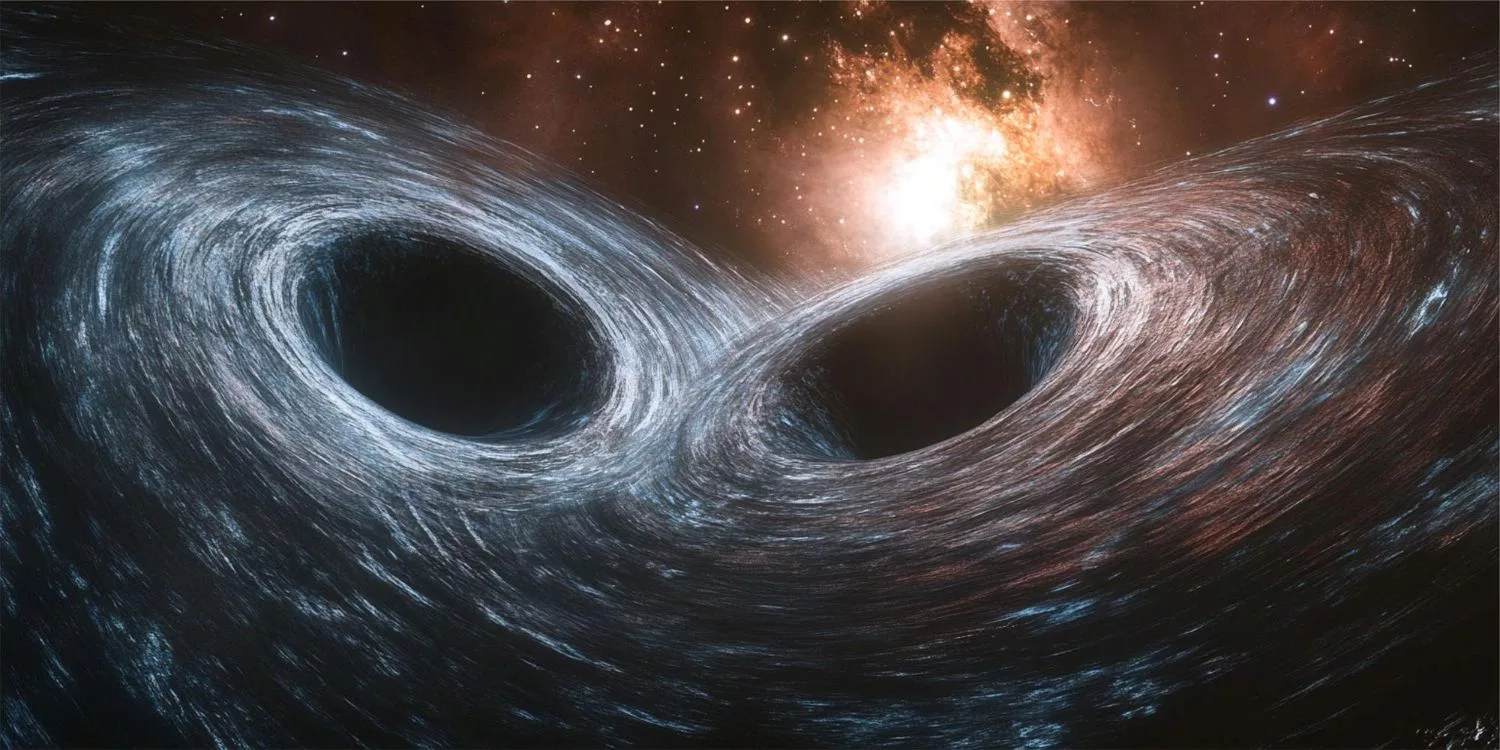
The biggest black holes in the cosmos may not be the quiet offspring of collapsing stars, but the bruised veterans of cosmic brawls. A new study reveals that these giant black holes grew densely packed in young star clusters by a series of violent mergers during which they disturbed spacetime itself.
An international team led by Cardiff University has combed through version 4.0 of the Gravitational-Wave Transient Catalog (GWTC-4), a record of 153 confident black hole merger detections from the LIGO–Virgo–KAGRA collaboration. Their findings, published in Nature Astronomy, suggest that the heaviest black holes are “second-generation” objects, forged when smaller black holes repeatedly merged in the dense cores of star clusters, where stars can be packed a million times more tightly than in our Sun’s neighborhood.
Their gravitational-wave data came in two flavors:
Low-mass black holes are consistent with standard predictions for stellar collapse. With a potential detection of gravitational-wave radiation from a higher-mass black hole, it spins rapidly after birth, is randomly oriented, and has an observational record of events typical of black holes merging in a dense cluster.
“What surprised us most was how clearly the high-mass black holes stand out as a separate population,” said co-author Dr. Isobel Romero-Shaw, Ernest Rutherford Fellow at Cardiff. “Unlike the lower-mass systems, which were generally slowly-spinning, the higher-mass systems are consistent with repeated mergers. That makes the cluster origin much more compelling than it was with earlier catalogs.”
The work also supports the long-predicted pair-instability mass gap, a range of stars that are theorized to explode rather than collapse to form black holes. The researchers identify a gap around 45 solar masses, a limit above which black holes born from stars should not be found. Yet we have now seen gravitational-wave observations of black holes lurking just below this limit.
“In our study, we find evidence for the long-predicted pair-instability mass gap,” explained lead author Dr. Fabio Antonini. “Above about 45 solar masses, the spin distribution changes in a way that is hard to explain with normal stellar binaries alone, but is naturally explained if these black holes have already been through earlier mergers in dense clusters.”
The implications ripple beyond astrophysics. Co-author Dr. Fani Dosopoulou noted that gravitational-wave data may even help probe nuclear reactions inside massive stars. The mass limit set by pair instability depends on the physics of helium burning, making black holes unexpected laboratories for nuclear science.
“Gravitational-wave astronomy is now doing more than counting black hole mergers,” said Dr. Antonini. “It is starting to reveal how black holes grow, where they grow, and what that tells us about the lives and deaths of massive stars.”
In other words, the Universe’s most violent collisions are not just echoes in spacetime; they are clues to how cosmic giants are born and how the crowded dance floors of star clusters shape the fate of the heaviest black holes.
Journal Reference:
Antonini, F., Romero-Shaw, I.M., Callister, T. et al. Gravitational-wave constraints on the pair-instability mass gap and nuclear burning in massive stars. Nat Astron (2026). DOI: 10.1038/s41550-026-02847-0