
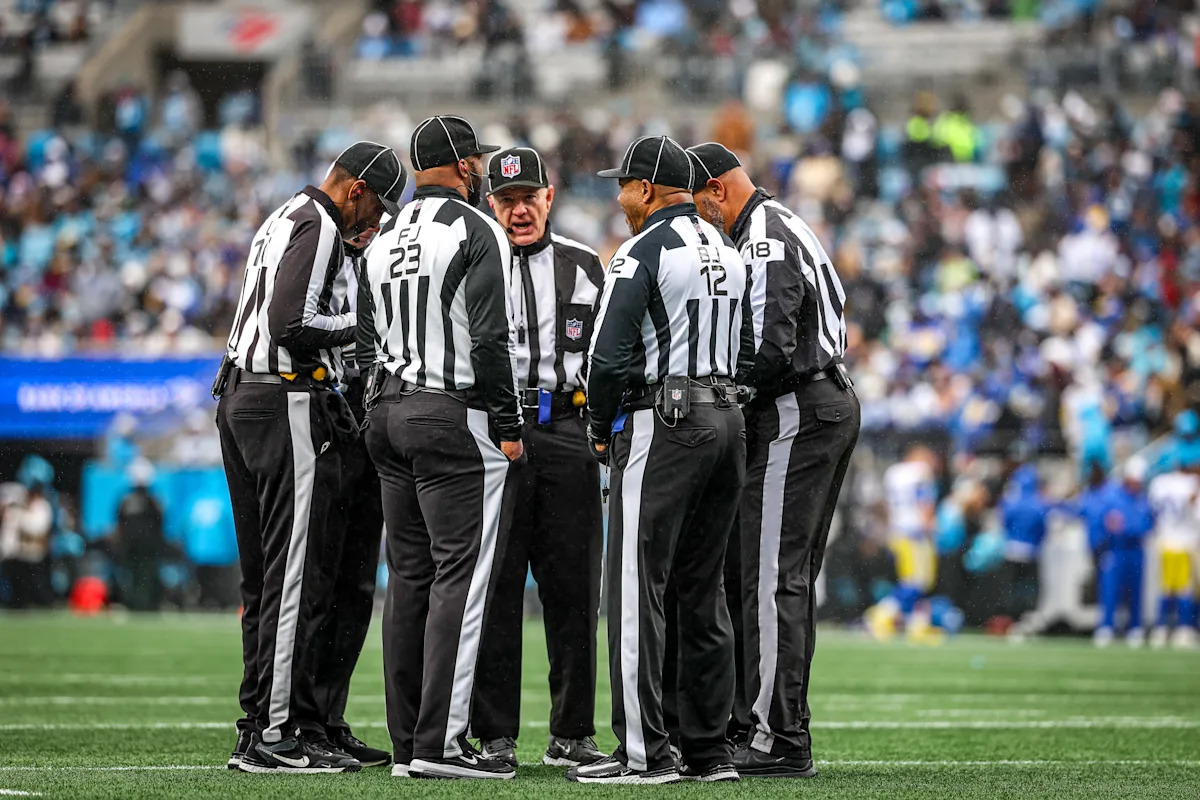
Less than a month before the most recent collective bargaining agreement between the NFL and the NFL Referees Association (NFLRA) was set to expire, the two sides reached a new CBA, which the league announced Friday.
Officials approved the deal by a vote of 116-4, according to NFL Network’s Tom Pelissero. The deal covers the next seven years, as the agreement will run through the 2032 season.
News broke Tuesday that the NFLRA had scheduled a ratification vote for this week. Shortly after that vote, it was announced that the CBA had been ratified. The NFL and NFLRA reached common ground after yearslong negotiations stalled this past winter and as the May 31 deadline neared.
Advertisement
“This agreement is a testament to the joint commitment of the league and union to invest in and improve officiating,” NFL executive vice president of football operations Troy Vincent said in a release the league sent out Friday. “It also speaks to the game officials’ relentless pursuit of improvement and officiating excellence. We look forward to working together for the betterment of the game.”
With a new CBA in place, the NFL can scrap a contingency plan that called for replacement officials and the enforcement of conditional replay-review rules that would have given NFL headquarters more in-game officiating authority.
Rules, contingent on replacement officials being used, were approved by NFL team owners this spring to give the staffers in the league’s New York officiating command center the ability to consult with a game’s on-field replacement ref on an assortment of penalties, called and uncalled, as well as other administrative procedures, per ESPN.
The NFL began recruiting replacement officials from the college ranks in early March, according to ESPN. Replacement officials were most recently used in 2012 when the lockout of NFL officials followed the previous season’s lockout of NFL players.
Advertisement
In that instance, the replacement officials were used for three weeks of the regular season, a stretch that culminated with the infamous “Fail Mary,” the ruling that incorrectly rewarded the Seattle Seahawks with a game-winning touchdown reception against the Green Bay Packers on “Monday Night Football.”
That lockout of officials lasted 110 days.
In March, NFLRA executive director Scott Green said he was surprised the NFL “would even consider” replacement officials after what transpired in 2012, according to ESPN.
Green flagged some possible issues with that approach, as described in ESPN’s March 18 report. He purported that there’d be a greater chance for gambling to find its way into officiating crews. Green also noted, per ESPN, that replacement officials can compromise the safety of players, given they aren’t equipped with the necessary experience at that level of football.
Advertisement
Green, however, appears satisfied with the NFLRA’s recent reconciliation with the NFL.
“It was a mutual and determined effort, and the outcome is seven years of certainty for the league and the officials,” he said in the league’s release on Friday. “We appreciate Troy Vincent and Larry Ferazani and their staff for recognizing that working together to find solutions is the best course of action to reach a long-term agreement.”
In a March 30 report, Yahoo Sports’ Jori Epstein outlined the main points of contention in the negotiations between the NFL and the NFLRA. Back then, Epstein reported the NFL eyed a performance-based officiating model that would place lower-performing officials on probationary periods.
Advertisement
While the NFLRA has wanted playoff assignments to be determined by seniority, the NFL has made it clear it prefers merit as the deciding factor in that selection process, Epstein reported at the time.
During their stalemate, the NFLRA and NFL had also been at odds about compensation, per Epstein, who reported at the end of March the NFL had offered an average raise of 6.45% per year in a deal that would last six years. Meanwhile, the NFLRA maintained that its officials should be paid like those from the NBA, MLB and NHL despite the disparity in total number of games the NFL requires compared to those other leagues. The NFLRA was looking for a raise of more than 10% per year on average, according to Epstein’s March 30 report.
Eventually, though, negotiations progressed to the point where a vote was held and a new CBA was ratified.