
Breadcrumb Trail Links
New BrunswickThe IssuesHealth care
Patients waiting an average of 16 days for regular appointments
Published May 04, 2026 • Last updated 4 days ago • 6 minute read
You can save this article by registering for free here. Or sign-in if you have an account.
 The Liberals campaigned on a promise to improve timely access to primary care in New Brunswick. PEXELSArticle content
Horizon and Vitalité patients are waiting an average of almost 16 days for a regular primary care appointment through facilities tied to their regional health networks, Brunswick News has learned.
Advertisement 2
This advertisement has not loaded yet, but your article continues below.

THIS CONTENT IS RESERVED FOR SUBSCRIBERS
Subscribe now to read the latest news in your city and across Canada.
Unlimited online access to articles from across Canada with one account.Get exclusive access to the e-Edition, an electronic replica of the print edition that you can share, download and comment on.Enjoy insights and behind-the-scenes analysis from our award-winning journalists.Support local journalism and the next generation of journalists.
SUBSCRIBE TO UNLOCK MORE ARTICLES
Subscribe now to read the latest news in your city and across Canada.
Unlimited online access to articles from across Canada with one account.Get exclusive access to the e-Edition, an electronic replica of the print edition that you can share, download and comment on.Enjoy insights and behind-the-scenes analysis from our award-winning journalists.Support local journalism and the next generation of journalists.
REGISTER / SIGN IN TO UNLOCK MORE ARTICLES
Create an account or sign in to keep reading.
Access articles from across Canada with one account.Enjoy additional articles per month.Get email updates from your favourite journalists.
THIS ARTICLE IS FREE TO READ REGISTER TO UNLOCK.
Create an account or sign in to continue with your reading experience.
Access articles from across Canada with one accountShare your thoughts and join the conversation in the commentsEnjoy additional articles per monthGet email updates from your favourite authors
Article content
That’s about three times longer than the Holt Liberal government has said New Brunswickers should wait under its collaborative care clinic model.
None of Horizon’s four regions are currently meeting the five-days-or-less target set by the Liberals as part of its primary care strategy, according to data provided to Brunswick News.
Patients are waiting an average of 15.7 days for a regular appointment through Horizon primary care sites, with slight differences between regions.
Average wait times are 17.3 days in the Fredericton/Upper River Valley area, 16.1 days in the Saint John area, 14.9 days in the Moncton area and 11.1 days in the Miramichi area.
Vitalité saw an average wait time of 15.5 days for regular primary care appointments in the first quarter of 2026, although that’s improved from 17.7 days in the last quarter of 2025, according to data provided to Brunswick News.
All these figures are based on what’s called the “third next available” appointment metric, which is “the average number of days between a patient requesting an appointment and the third next available opening in a provider’s schedule.”
Advertisement 3
This advertisement has not loaded yet, but your article continues below.
Article content
Horizon and Vitalité measure access to primary care through this metric, which is considered more reliable than measuring wait times for the next-available appointment.
About 27 per cent of Vitalité’s family health teams are currently meeting the Liberals’ five-day target.
Brunswick News asked Horizon how many of its family health teams and community health centres – which both provide primary care – are meeting the five-day target. The newspaper was told it would take some time to gather the data, although Moncton’s Mapleton family health team was given as an example of a team meeting the target.
“Horizon is committed to ensuring timely access to primary care services in our communities, and we continue to work toward achieving our targets across all sites,” Ashley Calvert, Horizon’s interim vice-president of community, said in a statement.
The Liberals have committed to expanding primary care access by establishing and supporting at least 30 collaborative care clinics by 2028. At this point, they’ve made 15 clinic announcements.

Morning Email Telegraph-Journal
Thanks for signing up!
Article content
Advertisement 4
This advertisement has not loaded yet, but your article continues below.
Article content
Last week, Premier Susan Holt told reporters the province is about one-third of the way through attaching 17,000 patients to the clinics announced to date.
As part of its plan, the Liberals have committed to improving timely access to primary care – not just getting each New Brunswicker matched with a health-care provider but ensuring they can see that provider within five days or less.
“We talk about the number of people attached, but if you are attached and can’t be seen for three weeks, are you really attached? We hold our clinics to those numbers,” Health Minister John Dornan said during a joint press conference with the premier last week.
“If you can be seen within five days, most of the problems you present with are treatable, and so when we talk to the clinics, we want to make sure there’s quantity and also quality and so they meet that by the five-day mark.”
Neither Dornan nor Holt had appointment wait time data on hand last week when asked for a breakdown of whether or not each collaborative care clinic was meeting the five-day target.
Advertisement 5
This advertisement has not loaded yet, but your article continues below.
Article content
However, Holt noted that the “third next available” appointment metric is being used by the province to measure primary access.
The third-next available (TNA) appointment is considered a more reliable measure of access than next-available appointment because it doesn’t factor in last-minute cancellations and other anomalies that can distort a provider’s true availability.
“TNA is a best-practice standard used consistently by health-care organizations across Canada and provides the most reliable picture of provider availability,” Calvert said in a statement.
“Horizon’s target is an average TNA of five days across all primary care sites,” she continued.
“In addition, Horizon’s family health teams are expected to reserve capacity in their schedules for same-day appointments, ensuring patients with more immediate needs can be seen promptly.”
Most Vitalité teams now offering minor emergency appointments
Most Vitalité family health teams are offering appointments for minor emergencies within 48 hours – a move that is helping take some pressure off emergency rooms across the regional health network.
Advertisement 6
This advertisement has not loaded yet, but your article continues below.
Article content
Twenty-four of Vitalité’s 32 family health teams now have the capacity to see patients on short notice to treat cases of the flu, minor cuts and other non-urgent conditions.
Plans are for all Vitalité family health teams – including the roughly four or five that still need to be created – to have the capacity to meet the 48-hour turnaround target, according to Patrick Parent, assistant CEO of Vitalité Health Network.
“We set ourselves a standard that fits with our culture, and our standard is to the best that we can possibly be and those are not targets you see in other provinces,” Parent said in an interview about Vitalité’s minor-emergency target.
“We want to establish a better-quality system, and regardless of targets that are asked of us, we will always raise the bar.”
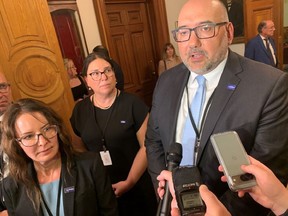 Patrick Parent, assistant CEO of Vitalite Health Network, speaks with reporters alongside CEO Dr. France Desrosiers. BRUNSWICK NEWS ARCHIVES
Vitalité started the transition to family health teams roughly two years earlier than Horizon. Largely serving francophone communities, Vitalité has a smaller catchment area than Horizon, the latter of which – in addition to creating new family health teams – is also in the process of transitioning dozens of community health centres to the collaborative care model.
Advertisement 7
This advertisement has not loaded yet, but your article continues below.
Article content
Horizon provided primary care wait time data to Brunswick News that included both its family health teams and community health centres.
In the 2025-26 fiscal year, Horizon secured funding for 10 family health teams to add staff, along with renovate and/or find new clinical space, to take more patients off the primary care waitlist. These projects are in various stages of development.
Both Horizon and Vitalité health networks have committed to having all their patients attached to a primary care provider by 2029.
Progress reported on reducing non-urgent ER visits
More primary care access is expected to help reduce the volume of non-urgent visits to the province’s overtaxed ERs – and Vitalité is already starting to see those results.
In January, Vitalité reported that the proportion of ER visits attributed to less urgent and non-urgent conditions has seen a downward trend over the past year at its hospitals.
The monthly ratio of those visits was 49 per cent in December 2025 compared to 58 per cent in November 2024.
Advertisement 8
This advertisement has not loaded yet, but your article continues below.
Article content
Under the Canadian Triage Acuity Scale, “less urgent” visits include strains, sprains, minor cuts and burns, while “non-urgent” visits include sore throats, earaches, minor contusions and prescription refills.
Part of Vitalité’s success has been attributed to its minor emergency primary care appointments, which are “supported by reserved appointment slots and collaborative practices within the teams.”
Dornan highlighted Vitalité’s success on this front when he and the premier briefed the public last week on their government’s progress on the health-care file.
Dornan acknowledged that some people are still presenting at Vitalité ERs with non-urgent conditions, but he expects that number will decrease as more patients are matched with a primary care provider.
“We want our emergency departments to be looking after emergencies, not patients that should be seen by primary care,” Dornan said.
Earlier this year, the Holt government celebrated progress on its target of increasing the percentage of people being able to access a doctor or nurse practitioner within a period of five days.
Advertisement 9
This advertisement has not loaded yet, but your article continues below.
Article content
According to data presented to the public, that figure sat at 34.2 per cent in 2024 – up from 31.4 per cent in 2023 – with the Liberals aiming to raise it to 37.4 per cent by 2028.
This performance metric has been based on data collected through the annual primary care survey conducted by the New Brunswick Health Council. About 5,300 people aged 18 and older were surveyed for the 2024 edition.
Last week, Holt told reporters that the province didn’t have baseline data for a lot of the existing primary care clinics in terms of appointment wait times, but as clinics move to digital health records, “that allows us to capture that data on third-next available and to determine how many days it is in that clinic and then help them work toward the goal of five days or less.”
– With files from Andrew Waugh
Article content
Share this article in your social network