
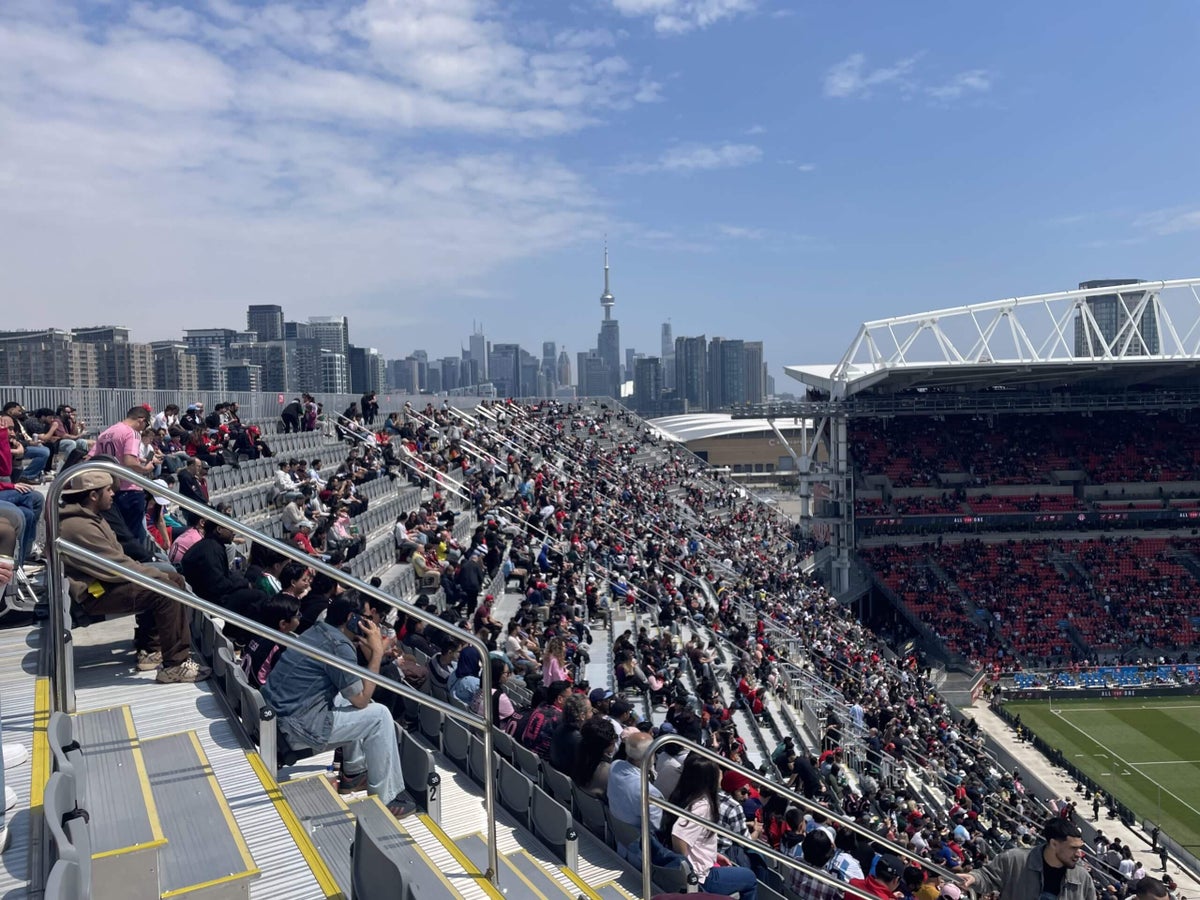
TORONTO – When Lionel Messi burst towards goal early in the first half of Saturday’s game between Toronto FC and Inter Miami, something strange happened in section 228 of BMO Field.
Hundreds of fans remained glued to their seats.
In countless other sections, every touch of the ball at the feet of the greatest player in the game’s history had fans leaping up in anticipation. But the hundreds of people in the far northwest corner of Toronto’s waterfront stadium can be forgiven for their rigid state. The wind had picked up from nearby Lake Ontario, and it felt like the seats were swaying. And so quickly darting into the air on seats supported by scaffolding is not an easy proposition for the mind to overcome.
“When it gets a bit windy, it feels unsafe because you feel it shaking,” Arleen Gill of Brampton, who sat in the last row of section 228, told The Athletic, “but otherwise when it’s not windy, it feels fine.”
Saturday was the first time that section 228 and the temporary stands installed on the north side of the World Cup stadium were being used. BMO Field’s normal capacity for MLS games is 28,180. FIFA regulates that all World Cup stadiums must have a minimum capacity of 40,000. BMO Field elected to erect temporary stands to hit FIFA standards: 10,000 in the north end and 7,000 in the south end.
Even with the 17,000 additional temporary seats installed for the World Cup, BMO Field — called Toronto Stadium for the World Cup thanks to FIFA regulations — will be the smallest of the 16 venues at the World Cup this summer. Its capacity will be 45,736.
The temporary stands make it this summer’s version of Central Stadium in Yekaterinburg, the Russian stadium that featured strange temporary stands built outside the stadium itself for the 2018 World Cup.
“The seats are moving but the stands aren’t really moving that much,” Stefano Di Matteo, who also sat in the last row of section 228, said.
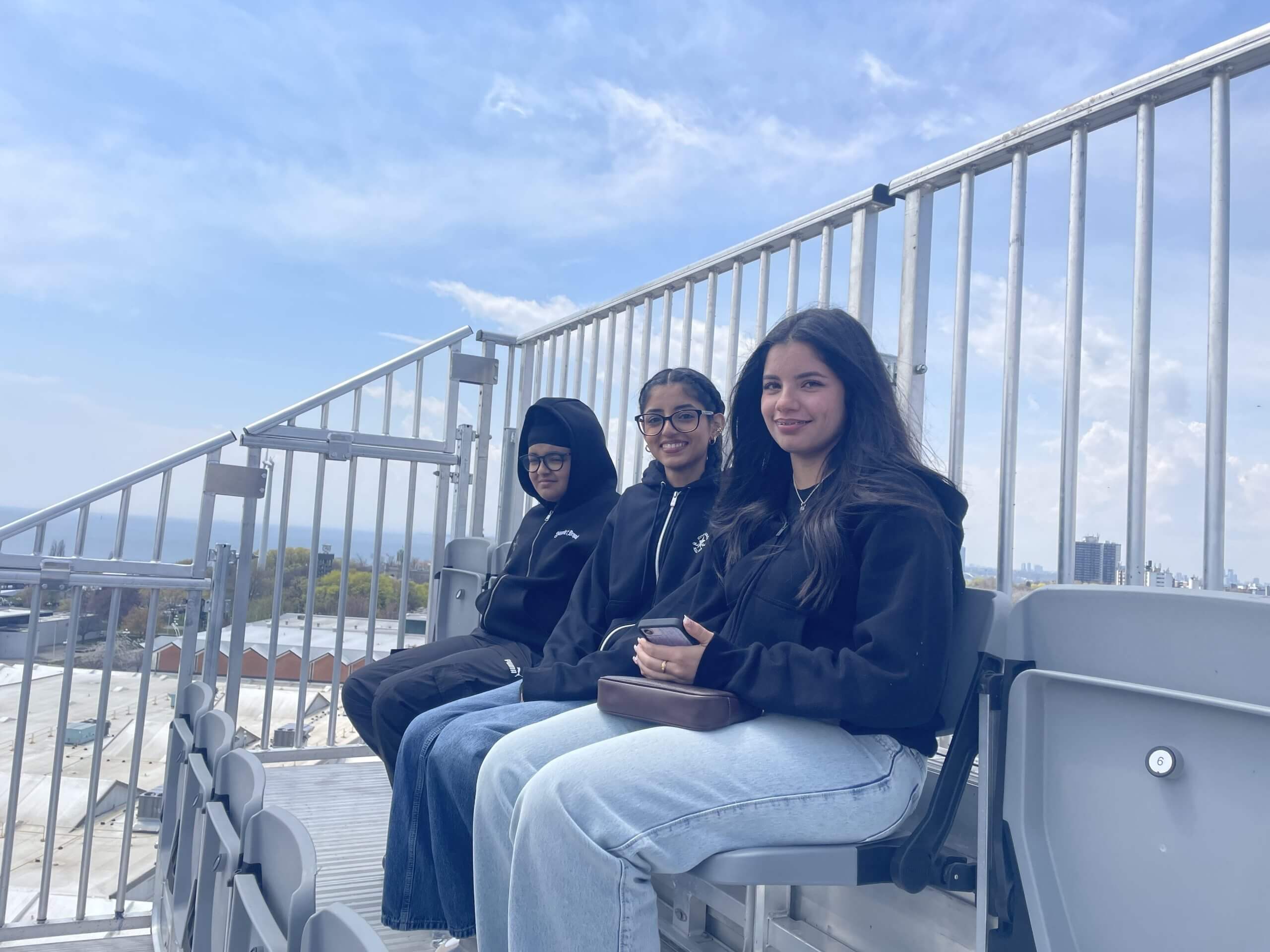
Manparas Gill, Arleen Gill and Hayzan Gill (from left to right) watch from the back row of the temporary north stand (Joshua Kloke/The Athletic)
This was the experience in Toronto as the north stand, installed for the World Cup, was put to use for the first time. How would it feel sitting in one of the 10,000 seats held up by scaffolding that looks, at least from far below, far less sturdy than the thousands of permanent seats nearby? It was worth sitting for part of the game in the north stand to experience it for myself.
In the north section, there are 13 rows in the first block of temporary seats close to field level. There are two levels of hospitality suites above those 13 rows. Then there are the 38 rows of additional seats making up the majority of the north stand.
Getting into the far end is not an easy proposition.
Fans must walk up multiple steep sets of temporary stairs. As I made my way to the top, I had to stop for people who (justifiably) needed to give their lungs a quick break as they traipsed upwards.
Once in the far reaches of the north stand, the impact of the wind became impossible to ignore. The stands felt like they were swaying with every gust, though nearby rails did not appear to move at all.
I checked in with multiple fans nearby to ensure I was not imagining the feeling of swaying. Their widened eyes were enough to answer in the affirmative.
As I stood for the American and Canadian national anthems before the game, I put my right hand on a nearby rail. At the conclusion of the anthems, I looked at my small navy blue notebook in my left hand: it had grown wet with sweat from my palm.
The strongest gusts of wind created a sensation difficult to come by at a soccer game: weightlessness. As fans sitting more centrally and lower in the north stand jumped throughout the game, it vibrated. The sensation of swaying high above the ground might be impossible to quell at the World Cup. Heavy gusts come regularly from nearby Lake Ontario and will continue through the summer.
“The stands will be perfectly safe,” Nick Eaves, COO of MLSE, which owns Toronto FC and manages BMO Field, said in March. “They’ve been designed by a company called Arena Group, which designs and constructs this type of hospitality, temporary and permanent, around the world for global sporting events. So they have a history in doing this very well.”
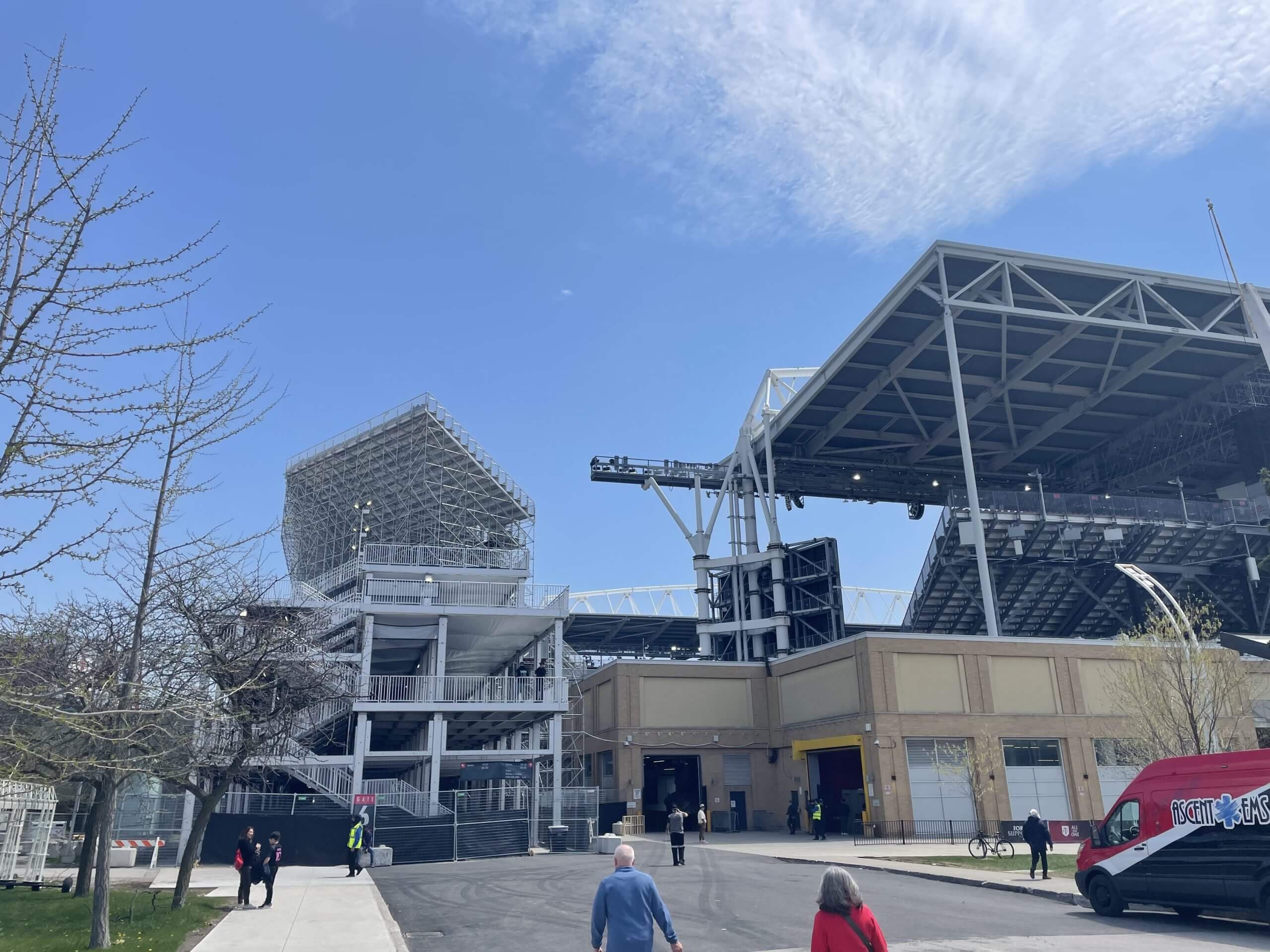
The temporary stands have been installed to increase capacity for the World Cup (Joshua Kloke/The Athletic)
Will the feelings of unease in temporary stands high above the ground quell the excitement that is supposed to go hand-in-hand with watching a World Cup game live? When Miami midfielder Rodrigo De Paul volleyed home Inter Miami’s first goal in the 44th minute, a smattering of fans did stand in appreciation. That appreciation only lasted a few quick seconds as the wind reminded them how far away from the ground they actually were.
“It’s definitely nicer to look into a closed stadium,” Miami and Canada goalkeeper Dayne St. Clair said. “And we know that playing in the stadium, there’s normally a lot of wind. So to be able to kind of block out some of that wind is definitely a nicer experience.”
Towards the end of the game, however, more fans became comfortable with their surroundings. Over a dozen brave supporters stood against the back rail of the north stand, with only a few pieces of metal separating them from a drop far down to the ground below.
Security guards were few and far between towards the top rows. As I left my seat, I had to bypass multiple people sitting in the aisles.
There is also the issue of protection on the outside edges of the stands. If you are sitting in one of the last seats on the far east or west sections, it feels too easy for an errant water bottle or phone to fall from your possession and then hundreds of feet to the ground.
Then there’s the weather: Saturday was a pristine early May day in Toronto. But rain can often come through June here. The idea of sitting in an exposed area through heavy rain is a different proposition than sitting in the wind alone. (As it turned out, shortly after the game finished, there was a heavy downpour in Toronto, which shows how quickly conditions can change in this city.)
And the view? Not bad at all. From the far corner of section 228, only a sliver of the field near the halfway line was obstructed by a newly-installed screen.
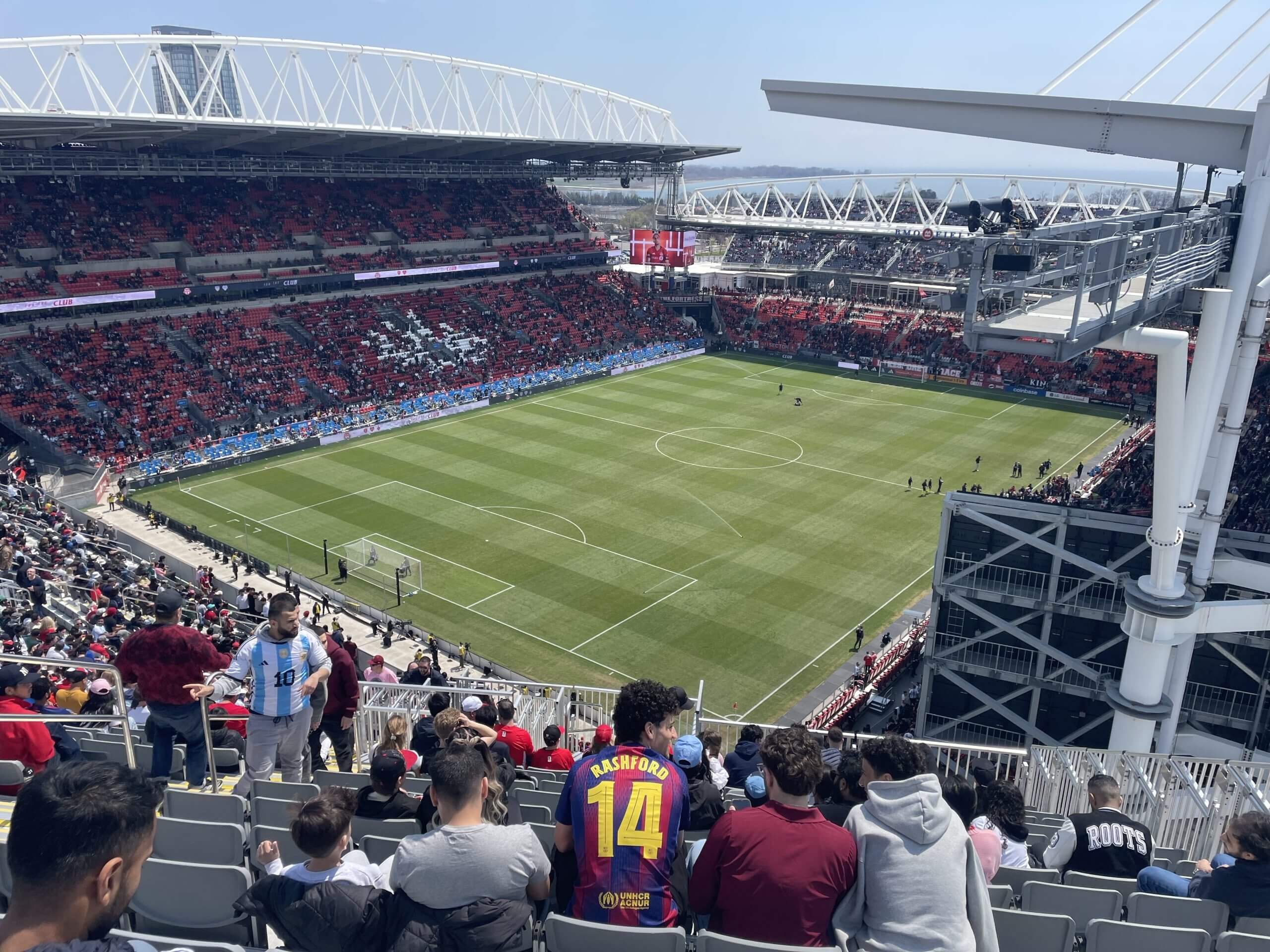
The view from the north stand (Joshua Kloke/The Athletic)
Beyond that, the sightlines were better than expected. The steep nature of the stands certainly made me feel alarmingly high in the air, but not alarmingly away from the field itself. From where I sat, it was easy to get a clear view of planes coming in for landing at Billy Bishop Airport, located on nearby Toronto Island. It was impossible to see the airport itself.
The Athletic spoke to five fans who sat in the last row of section 228, all of whom paid $130 (CAD) for their tickets.
“I feel like this is actually a way better view than I thought it was going to be, so I’m happy with it,” Olivia Diianni, also sat in the last row of section 228, said.
During the Toronto FC match, tickets on FIFA’s website remained available for purchase in the north stand for two of the six World Cup matches being played in Toronto. Toronto will host five group matches and one round-of-32 game. A single seat towards the back of the north stand for Canada’s opening game against Bosnia and Herzegovina cost $1,370 (CAD).
Seats for the match between Germany and the Ivory Coast — arguably the biggest group game in Toronto not involving Canada — were for sale for $395 (CAD). However, I experienced continued difficulty trying to actually add those tickets to my cart.
Saturday’s game was meant to be a dry run for Toronto Stadium as a World Cup venue: the announced attendance was 44,828, the most in BMO Field history. The game was against a star in Messi who brought in casual and non-Toronto FC fans.
Finally, in the 75th minute, almost every one of the 10,000 in the north stand received their sturdiest test.
Enough time had passed and those in attendance had waited long enough. Messi shoved home his ninth goal of the season and thousands leapt to their feet. It was the final nail in the coffin during a clinical 4-2 Miami win. The stands stayed in place as expected, even if heart rates may have increased and fans forgot they were standing on scaffolding.
Saturday was evidence of how much different things are going to look and feel in Toronto this summer.
Go Trains — southern Ontario’s regional train operation servicing nearby cities — into the stadium hit capacity before arriving at BMO Field. Go Transit did run extra trains in addition to its normal Saturday service, but those were announced as at capacity before the game. Saturday’s volume of people heading into downtown Toronto was compounded by the MLB’s Toronto Blue Jays playing nearby just two hours after Toronto FC, sure. However, three of the six World Cup games in Toronto also fall on the same day as Blue Jays games, meaning intense crowds should be expected through the World Cup.
And if Saturday was any indication, those crowds will gladly hang out high above the Earth in a strange new setting.
They did so for Messi and will do so again — as uneasy as the gusts of wind might make them feel — for what could be a once-in-a-lifetime World Cup.