
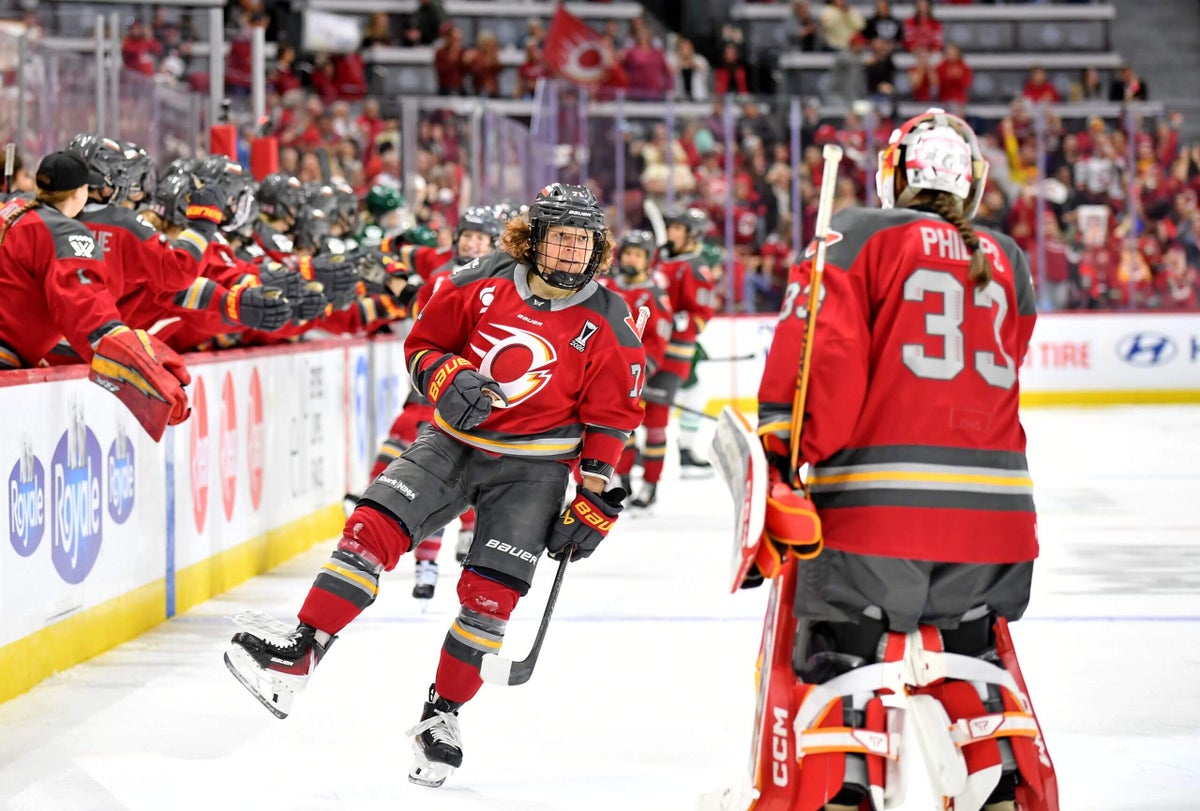
OTTAWA — The Ottawa Charge are heading to a second straight Walter Cup Final after defeating the Boston Fleet 4-3 in double overtime on Sunday night in Game 4 of the PWHL semifinals.
The game had two high-scoring, back-and-forth periods of hockey before American star goalies Gwyneth Philips (Ottawa) and Aerin Frankel (Boston) shut the door, forcing two extra frames of hockey. The second overtime, however, was short-lived, as Michela Cava needed just 72 seconds to end the game in front of 11,297 raucous fans at the Canadian Tire Centre.
The goal, Cava’s first as a member of the Charge after joining via trade from the Vancouver Goldeneyes in January, sealed the best-of-five series win 3-1 for Ottawa.
“It feels really good just to get this one for the girls,” Cava said after the game. “Everybody’s been so great (here). It’s a great team, so it’s a lot of fun.”
This was the third consecutive year that a PWHL playoff game on Mother’s Day went the distance. In 2024, Boston beat Montreal in a triple-overtime thriller that featured a 56-save performance by Frankel. Last year, Montreal and Ottawa set a record for the longest game in PWHL history with a marathon, spanning over 135 minutes and four overtime periods.
“We really like to extend our play on Mother’s Day,” said Ottawa coach Carla MacLeod after the game, who also called the win “tremendous.”
“We knew we were in for a good hard-fought battle, and (I’m) really proud of our group that we just continue to push and believe,” MacLeod said. “It’s pretty darn exciting when you can win a series and find yourself back in the Walter Cup Final.”
The Charge opened the scoring nearly seven minutes into the first period after a big Fanuza Kadirova shot on the power play deflected off rookie Sarah Wozniewicz to beat Frankel. Rebecca Leslie doubled the lead in the second period, but the Fleet responded with three goals in under two minutes in a dramatic change of momentum.
Ottawa defender Brooke Hobson tied the game 3-3 before the end of the five-goal second frame to set up the late-game goalie battle. Boston heavily outshot Ottawa again on Sunday with shots sitting at 37-22 at the end of regulation. By the end of the night, reigning playoff MVP Gwyneth Philips made 43 saves on 46 shots for her third straight win requiring at least 30 saves.
At the other end, Frankel made 29 saves on 33 shots and allowed four goals against for the first time in her playoff career.
The loss marks a disappointing early end for the Boston Fleet after a stellar 16-win regular season, which is tied with the top-seeded Montreal Victoire for the most wins ever in a single PWHL season.
“When you’re left with this sort of empty feeling that we have right now, our players are competitive, of course we wanted more,” said Boston coach Kris Sparre after the game. “I thought we were built for more, but we threw as much as we could at Ottawa over the last four games. We played physical, we blocked shots, we competed at a high level. I’m so proud of this group.”
The Charge now await the winner of the Montreal-Minnesota series, which is tied 2-2 heading into a deciding Game 5 on Monday night.
Kadirova comes through again
After losing over 30 goals from the lineup thanks to expansion and free-agency turnover, Charge general manager Mike Hirshfeld decided to take a flier on a small but skilled forward out of the Russian women’s hockey league.
Fanuza Kadirova was first put on Hirshfeld’s radar by advisor Mel Davidson, who coached Team Canada to gold medals at the 2006 and 2010 Olympics. Kadirova was highly productive in Russia but hadn’t played against top North American competition since the 2022 Olympics due to Russia’s ban from IIHF competition. And at 5-foot-4, there was a question of how her game might translate to the PWHL.
Still, Hirshfeld wanted to inject more skill back onto his team, and by the sixth round of the 2025 PWHL Draft, he felt the selection was worth the risk.
With a signature hairstyle (sprigs of hair poking out the sides of her helmet), excellent shot and skating ability, Kadirova has been an undisputed hit in Ottawa.
“I think (her) story is such a unique story,” said MacLeod. “She was flying under the radar a little bit at the draft time last year. And for her to be able to come in and settle in, you don’t have the language, you’ve got fast-talking coaches — she just has really embraced the whole experience and this whole opportunity.”
After taking some time to adjust to North America, Kadirova finished the season with 10 goals, third on the team, and scored twice in Ottawa’s back-to-back wins against Boston heading into Sunday’s game.
In the first period, it looked like Kadirova scored her third goal in as many games on the power play, but the marker was eventually credited to rookie forward Wozniewicz. Still, with two assists in the contest, Kadirova now has sole possession of the league lead in points (5) in the first round of the PWHL playoffs.
“Early on in the season, she was frustrated because she wasn’t scoring goals,” MacLeod said. “But this is why, because she knows she can. What we’re seeing is what she knows she can bring to our group, and she’s an elite-level player —with really good hair.”
Jenner and Leslie finally solve Frankel
In the regular season, no pair of forwards combined for more goals than Ottawa captain Brianne Jenner and her linemate Rebecca Leslie (16). In Ottawa’s first three games of the postseason, however, Jenner and Leslie had yet to connect; Jenner was held off the scoresheet entirely.
Before Sunday’s game, the Charge had struggled to generate a ton of offense in general against a stifling Boston defense. The Jenner-Leslie line specifically had spent a lot of time matched up against Megan Keller and Haley Winn, two of the very best defenders in women’s hockey who each play close to 30 minutes per night. (Keller played a game-high 43:34 on Sunday.)
“They’re a hard team to play against,” Jenner said. “They were all series.”
But that scoreless streak finally came to an end on Sunday. Nearly four minutes into the second period, Jenner did well to corral a rebound off Frankel’s pad and, instead of forcing a tough angle shot, made a cross-crease pass to Leslie, who crashed the net and got inside position on Keller to deflect the puck into an empty net. The goal was reviewed for a kicking motion, but was quickly deemed legal.
“Our D were doing a great job getting pucks through from the blue line, being ready to shoot,” Jenner said. “With the style that Frankel plays, sometimes you have to be patient and try to find the back side. So credit to our goalie coach Pierre (Groulx), for giving us that information, preparing us. And we just try to capitalize when we can.”
Boston’s three-goal outburst
It took the Fleet just one minute and 33 seconds to erase Ottawa’s 2-0 lead in the second period and take their first lead in a game this series since Game 1 — which was (somehow) 10 days ago.
First, just over five minutes into the second period, Shay Maloney scored her first career playoff goal, beating Philips with plenty of traffic at the net front. On the next shift, Gabbie Hughes was called for interference, giving a dormant Boston power play a chance to come alive.
And it did, courtesy of a point shot from Megan Keller that bobbled past Philips as she was moving across her crease. It was Boston’s first power-play goal of the series after failing to score on 12 previous attempts.
“We have elite players on our power play,” Sparre said on Friday. “We just have to deliver it to the net a little bit more and create that chaos.”
On Keller’s goal, Jessie Eldridge was battling near the blue paint, while Abby Newhook was parked right in front of Philips, providing the exact kind of chaos Sparre was looking for. Fifty-two seconds later, Jill Saulnier placed a perfect shot pass off Philips’ pad to a driving Sophie Shirley. It was the first time Boston got more than two pucks by Philips all series, and just the second time any team has scored more than two goals in Philips’ incredible playoff career.
In the end, though, it wasn’t enough to extend their season.
“I’m proud of our group for battling back, finding a way to have a lead,” said Sparre. “We just couldn’t find it in overtime. I thought we had our chances and opportunities, but couldn’t put it behind (Philips).”
Missed opportunities on the power play
After Keller’s massive power-play goal in the second period, the Fleet had three more chances to put the game away with a player advantage, including one in the late stages of the first overtime period. Obviously, they failed to do so, finishing the first round 1-for-16 on the power play for an abysmal 6.3 percent.
In the regular season, their power play clicked along at a middling 14 percent, which is frankly shocking given the star power on the first unit: Keller, Alina Müller, Winn, Eldridge and Newhook.
In this series, we can chalk some of Boston’s struggles up to Philips’ play. But Ottawa’s penalty kill is also peaking at the right time. Ahead of Sunday, the Charge had gone five straight games dating to the regular season without allowing a power-play goal against in 16 times short-handed.
Late in the game, Keller had several more opportunities from the point, but her shots hit a skate, or a stick, or an Ottawa player who dived into the shot lane.
“We’re starting to understand better what we’re trying to do, and we’re more connected as a unit of five when they’re out there, including Gwyn,” said MacLeod. “There’s maybe too many reps at it, but we’re getting the reps to build our own confidence and believe in what we’re trying to accomplish.”
Playoff Cava returns
Three months ago, the Charge made a massive six-player trade with the Vancouver Goldeneyes. They got useful depth on the blue line in Emma Greco and a solid young forward in Brooke McQuigge who had a successful rookie year en route to a Walter Cup in Minnesota. But make no mistake, the centerpiece of the deal was Michela Cava.
Cava is known as a big-time playoff performer who won back-to-back championships in Minnesota. Before joining the PWHL, she won an Isobel Cup with the now-defunct Premier Hockey Federation’s Toronto Six and overseas titles in Russia and Sweden.
Of course, after 20 scoreless games with the Charge, Cava found the back of the net in the biggest moment of Ottawa’s playoff push.
“She’s a competitor,” said MacLeod. “When you watch her out there, she’s got a knack for the net, she’s got a poise with the puck. It was nice to see her be rewarded here.”
With the Frost, Cava finished second in playoff scoring in 2024 and had 13 points in 18 career postseason games. With three points in her last two games with the Charge, Cava is heating up at the right time. As usual.