
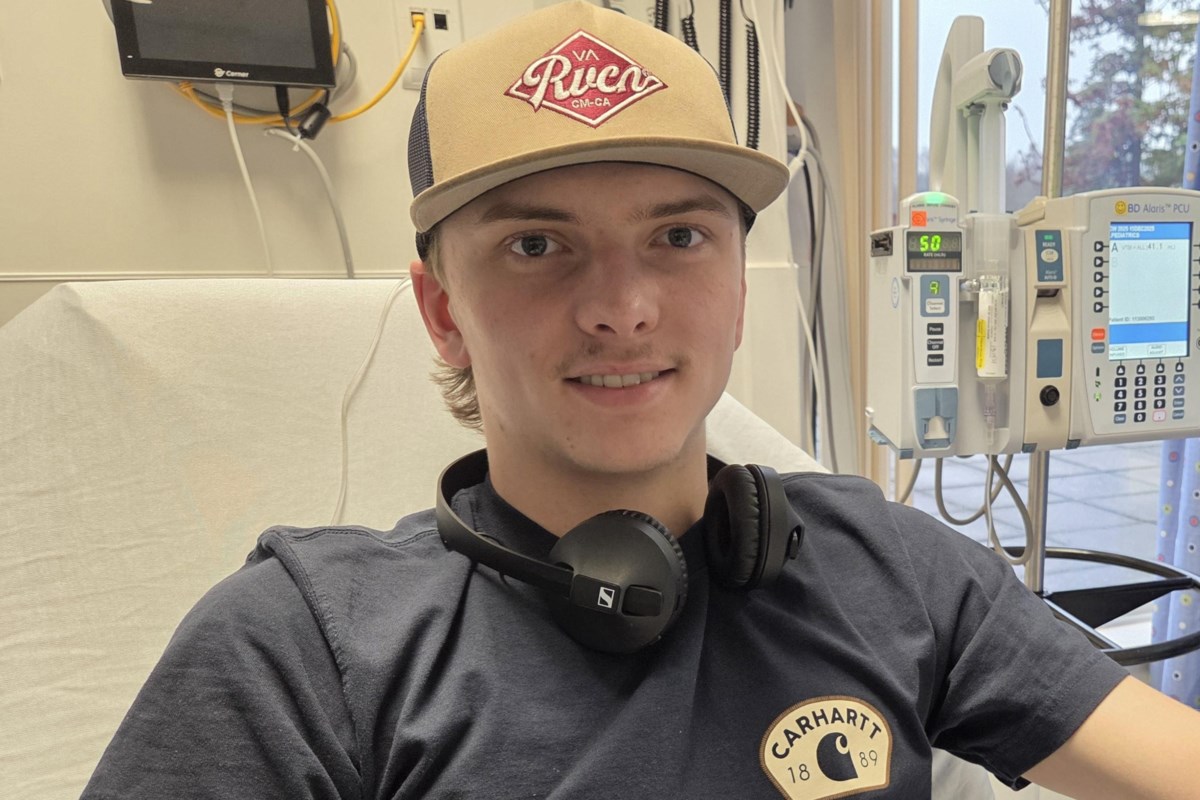
Jack Thiessen is one of two youths in Canada taking the newly approved medication
A newly approved Health Canada diabetes medication that has been shown to delay the clinical onset of Type 1 diabetes has been put through its first round of treatments with two BC youths, one of whom lives in Prince George.
The medication, Teplizumab, has been shown to target the immune system in patients with early-stage Type 1 diabetes, delaying the process that destroys insulin-producing cells.
Although this is not a cure, it can allow for those at risk of developing Type 1 diabetes to prepare and postpone the need for insulin injections, reducing the likelihood of severe complications.
The medication has not been publicly funded yet and is currently restricted to patients identified as part of a research-clinical collaboration.
Teplizumab was administered daily to two patients through intravenous (IV) infusions at BC Children’s over two weeks and was carefully monitored by a team of physicians and clinical staff.
This was the first time in Canada that this medication could be administered continuously in a child-friendly hospital setting.
Dr. Dina Panagiotopoulos, pediatric endocrinologist at BC Children’s Hospital, identified the two BC youths who would first receive this medication through a research screening program she led.
She spoke to The Citizen about what makes this new medication unique.
“It’s the only drug right now that’s approved by Health Canada to delay the progression of Stage 2 Type 1 diabetes to Stage 3 Type 1 diabetes,” she said. “That’s what makes it innovative right now, and we’re excited about the fact that we were able to treat the first two kids in Canada with this drug.”
Panagiotopoulos also noted that this medication is especially important to young people as Type 1 diabetes can present with a life-threatening condition called diabetic ketoacidosis (DKA) in 40-60 per cent of pediatric cases.
She shared what the trial stage of the medication looked like and how they knew the medication would be effective.
“Studies that were done on Teplizumab were where they took a group of people who had Stage 2 and gave them the drug for 14 consecutive days, and then they followed them over time and looked at how many of them get clinical Stage 3 Type 1 diabetes,” she explained. “What that showed is that in the people who got the drug versus the people who got a placebo, they were able to delay the progression to this Stage 3 Type 1 diabetes for an average of a median of two years,” she said.
A delay in the progression of diabetes from Stage 2 to Stage 1 can make all the difference in the world for someone suffering, as Panagiotopoulos explains.
“You can never forget about having Type 1 diabetes, not even for one day. You have to constantly be vigilant, and giving those insulin injections can lead to low blood sugars, and those low blood sugars can be quite severe, where kids can become confused or unconscious,” she said. “Delaying that progression means that the child can have a more normal life for a longer period of time, and basically lead to less stress on everyone’s part.”
For one Prince George family, the Thiessens, diabetes has become a part of their everyday lives, with relatives on both sides dealing with the effects and treatments of the disease.
Jack Thiessen, 17, has been part of a study that closely monitored the development of the stage of his diabetes and was chosen for Teplizumab treatments.
In the summer of 2025, he entered Stage 2 and then became at risk of developing Stage 1 of the disease. Then Teplizumab was approved by Health Canada and he was chosen as one of the first youths in Canada to receive the treatment.
“My brother and my dad both have grown up with it,” Thiessen said. “My dad was diagnosed at 12, and my brother was diagnosed at 13 months. It changes your life. It’s an everyday, all-day thing that you have to monitor and be aware of what you eat and do the correct amount of insulin and exercise. You’ve got to be really careful and be aware of what’s going on.”
He described what it felt like to be one of two people receiving first-in-Canada treatments.
“It is very intimidating,” he said. “I didn’t really know what to expect. I was obviously very intrigued because I knew we’d been monitoring this for years. We were kind of at the point where I’d realized that it was almost inevitable that I was going to develop Type 1. Once we heard about this, we did lots and lots of research, and then I was super-excited.”
Thiessen, along with his mother, Taryn, were sent to BC Children’s Hospital in Vancouver to undergo the treatment. They stayed at Ronald McDonald House while he underwent prep, blood work and eventually had the treatment.
He described the process as non-intrusive and detailed what the two weeks of treatment looked like.
“Every day for 14 days we would show up at the hospital at 8 a.m.,” he said. “And they would hook me up to the IV machine and give me some pre-meds, pre-medications, just in case I was allergic and just in case some of the side effects hit me. Then we would sit there while it did medication drift through the IV machine.”
Currently, it is too early in Thiessen’s treatment to determine if the medication is taking effect or not. However, he and his family will continue to monitor his condition.
“I’m looking forward to seeing if it worked and looking further into the future of this treatment and seeing what the other possibilities are,” he said. “They were talking about just the possibilities, maybe you can take it again and just keep delaying it. But they just, they don’t know right now.”
Research into the medication and its effects is ongoing, with Panagiotopoulos putting out the call for more people to participate in her study.
“If you’re a first-degree relative and you’re between the ages of 2 and 45, of someone with Type 1 diabetes, or a second-degree relative of someone with Type 1 diabetes and you’re between the ages of two and 20, you’re eligible to participate in my study,” she said.
However, there are a few things to keep in mind before you apply.
“There’s a bit of a workup and you need to have a preparatory time before you’re eligible,” she said. “I think the other provinces are also gearing up to identify and treat people. Right now, the drug isn’t approved for use under the age of eight.”
If you screen positive with two or more auto-antibodies, Panagiotopoulos would then arrange more detailed glucose testing. if you meet those criteria, then Teplizumab or a variety of other options can be offered.
To find out more about the study or to sign up to participate, visit www.trialnet.org/