
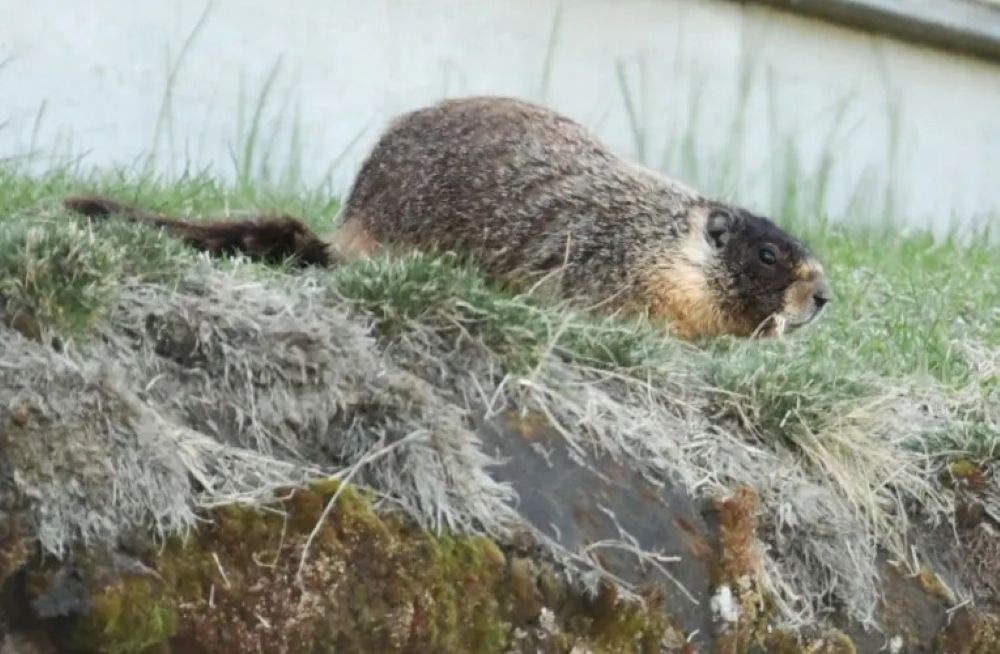
Yellow-bellied marmots don’t usually come this far north so UNBC prof wonders how it got here.
Being a social creature, the recently discovered yellow-bellied marmot living at the university’s campus in Prince George might be lonely.
Usually the large, social, ground squirrel only comes as far north as Williams Lake.
As with most things nowadays the sighting was announced online.
“The iNaturalist website is a site where people can report sightings of all kinds of life forms – all plants and animals – and that’s how we first discovered that this little critter was living on campus,” Jamie Gorrell, UNBC associate professor, ecosystem science and management, said.
“Somebody had actually seen it and posted a photo of it on that website.”
Yellow-bellied marmots are extremely social, he added.
“They are not meant to live solo and this one appears to be solo,” Gorrell said.
“Yellow-bellies can be in large, multi-generational families, up to 40 individuals together, so this is kind of the opposite of that. So this little guy – we don’t know if it’s male or female – this little dude showed up and appears to be living on the hillside next to the building by themselves.”
There’s nothing to be done to help the marmot other than to leave him in peace so Gorrell put up some yellow tape to caution people not to approach.
“There’s no risk of him damaging anything and we’re just happy to give him space and leave him alone,” Gorrell said.
The yellow-bellied marmot is a herbivore so he just eats grass and flowers, Gorrell added.
“So he’s on this grassy hill and we’ve noticed there are no dandy lions in front of the burrow but there are some further down the hill,” Gorrell said.
“So we’re assuming he’s weeding the garden.”
Typically yellow-bellied marmots hibernate for seven or eight months of the year, he added.
“So basically they come up in May, they usually mate and then they put on fat – they will double or triple their body size and then they’ll go back into hibernation in September and sleep all winter,” Gorrell said.
As discussions have come up about the little beastie someone came forward with a photo from last August where they had spotted the marmot.
“So that means he survived the winter here,” Gorrell said.
“So he must have hibernated in that spot and people who had seen him didn’t recognize the significance of the sighting and what’s really neat and scary is that it’s so much further north than normal.”
Which begs the question.
“How did it get here and how did it survive here?” Gorrell asked.
“So, it’s cute but at the same time it’s a concern in the sense that it is an example of how the climate is warming – that species are moving further north.”
The marmot spotted at the Prince George campus has been named Dutni (duht-nee), which is the Dakelh word for marmot.
Stay tuned for the webcam that will soon be set up so people can watch the marmot in action at his home on university hill.
“We welcome people to come up and see it but please maintain a respectful distance,” Gorrell said.
“We don’t want to spook it or have it move away because it’s getting disturbed too much.”
For online updates in the coming days check out https://www.unbc.ca/ecosystem-science-and-management/do-you-see-marmot