
There have been a few twists and turns as the Vancouver Canucks have conducted their search for the 13th general manager in franchise history.
The club began by casting a wide net, with 15-20 candidates being interviewed. There was the Pierre Dorion thing.
After Vancouver didn’t win either of the draft lottery draws, Canucks president Jim Rutherford — who has been leading this search, alongside a panel that includes multiple representatives from Canucks ownership and business operations leadership — announced that he would be leaving his post this summer, and continuing in an advisory role with the organization.
Now we’re really down to brass tacks. A cone of silence has descended on Rogers Arena. The information flow has mostly halted, with the Canucks intent on announcing the news themselves.
All that The Athletic was able to confirm about the state of the search on Monday evening is that an announcement is expected sometime this week, and that officially, no decision on a new general manager has been made yet.
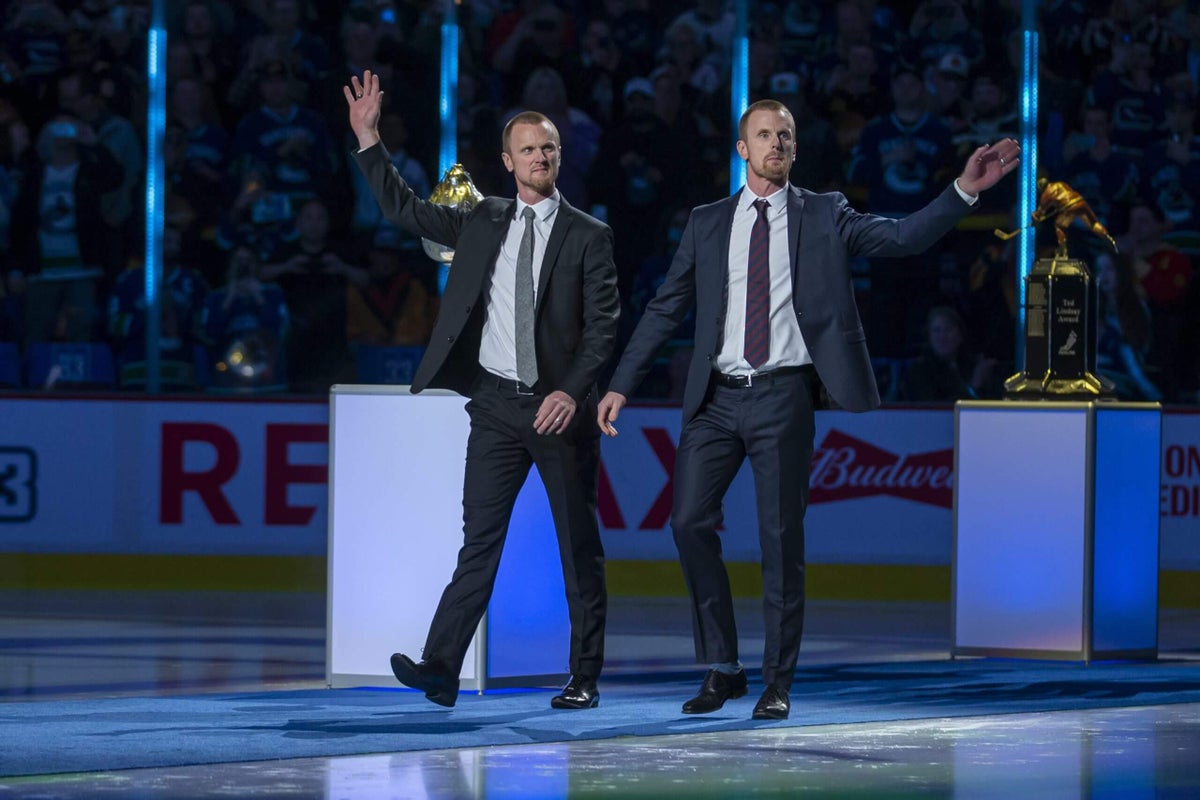
The club is down to two final contenders for general manager: current Canucks assistant general manager Ryan Johnson and Boston Bruins assistant general manager Evan Gold. Meanwhile, over the weekend, as first reported by Elliotte Friedman and Irfaan Gaffar, and confirmed by a source familiar with the state of internal discussions and granted anonymity to discuss the situation freely, Henrik and Daniel Sedin agreed to take on a larger role within Vancouver’s hockey operations department.
The role or co-role, as it were, won’t be a primary decision-making role, Friedman reports. A source told The Athletic that as of Monday afternoon, the precise structure that the Canucks are attempting to build, and the extent of the Sedin twins’ elevation within it, was still being discussed and negotiated.
It seems that this could still be a Sedin co-presidency, in a capacity like that which Keith Jones fulfills in Philadelphia. Or it could be in something more similar to the advisory role that Mats Sundin has recently taken on with the Toronto Maple Leafs.
As we near the final turn of this Canucks general manager search, there are parts of this process that have seemed to mark a new era, or at least a departure from the organization’s traditional method of doing business over the past couple of decades.
That the club conducted such a thorough search in the first place, in fact, is a significant and telling break with the last 20 years of franchise history.
That the Canucks, who have generally been addicted to landing the big name whenever possible, have conducted this process and appeared to settle on a pair of young-up-and-coming assistant general managers in Gold and Johnson as the finalists is refreshingly business-like and unsexy.
And certainly that Canucks ownership is operating with an apparent counterweight to chairman Francesco Aquilini, with his nephew Dax Aquilini sitting in on video interviews, as confirmed by multiple league sources, and appearing to take an active role in the process, represents a significant organizational sea-change.
There are other aspects of this search, however, that seem familiar. The emergence of Dorion as a serious contender for the top job last week, and the organization immediately seeming to fold in the face of significant public outcry and criticism, wasn’t exactly confidence-inspiring.
Likewise, the club ultimately turning, in a moment of waning public confidence, to a pair of franchise legends is precisely the sort of play that we’ve seen the Canucks run on multiple occasions.
In 2014, for example, when fans called for Mike Gillis, objectively the most successful general manager in franchise history, to be fired one fateful night at Rogers Arena, the Canucks promptly turned to Trevor Linden as his replacement.
In 2021, after finishing last in the all-Canadian division, the organization brought in the Sedins in an advisory capacity, a token gesture that served to distract from the catastrophic error of having returned Jim Benning and Travis Green for another season.
Now, it seems, the Canucks are preparing to go back to that well. In some manner, the Canucks plan to elevate the twins within the organizational hierarchy and empower them to a far greater degree than they have been over the past several seasons, during which they’ve served as development coaches working closely with players in both Abbotsford and Vancouver.
Why the Sedins would be eager to take on this challenge, this greater level of responsibility and legacy-threatening scrutiny that will come attached to it, at this low point in franchise history, is beyond me. They certainly have a deep sense of pride in the Canucks and this community; it may be that simple.
Certainly, Henrik and Daniel are people with real substance. Hardworking, honourable and bright, they’re the sort of people and leaders whose enhanced presence can’t help but benefit whatever enterprise they’re associated with.
The Canucks, however, have had a habit of complicating the relationship of fans with various franchise legends.
Very few people have joined this organization and left with their reputation intact over the past two decades, and those who have pulled it off — like former head coach Rick Tocchet — had the good sense to elect to walk away.
We’ll see precisely what this looks like when it all shakes out this week, and who ultimately emerges as Vancouver’s top hockey operations decision-maker.
At a moment of acute franchise need, however, the Canucks are asking Henrik and Daniel to hop over the boards. Now, Vancouver needs them to put together one of those signature, persistent 90-second cycle shifts and singlehandedly alter the momentum of this listing franchise, but this time from the executive suite.
Who is Evan Gold?
I’ve been asking around to get a better sense of who exactly Gold is, soliciting opinions and character references from eight working executives, agents and hockey operations types from around the NHL over the past few days.
The longtime Bruins AGM has spent the past two decades working his way up the hockey operations ladder, first with the Washington Capitals, and then for the past decade, with the Bruins. His credentials are impressive — he went to University of Toronto law school, and also has an MBA — and he’s worn a variety of hats for the Bruins, working his way up from VP, legal affairs to his current role as assistant general manager and the general manager of AHL Providence.
Gold is highly regarded for both his intelligence and responsiveness around the league. He’s widely thought of as a sharp guy and reasonably well-liked.
One Eastern Conference executive told The Athletic that they thought so highly of Gold that they’d welcome him moving into the other conference in a top job out West. That’s about as complimentary as it gets.
Gold’s hockey operations background is cap management, but in the assessment of some of his peers, he stands out from the customary capologist-type because of how hands-on he’s opted to get in contributing to running various other aspects of the Bruins organization. That’s a similar profile to the likes of Bill Zito and Julien BriseBois.
Gold really built out and modernized the analytics department within Bruins hockey operations, and is said to have had a significant influence on Boston general manager Don Sweeney’s approach to utilizing data in hockey decision-making. He’s also known to be a relentless hard worker, and is often seen at AHL rinks both in his capacity as Providence’s general manager and as a scout getting in live viewings.
Of the constructive feedback that The Athletic received in asking about Gold, several of our respondents noted that the Bruins’ AHL development track record during Gold’s tenure is lacking. Most of Boston’s best young players have done the bulk of their development in the NHL, while top prospects like Fabian Lysell and Matt Poitras have stagnated.
Others have pointed out that while Gold interviews well and has impressed teams that have considered him for GM positions over the years, his experience dealing with the sort of media scrutiny that exists in a cauldron like the Vancouver market is limited. Handling an intense public-facing role will likely be an adjustment if Gold is the candidate the Canucks select to be their next general manager.
Lastly, it’s probably worth noting that while the Bruins had an astonishing season and made a series of impressive, difficult decisions during a one-year tank in 2025, the Boston front office isn’t generally viewed as especially creative or cutting edge, although it’s difficult to really parcel out credit or blame for that to Gold personally.
Overall, Gold’s resume and overall profile are impressive.
Like with Johnson, he seems like the sort of sharp, modern executive worth betting on. And it’s really only a matter of time before he gets a chance to sit in the GM’s chair somewhere, whether that’s in Vancouver or elsewhere.