
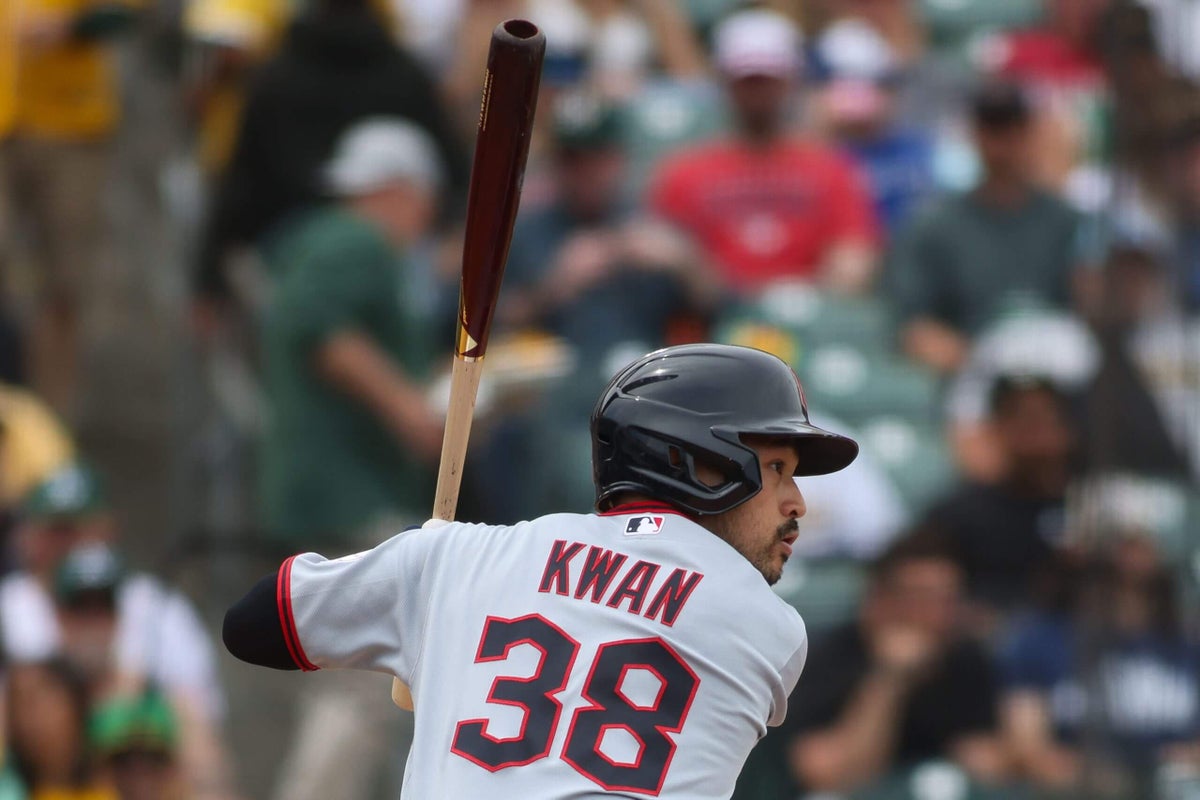
CLEVELAND — When he steps into the batter’s box and his face pops up on the scoreboard beside a bunch of statistics, Steven Kwan never peeks at those numbers.
“Ever,” Kwan said. “(Whether) they’re good or bad.”
The numbers are more striking this season, and not just because they’re posted all over the ballpark in 144-point font four or five times each game. More than a quarter of the way into the season, Kwan has yet to find a rhythm at the plate. It’s been an uncharacteristic stretch for a two-time All-Star who has served as Cleveland’s leadoff hitter since 2022.
This season, Kwan has logged a .206/.311/.265 line.
“Obviously, the start’s pretty disappointing, just from an overall production standpoint,” he said.
In his first at-bat Tuesday, Kwan worked the count 2-1 against Angels starter Walbert Ureña before he socked a low-and-away changeup to left field for a single. It was vintage Kwan, depositing a tough pitch into a vacant plot of outfield grass. It was precisely the type of counter the coaching staff has been seeking, an answer to the growing trend of pitchers peppering the outside corner when facing him.
The single snapped Kwan’s 0-for-12 funk.
“This is the time now to really believe in ‘No highs, no lows, stay right in the middle,’” he said. “Before, I’ve had the comfort of having some good numbers and then when a dry spell happens, ‘OK, well I still have these numbers to fall back on.’ Obviously, I don’t have that luxury this time, but I just have to frame it as a good, new challenge.”
Steven Kwan, through the years
YearAVGOBPSLG
2022
.298
.373
.400
2023
.268
.340
.370
2024
.292
.368
.425
2025
.272
.330
.374
2026
.206
.311
.265
What the numbers say
In their two encounters, Ureña tossed six of seven pitches to the outer part of the plate. At this point, the approach is unsurprising to Kwan.
“He’s looking to try to figure out ways to get them to throw him back to his hot zones,” said Cleveland hitting coach Grant Fink.
Those hot zones are on the inner half of the plate. Pitchers know that. Pitchers also know Kwan almost never swings at the first pitch.
League-average first-pitch swing percentage: 30.1 percent
Kwan’s first-pitch swing percentage: 9.6 percent
One strategic tweak that could pay dividends, right?
“Aggression early in the count, first pitch,” said bench coach Tony Arnerich.
Otherwise, Kwan risks an automatic 0-1 deficit every trip to the plate.
“He’s just getting behind early,” Fink said, “so we’ve had a lot of conversations about being a little more aggressive, ready to hit earlier on.”
It’s not just the first pitch.
Kwan is swinging at 36.1 percent of all pitches, the lowest mark of his career and more than 11 percent lower than the league average. He’s swinging at only 51.2 percent of what Statcast deems “meatballs,” pitches thrown down the middle, 25 percentage points lower than the league-average swing rate on those pitches. Kwan said that the last few weeks in particular, he has seen mistake pitches and has “not capitalized on them.”
Part of the issue is timing, and Kwan said he and the hitting coaches are “trying to pinpoint” how to correct it.
Granted, he’s not seeing a ton of meatballs. He’s seeing plenty of pitches away, especially after pitchers flip in a first-pitch strike.
“I feel like every at-bat, I’m going up there with two strikes,” Kwan said, “and I have to fight, defend.”
And that, the Guardians contend, has spurred dramatic decreases in some of his under-the-hood numbers. Kwan isn’t a metrics darling to begin with, at least when it comes to batted ball data, but he’s experiencing marked decreases in exit velocity, hard-hit rate and bat speed. It’s not that his metrics are low; it’s that they’re so much lower than usual for him.
Exit velocityHard-hit rate
2022
85.10 mph
20.80%
2023
86.0 mph
18.80%
2024
86.30 mph
23.70%
2025
86.20 mph
19.30%
2026
82.50 mph
10.50%
“Two strikes, the bat speed’s always going to fall,” Kwan said.
More two-strike counts equal more defensive swings, more attempts to keep the at-bat going, rather than uncorking an aggressive swing that aims to inflict damage. His average exit velocity against two-strike pitches is 81.4 mph, another tick below his overall mark. He’s still drawing walks at a healthy rate, and he’s adept at avoiding strikeouts.
He’s one of 15 qualified hitters with more walks than strikeouts.
He makes an almost unparalleled amount of contact. But not all contact is productive contact.
“He’s trying to find that right now, so guys have to start coming back in and not just living away for three pitches in a row,” Fink said. “And being a little more aggressive so he doesn’t allow them to get to 0-2.”
The past, present and future
Until the Guardians caught wind that Emmanuel Clase was on non-disciplinary paid leave for his alleged involvement in a pitch-rigging scheme, they were fielding offers for their All-Star closer. When Clase became unavailable, as one team source described it, rival clubs smelled blood in the water, figuring the Guardians had no choice but to ship out Kwan.
One rival executive, just before the trade deadline, referred to Kwan as “immensely valuable.” José Ramírez teased his teammate that it was his “last day” on the team. (In reality, Ramírez and the rest of the clubhouse desperately wanted Kwan to stay.) Kwan’s agent even flew to Cleveland so they could talk through scenarios leading up to the 6 p.m. ET deadline.
The San Diego Padres, Houston Astros, Toronto Blue Jays, Philadelphia Phillies, Los Angeles Dodgers and Cincinnati Reds all checked in. A few of those teams scoffed at Cleveland’s price. The Padres opted to deal their prime prospect chip for closer Mason Miller. The Phillies couldn’t align on a package. The Dodgers instead made upgrades on the margins.
Nine minutes before the trade deadline, team president Chris Antonetti called Kwan and told him he could exhale. They weren’t trading him.
In the clubhouse, there was a collective sigh of relief. The Guardians had weathered a 10-game skid and the shocking departures of Clase and Luis Ortiz. They were hanging around the periphery of the Wild Card race. Ultimately, they stormed back to win the AL Central. Kwan had a rough August (.214 average, .514 OPS) and a so-so September (.279 average, .699 OPS).
This year, he’s had a brutal April and a bad start to May.
“It’s funny, at times I think, ‘Oh, fifth year, I’ve experienced everything,’” Kwan said. “And then something new comes up. So it’s something I can learn from.”
He’s under team control through next season. It’s in both parties’ best interest for him to recapture his form, and the Guardians are confident there will be a course correction. There’s time for this seven-week stretch to be a mere footnote.
The Guardians aren’t backing away from him in the leadoff spot.
“Kwan’s been a really good player for a good amount of time,” Arnerich said. “We don’t doubt that he’s going to come out of it. He’s working. He’s doing the right things. He’s having good at-bats. You have to trust guys.”