
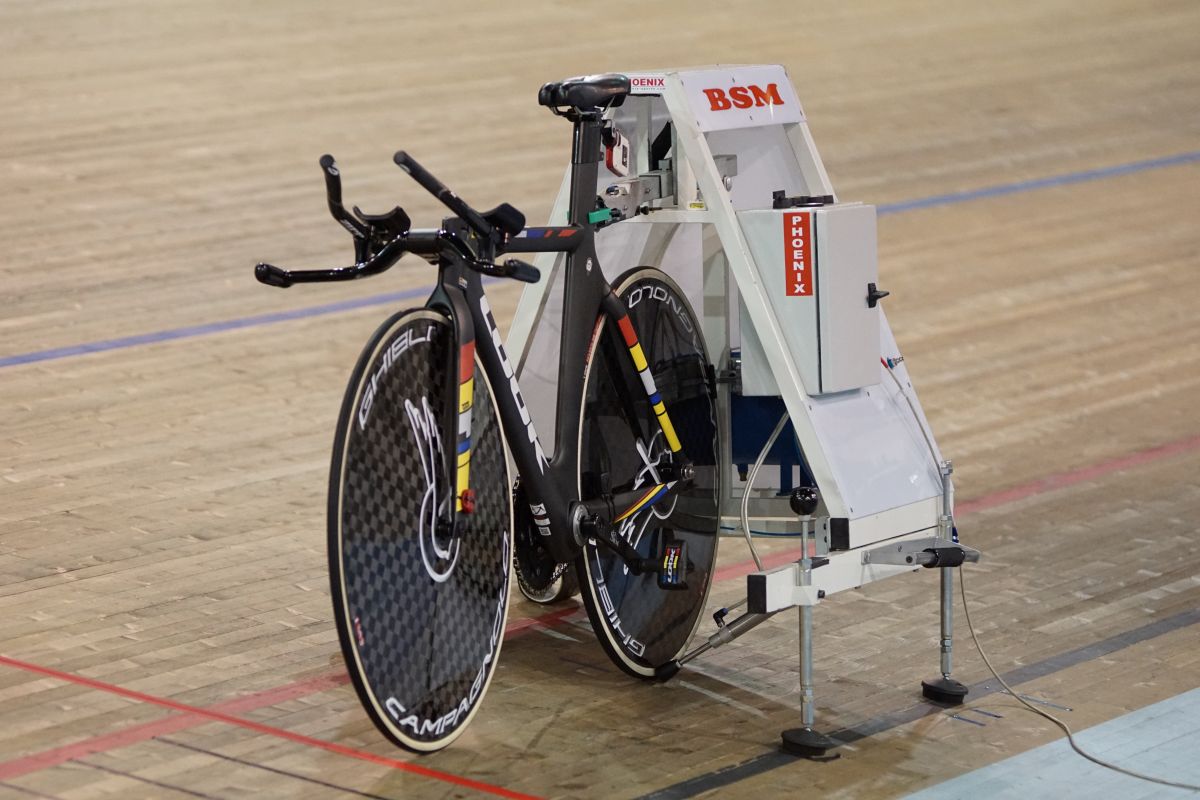
On May 6, the news came out Cycling Canada would not be sending a team pursuit squad to the world championships in Shanghai in October.
The women who are currently in the TP program were understandably upset given the huge focus and sacrifices they have made to be elite athletes.
Many comments on social media reminded readers that the Canadian women’s team pursuit program has two medals to its credit.
In fact, looking at Canada’s medal tally since the 1996 Atlanta Games, the majority have been won by women. In 1996, Curt Harnett and Brian Walton took bronze and silver, respectively.
In the years that followed, all medals went to Canadian women. In 2004, Lori-Ann Muenzer won the gold. The women’s TP squads took bronzes in 2012 and 2016. And then in 2020 sprinters Lauriane Genest got a bronze and Kelsey Mitchell won a gold.
Canadian Cycling Magazine reached out to Kevin Field, who has a long history in the sport for his take on the matter. His extensive resumé includes a tenure at Cycling Canada as its head of performance strategy. He has worked as a sport director for multiple pro teams. He is a firm believer in using data to inform decisions when it comes to the sport.
How do you read Cycling Canada’s decision to cancel the women’s team pursuit program for the world championships?
I think there are two separate things at play: the decision itself and how the system handled it.
In performance sport, difficult decisions are unavoidable. If a program isn’t realistically on-track to be world championship or Olympic competitive, or if the resources required to change that aren’t available, leadership has to make calls that may not be popular.
The Moneyball of Canadian Cycling
I also think a lot about how those decisions are made. How they are explained and sequenced matters just as much as the decision itself.
5 athletes file appeal against Cycling Canada’s cancellation of Women’s Team Pursuit program
Whether it’s a private team or a national sports organization’s high-performance (NSO HP) program, there is a duty of athlete care and a responsibility to handle these kinds of decisions with humanity, competence and dignity.
It appears by those standards, this recent decision was managed poorly.
Would you have made a similar call? If so, what would you have done differently?
I probably would have ended up in a similar place from a performance standpoint.
However, I wouldn’t have started with the athletes. First look at the system that is supposed to support them. Is it coherent? Is it credible? Does it behave consistently under pressure? Is it resourced appropriately? Does it communicate clearly to athletes?
If the system is incoherent, you can underperform with the best athletes in the world. So, you need to adjust the system first.
Cyclists react to Cycling Canada’s team pursuit decision
If you don’t, the athletes will feel like they are absorbing the consequences of organizational underperformance.
When that happens, proper athlete care is likely impossible.
Cycling Canada says its decision was based on “analysis and forecasting.” What does that mean, and why is it important to discuss?
That kind of language is common in performance sport, but it doesn’t always help people understand what actually changed.
If you’re going to say “Olympic viability,” then people naturally want to know a few things.
What does that mean in practice? What thresholds are you using? What does success look like, and how close or far are you from it? Show the data.
Without all those questions being clearly answered and explained, you kind of end up with a gap between the decision and athlete’s or the public’s understanding of it.
When that gap exists, people fill it themselves.
The reaction online has been pretty strong around gender. Why do you think that is?
Once the decision was announced, the comparison to the men’s program was inevitable, even if Cycling Canada says no direct comparison was made between programs.
From the outside, people see one Olympic pathway being removed and others continuing, and they draw their own conclusions from that.
Whether that’s the full story or not, that perception becomes very powerful very quickly.
Once that narrative takes hold, it moves faster than any formal explanation can keep up with.
The speed of the narrative gets its fuel from the athletes’ credibility and their authentic emotions. Alongside that, the organization doesn’t appear to have made its underlying logic legible.
That last part is important: make the logic legible.
People have also referenced the OSIC report from 2024 in this discussion. Remind us about it, and how it connects with the reactions we’re seeing.
The Office of the Sport Integrity Commissioner (OSIC) report matters here because many of the organizational patterns people think they’re seeing now feel very similar.
Things like unclear decision-making, low trust in leadership, inconsistency, bias, discrimination, insider protection, process replacing accountability and athletes feeling exposed rather than backed were noted in the report.
Sport integrity commissioner’s office criticizes working conditions at Cycling Canada
When people see those patterns again, they stop evaluating incidents independently and start evaluating the organization itself.
Credibility is cumulative. When another situation comes up in which the athletes feel unheard, or where the reasoning behind decisions doesn’t feel fully clear, people don’t look at it in isolation anymore. Perception becomes shaped by the broader context around the organization.
What do you think is the core issue here, beyond this one decision?
I don’t actually think the central issue is women’s team pursuit specifically. I think it’s whether the system is coherent.
Do people understand how decisions are made? Do they believe the standards are applied consistently?
Do athletes feel supported when things go wrong? Right now, it feels like there’s a gap between performance language and lived understanding. And that gap appears to create mistrust.
Cycling Canada likely saw this as a technical performance issue involving Olympic viability, podium gap, funding constraints, performance forecasting and prioritization. But outside observers and social media do not process nuance particularly well.
The story quickly compressed into something much simpler: Cycling Canada cut the women’s Olympic pathway while preserving the men’s equivalent, despite the women historically being the marquee program within Canadian track cycling.
That narrative is not only true, it is emotionally powerful.
What would a more credible approach have looked like?
Cycling Canada could have said something like: “We take responsibility for the conditions that have led to the performance decline of the team pursuit program.” Not women’s. Not men’s. Simply team pursuit.
Then Cycling Canada could have followed with explaining the actual conditions for success. It should be clear about what it believes the resource requirements are to sustain a modern, internationally competitive team pursuit program. It should say what the gaps to those standards are. It should be clear about its constraints.
Only after that should the federation start explaining what everything means to the athletes: what the performance standards are, how those standards are used consistently across both the men’s and women’s programs. Then, present what concrete support needs to be in place for athletes.
Where is it now, where does it want to be and how long will that take? End with implications for athletes today, in three, six, and 12 months.
That approach changes the discussion from “Why are you cutting this?” to “What does it actually take to compete now?”
That’s a much stronger position to be in.
You’ve talked a lot about athlete care. What does that actually look like in moments like this?
The tough moments in sport are not the victories. They’re the non-selection conversations, appeals, funding cuts, injuries and disappointments. Those are the moments when organizational culture becomes real.
I think that’s part of why this situation became bigger than just a technical performance discussion. The gender-equity concern became legitimate because the organization did not make the underlying performance logic legible enough, early enough or consistently enough. Once that happened, the public filled the vacuum themselves.
So where does this leave us now?
I want to end by saying I feel this is a higher order governance situation.
The real question Cycling Canada’s board needs to wrestle with isn’t, “Did we make the right team pursuit decision?”
The harder question, and the one that ultimately leads to better performance, is “Did we behave in a way that increased or decreased the credibility of the system while making our decision?”
Those questions lead to very different answers, and avoiding the second question is where organizational decline begins.
In performance sport, organizations are not judged by whether they make hard decisions.
They are judged by how clearly they explain decisions, how consistently they apply standards, how honestly they own failure and whether athletes feel backed or exposed when things get tough.
All that feeds into credibility and reputation, which fall under governance, and is owned by the board.