

Listen to this article
Estimated 4 minutes
The audio version of this article is generated by AI-based technology. Mispronunciations can occur. We are working with our partners to continually review and improve the results.
The Alberta government says it plans to appeal a decision by an Alberta Court of King’s Bench justice that has quashed the approval of a petition seeking a referendum on Alberta independence.
The judge’s decision puts the future of Stay Free Alberta’s independence petition, which the separatist group said has garnered more than 300,000 names, in question.
In two decisions issued Wednesday, Justice Shaina Leonard found that Elections Alberta’s chief electoral officer Gordon McClure made an error in law to approve the second citizen initiative petition and failed to consider an earlier court decision that said separation would violate Indigenous people’s treaty rights.
Leonard’s conclusion says there was an error of law, “rendering the [chief electoral officer]’s decision unreasonable.”
At an unrelated news conference, Premier Danielle Smith spoke about her government’s plans to appeal Leonard’s decision.
“We think that today’s decision by the court will deny opportunity to well over 300,000 Albertans to have their petition verified by Elections Alberta,” Smith said Wednesday afternoon.
“We think that this decision is incorrect in law and anti-democratic, and we will be appealing it as a result.
“Our cabinet and caucus will, of course, be meeting in the next couple of days to discuss the full context and make some decisions after we’ve had a chance to talk it through.”
Leonard found that the government, as representative of the Crown, failed in its duty to consult with applicants Athabasca Chipewyan First Nation, Blood Tribe, Piikani Nation and Siksika Nation.
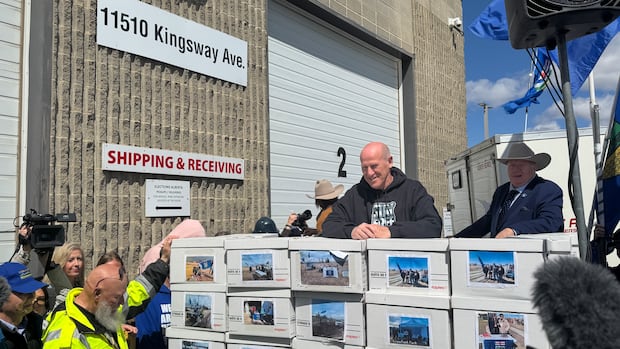
Stay Free Alberta collected signatures between Jan. 2 and May 2. Mitch Sylvestre, leader of the group, delivered the petition to Elections Alberta’s Edmonton office on May 4.
Jeff Rath, one of Sylvestre’s lawyers, said he was unhappy with Leonard’s decision.
“We disagree fundamentally with the decision which appears on its face to violate principles of natural justice and contain numerous errors of law,” he wrote on X.
“We have been instructed to prepare and file the appropriate appellate documents.”
Injunction rejected
In a separate decision released Wednesday, Leonard denied an injunction request from another First Nation to stop the petition.
The Sturgeon Lake Cree Nation argued the government violated Treaty 8 by changing the law to make it easier for the separation petition to proceed.
It also alleged increases in racism and misinformation from the petition process, but the judge was not satisfied that “the observed increases in that regard are attributable to the [citizen initiative] process, Bill 14 or the second proposal itself.”
Leonard said the evidence didn’t meet a legal test to prove irreparable harm if the injunction wasn’t granted.
Orlagh O’Kelly, lawyer for the SLCN, said her clients are disappointed and are reviewing the decision to see if there are any next steps.
Chief Sheldon Sunshine said while the SLCN lost the case, the First Nation changed the discussion.
“Many Albertans know that this secession cannot happen without breaching treaties, and many more Albertans are aware of foreign interference because of this case,” he said.
Smith and some of her cabinet ministers have said they support a sovereign Alberta within a united Canada but also believe in direct democracy.
The premier has outlined nine questions dealing with immigration and constitutional changes for an Oct. 19 referendum.
A pro-federalist petition was earlier verified. Thomas Lukaszuk, a former deputy premier of Alberta, spearheaded the “Forever Canadian” petition, which had just over 400,000 signatures verified by election officials in December.