
‘Given the timelines to stage, plan and build, the health-care system in our region will continue to experience pressure in the near term,’ says Simcoe County hospital alliance chair
Simcoe County’s hospitals are treating more patients with more complex needs than ever, and even major expansions won’t catch up, councillors were told today.
Dr. Nadiya Sunderji, chair of the Simcoe County Hospital Alliance (SCHA) and president and CEO of Waypoint Centre for Mental Health Care in Penetanguishene, outlined mounting capacity pressures and the need for co-ordinated investment across local health‑care partners.
Local hospital leaders “play a vital role in enabling health and well‑being in our communities,” she told committee of the whole on Tuesday, adding that regional partnerships are “highly valued.”
Sunderji’s update highlighted system performance, access challenges and the regional response.
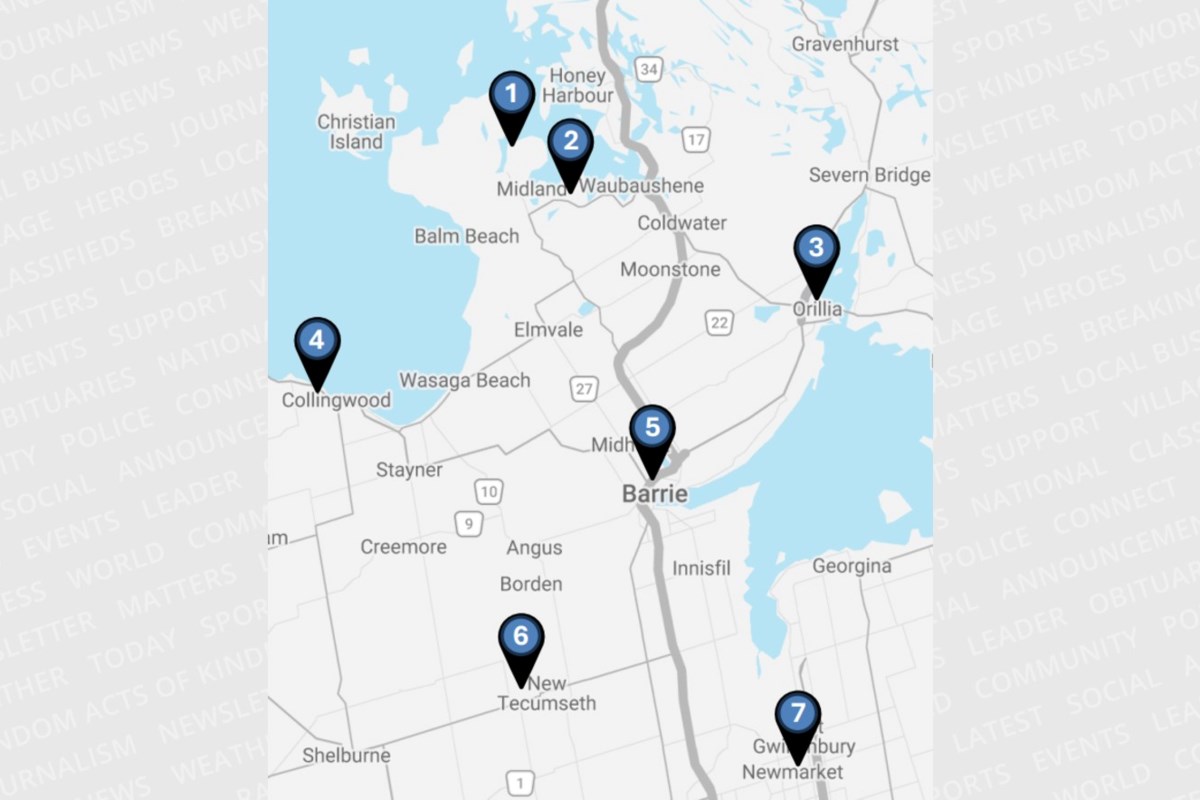
Over the past year, SCHA’s hospitals — Royal Victoria Regional Health Centre, Collingwood General & Marine Hospital, Georgian Bay General Hospital, Stevenson Memorial Hospital, Orillia Soldiers’ Memorial Hospital, Southlake Health and Waypoint — recorded:
6,846 births
49,044 surgeries
377,717 emergency visits
258,694 cancer visits
19,101 cardiac cases
116,708 mental‑health emergencies and outpatient visits
and 6,029 mental‑health admissions.
The network includes 2,246 physicians, 13,163 employees, 1,769 volunteers and more than $1.2 billion in salaries.
“As you can see, the volume is substantial,” Sunderji said. “We are seeing more patients with more complex needs as our population both ages and grows.”
Mental health is a growing share of activity, she added.
“It’s not episodic and it places continuous pressure on staff, infrastructure and patient flow,” Sunderji said.
She said hospitals are working in a highly co-ordinated way, with shared clinical models, integrated staffing and joint use of infrastructure. Surgical partnerships also redistribute procedures to reduce wait times.
“Shared leadership roles and administrative supports help stabilize operations where there are gaps,” said Sunderji, adding that regional digital systems are improving information flow and continuity of care. “These approaches are allowing us to use the system more effectively as a whole.”
Hospitals also work closely with community and social‑service partners to improve access, strengthen navigation, respond to urgent needs and prevent avoidable emergency visits.
“Together, these partnerships are also supporting healthier communities and a more sustainable health system,” Sunderji said.
Collaboration with the county has been “extremely impactful,” she added, pointing to new programs to address addiction and homelessness.
“The HART Hub of Simcoe County and StreetReach improve engagement and outcomes for an incredibly marginalized and disadvantaged population,” Sunderji said, noting offload nurses help paramedics work to full capacity, while community paramedicine supports care in outpatient and community settings.
“These initiatives really reflect the importance of aligning health services with broader social supports and continuing to partner,” she added.
Sunderji also detailed how funding directed to the alliance for 2017 to 2031 has supported priority projects, infrastructure and service development.
“This co-ordinated investment strategy has enabled progress across multiple organizations while maintaining a regional perspective,” she said. “It reinforces the importance of sustained long-term funding to support system growth and modernization.”
But activity continues to exceed funded growth, creating structural deficits.
“Costs related to labour, supplies and infrastructure are increasing and are difficult to offset under current models,” Sunderji said.
Population growth, aging and rising clinical complexity are creating longer stays and more intensive supports, she noted.
“Our region is aging faster than the provincial average and this is increasing demand for emergency, in patient and chronic disease care,” Sunderji said. “Even with stronger primary and home and community care, hospital care will still be needed.”
Several major capital projects are underway to modernize infrastructure, add beds, expand emergency departments and grow mental‑health and specialized services, she added.
“These projects are phased with different timelines, meaning capacity will come on gradually rather than all at once,” Sunderji said. “Given the timelines to stage, plan and build, the health-care system in our region will continue to experience pressure in the near term.”
Still, projected growth continues to outpace expansion. The region is short 329 beds compared with the provincial benchmark, she noted.
“Even after planned expansions, a gap of about 275 to 349 beds is expected to remain depending on project timing. Even in the most optimistic scenario, the system is short, roughly the equivalent of a community hospital,” Sunderji said. “In other words, every bed that we have planned will be needed and then some.”
Progress depends on provincial approvals, and rising capital costs affect both provincial and local contributions, she added. In the meantime, hospitals are managing demand through innovation and partnerships.
“Our health-care system is under growing pressure, but this region is responding through strong collaboration and shared leadership,” Sunderji said. “Simcoe County has been a vital partner in that work, especially where health care connects with housing, long-term care, paramedic services and community supports.”
Attracting and retaining physicians remains a priority, she noted, with hospitals expanding training programs and academic partnerships.
“Distributed education models have a particular value in our rural and regional context,” Sunderji said. “Retention is closely linked to training locally early, creating those opportunities for professionals to remain in the region along with their families. This is a long-term strategy that supports system stability.”
As pressures grow, she said the county’s continued advocacy will be essential to securing the capacity and investment the region needs.