
From the November 1999 issue of Car and Driver.
Although the vast majority of prancing-horse fans appreciated our exclusive first test of the Ferrari 360 Modena published in our July 1999 issue, some of you rightfully pointed out that a few statistics were missing, such as skidpad performance, sound level, and top speed.
Those who actually read editor Csere’s story also were made aware that our testing—done under time restraints in Italy on the Fiorano track’s front straight, with equipment Csere lugged across the Atlantic, on a surface that was on the verge of dampness from an impending shower—was not conducted under ideal conditions.
So, in the interest of science, we made time in our hectic schedule to order up a Modena and have it delivered to our Hogback Road headquarters for our typical thorough thrashing. The things we do for you readers! You can thank us later.
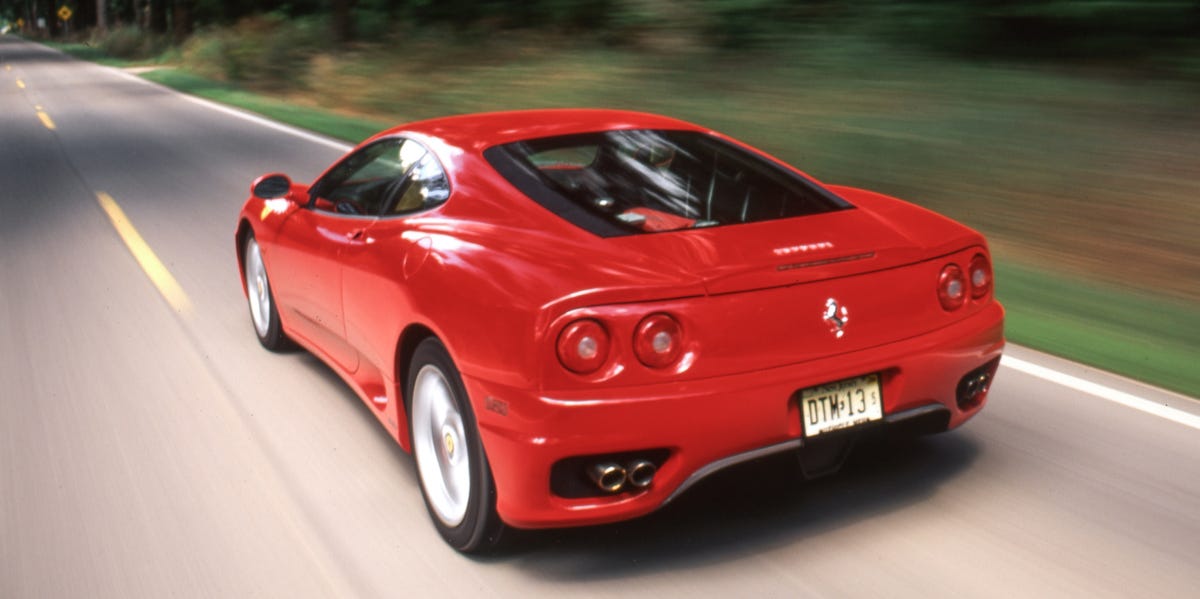
Needless to say, the Modena did not sit still much, being handed off, almost while still rolling, from one staffer to another during its week here. This is a gorgeous automobile from any angle, arguably as sensuous as any other modern-era Ferrari.
Its looks were sullied only by the big yellow stick-on Ferrari logo on the front fenders—it’s the sort of needless reminder that makes sense only on Fieros turned into fake Ferraris. Also, we wonder how long it would take youthful knife-equipped admirers to liberate it from the Modena. Thanks, but no thanks. A car like this gives us enough to worry about.
On the road, the Modena is surprisingly civilized, almost Buick quiet until you dial in the rpm. Anything more than 4000, and the Buick similarities disappear with a sobering, fabric-ripping scream that builds right up to, and past, 8000 rpm, at which point it’s almost deafening. It sounds wonderful from inside the car, but from the outside, it’s oddly raspy, almost flatulent. “Geez,” said one observer, “sounds kinda like my RX-7 with the muffler off.” Yes, well. It isn’t as sweet a song as that of the F355 it replaces, but it is compelling as hell. The paddle shifters for the automatically shifted six-speed manual are located at the 9 and 3 o’clock positions behind the steering wheel. Of course, you can press a big button on the center console and allow the transmission to shift automatically, but we did that only in bumper-to-bumper traffic. We suspect you’d do the same. To engage reverse, you lift up on a dainty little T-handle in the center console and move it to the rear. Cute.
The rest of the cockpit is built to a level of comfort the F355 did not match, but the pricier Maranello does. In execution, as well as exterior styling (dictated by the wind tunnel as much as aesthetics), the 360 shares more with the Maranello than the model it replaces. Ingress and egress are easy, the seats are comfy even for long hauls, the switches are properly placed, and the gauges are easy to read, with the exception of the digital gas gauge, which is tucked away beneath the speedometer. With our test car averaging 14 mpg, we’d like a more precise, easier-to-read analog gauge. Although few will buy this car for its cargo-carrying ability, there is adequate room for a weekend’s worth of luggage, including an area behind the seats big enough for a couple of soft duffels.
HIGHS: Screaming-meemie exhaust note, surprisingly friendly interior, work-of-art hardware, invigorating performance.
As for the performance, it mirrored closely that of the car we tested in July. This Modena was slightly slower—almost certainly owing to the fact that its 40-valve V-8 had only covered 300 miles when we tested it—and rain prevented a retest after we had logged a few hundred more miles. This 395-hp Modena went from 0 to 60 mph in 4.5 seconds, 0.1 second slower than the performance of the 360 we tested in Italy, but that is still 0.4 second quicker than the heavier 375-bp F355 F1 we tested in September 1998. This car was a hair slower in the quarter-mile, too—13.0 seconds at 112 mph, 0.1 second and 1 mph slower than the July tester. This car stopped better, though—159 feet from 70 mph, compared with 173 feet.
It circled the skidpad at 0.96 g (we weren’t able to test on the skidpad in July); the F355 F1 tested in September 1998 managed 0.97 g. That F355 wore Pirelli P Zero Direzionale radials (225/40ZR-18 up front, 265/40ZR-18 at the rear). This Modena had Goodyear Eagle F1 GS Fiorano radials (215/45ZR-18 up front, 275/40ZR-18 out back). The Modena we tested in Italy wore Pirellis, another possible explanation for the tiny differences in performance.
LOWS: Semiautomatic transmission shifts too slowly, unnecessarily complex starting ritual, big ol’ yeller fender badge looks Pep Boys-inspired, priced for lottery winners only.
Top speed on both cars was a redline-limited 173 mph, reached quite easily. At triple-digit speeds, the Modena feels a little light in the front end, but stable. Handling is razor-sharp, with turn-in telepathically precise. You have to push the 360 right up to its limits to experience any front-end washout; past its limits to break the rear loose. The car weighs 3241 pounds, so it’s no Miata, but it feels much more nimble than its weight suggests. And keep in mind that, although it’s a larger car, it weighs some 60 pounds less than the F355. Despite its light-footed feel, the ride on all but the roughest Detroit roads was entirely tolerable.
The Modena gave us only two genuine reasons to complain. As noted in two of the three counterpoints, when shifted manually, the transmission seemed reluctant to initiate a shift, and then when it finally did shift, it did so abruptly. Editor Csere, who was out of town when this Modena came to visit, did not have that complaint about the car he drove in Italy, nor have we uttered that complaint about previous Ferrari F1 transmissions, so we suspect our car was in need of a tweak or two. Most of us would choose the six-speed manual transmission and save 10 grand.
The other complaint had to do with the general complexity of actually starting the car and making it go. Unlock the car using the key fob, get in, and you have 15 seconds to start the car or the alarm system disables the ignition. The car won’t go into gear without a foot on the brake and all the doors closed. For two staffers, however, even that ritual didn’t always work. At least three times the Modena declined to go into gear—any gear—despite any combination of engine-on, engine-off; door open, door closed; foot on brake, foot off brake. Once, it would only go into reverse, then happily clicked into a forward gear and was trouble-free for the 60-mile drive home. Our suspicion is that the various interlocking anti-theft systems were having trouble communicating—likely a simple reprogramming job for a dealer.
Our only other complaint is the one we have with all new Ferraris—we can’t afford one without the help of Publishers Clearing House. Hey, will tonight’s lottery jackpot cover $154,429 after taxes?
VERDICT: A thoroughbred, yes, but—triumphantly—without the high-strung flightiness. Counterpoints
Words do little to describe the tingly feeling I got when I rolled down the 360’s window and heard the mother of all engine notes wailing in my left ear. I nearly fainted. If my house were worth the price of this Ferrari, I’d sell it to buy one. The 360 isn’t saddled with any substantive faults, except for the shift paddles, which should rotate with the steering wheel but don’t. The driving position is perfect, the view out expansive, and the entire structure feels tight and rattle-free. Although the F1 ‘box is the best automatic unit available on any car, I’d still opt for the manual—I missed the subtle thrill of blipping the throttle for downshifts. If you can afford one, I’m jealous. —Larry Webster
Give Ferrari credit for trying to share Formula 1 techno-thrills with folks who are in a position to buy this achingly gorgeous car. From that perspective, the latest F1 transmission is a nifty option. It would be much niftier, though, if it actually worked. Okay, if it worked well. There’s a big pause between upshifts, and when engagement finally occurs, it does so with a bang—whether the driver uses the paddle controls or lets the transmission shift for itself. Shift-pause-wham! Shift-pause-wham! Besides retarding forward progress, it’s a concentration buster. Tip: Get the six-speed manual. You’ll save your· self $10,070 and also spare yourself a fair amount of irritation. —Tony Swan
Yeah, yeah, so the 360 makes some great noises. But I recall the F355 belting out a more inspirational tune at wide-open throttle. The F355’s shriek was smooth and siren-like, whereas the 360’s strikes me as hoarse and somewhat stressed, and definitely less distinguishable among exotics. I also remember the F1 gearbox shifting with more conviction and speed in the F355. The 360’s structure is clearly superior, and its curves are even more alluring, but overall, this car moves me only a smidgen more than its predecessor. —Don Schroeder
 Specifications
Specifications
2000 Ferrari Modena F1
Vehicle Type: mid-engine, rear-wheel-drive, 2-passenger, 2-door coupe
PRICE
Base/As Tested: $154,429/$154,429
ENGINE
DOHC 32-valve V-8, aluminum block and heads, port fuel injection
Displacement: 219 in3, 3586 cm3
Power: 395 hp @ 8500 rpm
Torque: 275 lb-ft @ 4750 rpm
TRANSMISSION
6-speed manual with automatic shifting and clutch
CHASSIS
Suspension, F/R: control arms/control arms
Brakes, F/R: 13.0-in vented, cross-drilled disc/13.0-in vented, cross-drilled disc
Tires: Goodyear Eagle F1 GS Fiorano
F: 215/45ZR-18
R: 275/40ZR-18
DIMENSIONS
Wheelbase: 102.4 in
Length: 176.3 in
Width: 75.7 in
Height: 47.8 in
Passenger Volume: 52 ft3
Cargo Volume: 8 ft3
Curb Weight: 3241 lb
C/D TEST RESULTS
60 mph: 4.5 sec
100 mph: 10.5 sec
1/4-Mile: 13.0 sec @ 112 mph
130 mph: 17.9 sec
150 mph: 27.1 sec
Rolling Start, 5–60 mph: 5.6 sec
Top Gear, 30–50 mph: 7.4 sec
Top Gear, 50–70 mph: 7.4 sec
Top Speed (redline ltd): 173 mph
Braking, 70–0 mph: 159 ft
Roadholding, 300-ft Skidpad: 0.96 g
Interior Sound
Idle: 54 dBA
Full Throttle: 90 dBA
70-mph Cruising: 77 dBA
C/D FUEL ECONOMY
Observed: 14 mpg
EPA FUEL ECONOMY
City/Highway: 11/16 mpg