
For decades, scientists have studied Earth’s ancient mass extinctions by searching for clues preserved in rocks.
Experts have been able to reconstruct pieces of the disasters – falling oxygen levels, crashing temperatures, volcanic upheaval, and signs of dying oceans.

However, one suspected trigger kept remaining just out of reach
Phosphorus, the nutrient that can supercharge ocean life and also help destroy it, was thought to be impossible to trace reliably in rocks hundreds of millions of years old.
Now, researchers say ancient limestone was preserving that record the entire time. The researchers decoded a hidden chemical fingerprint locked inside the rocks.
The team uncovered direct evidence of massive phosphorus surges linked to two of the worst marine extinction events in Earth’s history.
Two ancient marine disasters
Roughly 445 million years ago, the Late Ordovician mass extinction killed off about 85 percent of marine species.
Around 73 million years later, the Late Devonian Mass Extinction took out another 80 percent.
These were not gradual collapses. Entire branches of the marine family tree vanished in geological eyeblinks. Scientists have long debated what triggered them.
Climate cooling, volcanic eruptions, falling sea levels, and stretches of oxygen-starved water have all shared part of the blame. But one suspect kept slipping through scientists’ fingers.
The missing extinction clue
That suspect is phosphorus, the nutrient that fuels ocean life and, in excess, can help kill it. Modern phosphorus runoff from agriculture feeds algal blooms and the low-oxygen zones that follow.
Researchers had long suspected that ancient surges of phosphorus could have done something similar on a planetary scale – choking the seas and helping trigger cascading ecological collapses. But the hypothesis lacked direct proof.
Phosphorus in ancient rocks is difficult to measure. No reliable tool existed for analyzing rocks half a billion years old. Until now.
Clues in ancient seawater
An international team has now developed one. They used carbonate-associated phosphate, or CAP – a technique that extracts traces of phosphate locked inside ancient limestone.
The trapped phosphate carries a chemical fingerprint of the ancient seawater in which the rock formed.
Limestone samples from seven sites scattered across multiple continents went under the team’s instruments.
Rocks frozen in time
Anticosti Island sits in the Gulf of St. Lawrence in eastern Canada. Its cliffs expose layer upon layer of limestone deposited on a shallow tropical seafloor roughly 445 million years ago.
Most other sites of similar age have been crushed by mountain-building processes or altered chemically over the eons. Anticosti has remained unusually well preserved.
André Desrochers, Adjunct Professor in Earth and Environmental Sciences at the University of Ottawa (uOttawa), helped lead the sampling there.
“The outcrops there gave us sedimentary archives of exceptional precision for reconstructing ocean conditions during the Ordovician,” Desrochers said.
The phosphorus signal appeared
Across all seven sites, the same pattern appeared: short, sharp surges in seawater phosphorus during both extinction events. Until this study, no one had captured that signal directly – only inferred it.
What surprised the team most was the synchrony. Whether sampled from Canada or China, Estonia or Australia, the rocks carried the same chemical pulse at the same geological moment, despite forming in very different marine settings.
“What is striking is the global coherence of these signals,” Desrochers said. “Rocks formed on different continents, in very different marine environments, all tell the same story at the same moment in time.”
How phosphorus kills
Phosphorus acts as a nutrient for marine life. In small amounts, it feeds the microscopic algae at the base of ocean food chains. In excess, it can feed them too well.
Algal blooms form, die, and sink. The bacteria that break them down strip the surrounding water of oxygen. Once that water turns anoxic, marine animals begin to suffocate.
The team’s model suggests those phosphorus pulses helped trigger widespread ocean anoxia and global cooling, likely through carbon burial as marine life crashed and sank.
That pattern matches separate geological evidence, including a study that used a different chemical marker to trace oxygen loss across the same intervals.
A perfect extinction storm
The new data do not portray phosphorus as the sole villain. Major glaciation and falling sea levels coincided with the first pulse of the Late Ordovician extinction.
Other research, including a paper modeling how volcanic ash could have flooded the oceans with nutrients, has pointed to other possible triggers.
So phosphorus is one piece of the puzzle – a major one. But cooling, anoxia, and runaway biological productivity likely reinforced one another, wiping out most marine life.
At its core, the study shows that phosphorus spikes and the extinctions happened at the same time – not that one definitively caused the other.
The model connecting phosphorus pulses to anoxia and cooling offers a plausible reconstruction, but that sequence cannot be determined directly from rocks alone.
Warnings for modern oceans
The closer scientists look at those ancient crises, the more familiar the chemistry becomes.
Agricultural runoff pumps phosphorus into coastal waters at rates that already produce seasonal dead zones off places like the Gulf of Mexico. The timescales differ. The mechanism does not.
“This study reminds us that disruptions to nutrient cycles can have devastating consequences for marine ecosystems,” Desrochers said.
The connection between phosphorus and ancient extinctions has now moved from theory to direct chemical evidence.
Earlier work by some of the same researchers – in a paper that first applied the technique to even older Precambrian rocks – laid the foundation.
With both Paleozoic extinction crises now showing the same fingerprint, the question for today’s oceans is what level of nutrient loading should begin to worry scientists.
The study is published in the journal Nature Communications.
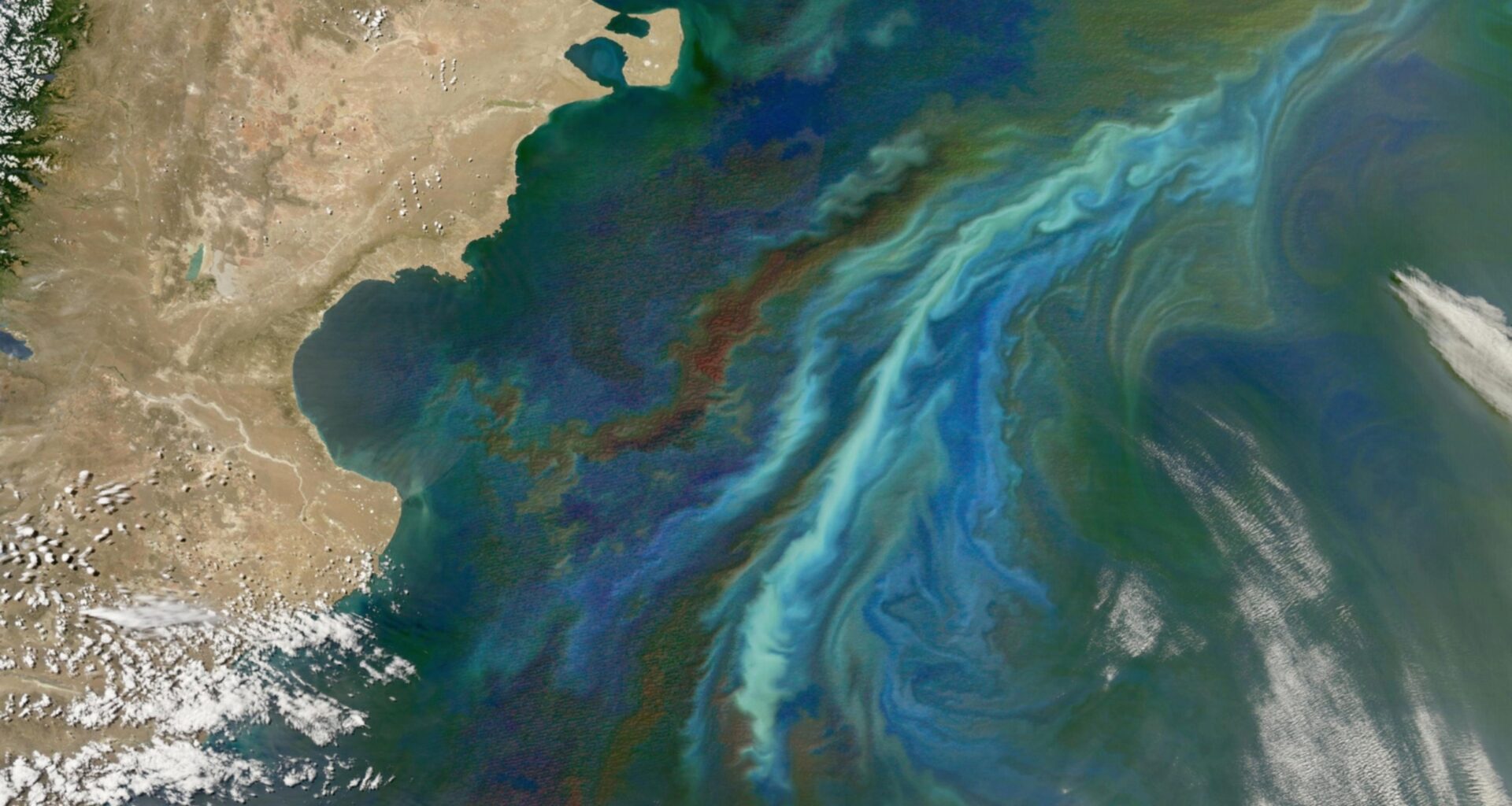
Image Credit: NASA Earth Observatory
—–
Like what you read? Subscribe to our newsletter for engaging articles, exclusive content, and the latest updates.
Check us out on EarthSnap, a free app brought to you by Eric Ralls and Earth.com.
—–