
Lost in the Signal: Radio as Instrument
By
·
Illustration by
·
May 14, 2026
On the evening of November 6, 1919, the Netherlands radio station PCGG aired their “Radio Soirée-Musicale,” featuring selections from Rigoletto, The Barber of Seville, and Carmen. It was the first of a new breed of commercial entertainment broadcasts after wartime restrictions on civilian radio were lifted. Stations around the world quickly followed with debuts from Buenos Aires, Detroit, Montreal, and Chelmsford, England. By the end of the 1920s, there were so many competing radio stations that comedy DJ duo The Happiness Boys satirized the overabundance with the 1928 track “Twisting the Dials,” which took the listener on a speed-run through the standard fare of the day: a children’s story, a radio drama, a boxing match, a flustered announcer introducing the musical stylings of “Pete & Re-Pete.”
The advent of commercial radio brought with it the same mix of awe and anxiety as any new technology. The flood of information that had burst onto the airwaves was a democratic source of arts, culture, music, and news, but it was also the cause of a moral panic: “Here is a device, whose voice is everywhere… We may question the quality of its offering for our children, we may approve or deplore its entertainments and enchantments; but we are powerless to shut it out,” warned a parenting magazine in 1939. The sheer amount of material on offer was dizzying; anyone could get lost between one end of the dial and the other. Of course, this aspect also made the medium irresistible for artists and musicians. Beginning with John Cage’s 1942 piece Credo In Us, composers incorporated the radio into their work in order to celebrate—and to confront—the new mass media.
Robin Rimbaud, who has deployed broadcast signals in his work as Scanner since the early ‘90s, is one of the artists most commonly associated with the radio today. “Radio remains compelling for me precisely because it resists control, and I’ve never tried to ‘tame’ that unpredictability—instead, I treat it as a live collaborator, something between an environment and an instrument,” he explains. “It brings with it fragments of the world: voices, atmospheres, interference, accidental poetry. My role is to listen very attentively and decide, in real time, how to frame or respond to what arrives.”
Rimbaud first encountered the unpredictability of radio as a teenager through pure chance. He had purchased Brian Eno’s Ambient 4: On Land and especially appreciated how well a sweet female voice, found low in the mix, worked with the album’s evocative mood. However, the next morning he put the LP on again to find that the voice was missing. What he had experienced was radio interference from his neighbor’s CB radio as she spoke to her boyfriend. In this moment, the seed was planted for the Scanner project, which began in earnest over a decade later when Rimbaud purchased the product that gave the project its name and began integrating transmissions into his concerts.
Adapting radio signals into a live show requires an improvisatory feel for the airwaves. “Sometimes a stray voice or burst of static suggests a direction, and I’ll follow it—looping it, filtering it, or placing it in dialogue with other materials. Other times, I’ll resist it, letting it pass through as a fleeting interruption,” Rimbaud says. “Ultimately, it’s about trust: trusting your instincts as a listener, and trusting that the world, as it arrives through the airwaves, already contains a kind of music.” At times, the world intervenes in serendipitous ways during Scanner concerts—like the time at a festival that he picked up the security team’s walkie-talkie chatter about a secret Jah Wobble afterparty and broadcast it to his audience of thousands—and these moments make the unruliness of radio a thrilling prospect.
Radio has seemingly been in danger since the rise of the internet and on-demand streaming, but it perseveres because of the magic of simultaneous listening. “Radio is one of the few remaining media where you know that others, somewhere else, are hearing the same thing at the same time. That shared temporal experience, however invisible, can feel intimate, even communal, in a way that personalized digital feeds rarely do,” Rimbaud muses. There’s also simply no replacement for the sound of traditional radio, with all its static, hiss, lost signals, and interference. “All of these carry meaning—they remind us of physical distance and the concept of transmission.”
Below is a list of some of the key pieces in the history of radio as an instrument. Don’t touch that dial.
John Cage
Imaginary Landscape No. 4
In the early 1950s, John Cage was devising new ways to absent himself from his own compositions, to rely on chance as ways to avoid the ego in the act of creation. In this era, he turned to the I Ching, an ancient Chinese book of divination, to determine the form his pieces would take. Imaginary Landscape No. 4 calls for 24 performers operating 12 radios, with one person controlling the volume and the other the tuning of each unit. The piece’s musical changes depended on the I Ching, while its content depended on the airwaves. It debuted at around midnight on May 2, 1951 at Columbia University. The late hour meant that many New York City radio stations had gone off the air, but snippets of baseball games, news of Korea, and a Mozart violin concerto (which elicited ironic applause from the audience) made it through the static. Cage was disappointed in the performance, saying it “was certainly not a rabble-rouser.” Still, Imaginary Landscape No. 4 has become one of the most important radio compositions in history and has been performed numerous times (when more stations were on-air). Percussion Group Cincinnati’s version is a snapshot of the U.S. in 2011, featuring a news report on terrorism, snatches of country and hip-hop, and a brief but immediately recognizable excerpt of the Beatles’ “Let It Be.”
Karlheinz Stockhausen
Kurzwellen
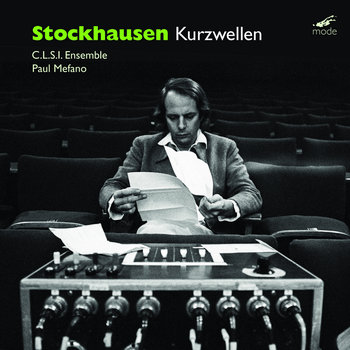
Karlheinz Stockhausen’s 1968 piece Kurzwellen also brought radios into the concert hall, but with a key difference in emphasis from Cage. Whereas Cage’s performers had to be indifferent to the material they came across as they followed the randomized score, Stockhausen’s were meant to respond with their instruments to the “events” that they tuned into. They lingered on interesting transmissions, imitated what they heard, and then iterated on the passage according to their choice of musical parameters. Crucially, Cage did not specify what type of broadcast should be used, but Stockhausen chose shortwave radio for its ability to pick up signals from across the globe with the idea that the performers were, in a real sense, improvising across space with transmissions from around the world. This is a utopian ideal for radio and a step toward Stockhausen’s conception of a “universal music” that would unite humanity—Kurzwellen is nothing less than “a quest for the harmony of the spheres through the guise of technology and electricity,” in his words. This 2011 performance by the C.L.S.I. (Circle for the Liberation of Sound and Image) Ensemble sounds like it stretches across time as well as space, as the characteristic timbre of shortwave transmissions sounds the same today as it did when the piece was composed.
Tod Dockstader
Aerial
Tod Dockstader had a serious case of eczema when he was a child, so serious that he had to spend entire summers in the hospital alternating medicinal baths with long hours lying alone in a darkened room. During these times, all he had to relieve the monotony was a radio. He fell in love with the music and radio plays, but also the crossed signals and noise. “I was always fascinated when it went wrong. Most people would turn their radios off but I’d leave mine on. Somebody would make a mistake, but there was still a presence I could hear,” he remembered years later. Over the course of 15 years beginning in the late ‘80s, Dockstader returned to his passion for shortwave radio by recording such moments at night, gradually building a 90-hour-long archive. For the Aerial series, he painstakingly culled and edited these recordings into a three-part drone opus, full of static, pulses, and indecipherable voices. “The origin is very homely, the old shortwave analog signal. I chose the subject because of my experience, because I remember the mysteries as a child,” he says. Aerial returns to those mysteries and transforms them into a haunting homage to the medium.
Scanner
Sulphur
“What’s broadcast at that moment exists only then, in that configuration, in that particular location,” Rimbaud says of his method. “In a sense I’m effectively composing with time, the actual location and chance itself.” On Sulphur, the time is March 11, 1995 and the location is the Purcell Room in London’s Southbank Centre. By chance, he picked up truly remarkable phone conversations with his radio scanner that night. A man goads his friend to go out and party; a woman argues with her boyfriend; men discuss boxing; women share medical advice; and none of them know that a theater of people are listening in. The album is voyeuristic, subversive, and utterly compelling, a glimpse underneath the public airwaves at private dramas unfolding at hidden frequencies.
Jim Haynes
Shortwave Recordings on MiniDisc (2001-2012)
Jim Haynes became interested in shortwave radio in the late ‘90s and quickly found a setup that would enable him to record transmissions while traveling: a portable Grundig set and a MiniDisc recorder. He recorded his shortwave experiments with these tools for over a decade and gathered the most interesting on Shortwave Recordings on MiniDisc (2001-2012). The album benefits greatly from its liner notes, which relate what each section consists of and where it was recorded: Side A features an American evangelist, a Spanish newscast, a Romanian language lesson, and morse code from Estonia. On Side B, we hear a ham radio, the BBC World Service, Radio Damascus, and Radio Vatican. This album replicates better than any other the experience of twisting the dials, searching the airwaves for the next exciting find—except, of course, with a much better hit rate.
Olivia Block
Dissolution
If the other albums on this list celebrate radio interference, Dissolution sees it as a metaphor for failures of communication. Olivia Block gathers recordings of shortwave and local broadcasts along with found and personal microcassettes, then edits them into a busy back-and-forth in which much is said but not much is understood. This is a very personal record, made during Block’s divorce—some of those microcassettes are of couples’ therapy sessions—but the dissolution of the album’s title is more societal than domestic. Across two long tracks, voices are garbled and interrupted; people talk over one another and in turn are drowned out by static. It’s an uneasy reminder of the flip side of radio’s promise: All of these transmissions are ultimately fragile, with messages that are liable to be distorted or lost in their long journey over the airwaves.
Aki Onda
Nam June’s Spirit Was Speaking To Me
The radio has always had a secretive, almost occult aspect. Disembodied voices appearing from the ether will always seem a bit otherworldly, and clandestine uses such as numbers stations increase the odds of stumbling across messages meant for someone else. Thus it was that when artist and composer Aki Onda spent time in 2010 at the Nam June Paik Art Center in South Korea, he began hearing a voice underneath the static that he imagined came from Paik himself—a hypothesis bolstered by the fact that Paik was deeply invested in shamanism. As he traveled the world over the next several years, Onda performed a series of “séances” by gliding across the dial of a handheld radio, recording with its built-in tape recorder. These pieces were created in South Korea, Germany, Poland, and the U.S., but despite their differing sources they share a noisy, percussive element that unites them. It could be a byproduct of the tape recorder itself, or—if we suspend our disbelief for a moment—it could be that the spirit of Nam June Paik is speaking to us, too.