

When Quebec passed a law barring street prayers in April, Emanuel Linhares read through it closely to ensure it didn’t jeopardize Montreal’s annual Senhor Santo Cristo dos Milagres procession.
Since the Portuguese procession doesn’t involve any collective praying, Linhares believed he was in the clear. But the Plateau-Mont-Royal borough still denied the event’s permit last week, citing the new law.
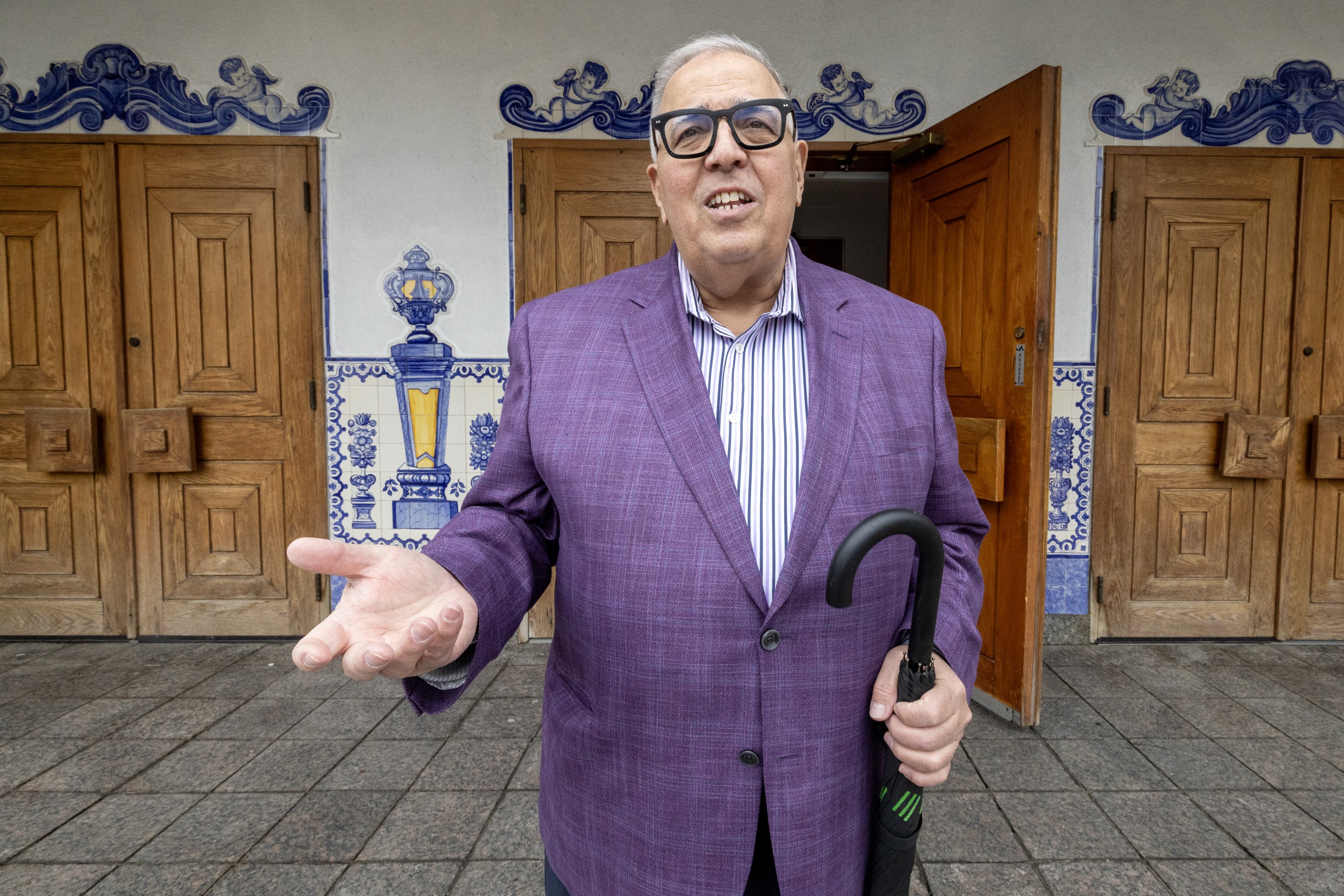 Emanuel Linhares, one of the organizers of the annual Portuguese Senhor Santo Cristo dos Milagres procession, outside the Mission Sant Cruz in Montreal on Thursday, May 14, 2026. The City of Montreal has denied the community’s request for a parade permit, citing a new provincial law governing public prayer. John Mahoney / Montreal Gazette
Linhares is now calling on the city of Montreal to clarify how the law is applied across its territory, arguing it shouldn’t be left to individual boroughs to decide.
“I think there’s confusion, and it’s something the centre city should have a position on — instead of leaving the possibility for each borough to interpret it their own way,” Linhares said Thursday.
After meeting with the local police station, Linhares — who organizes the procession with the Mission Santa Cruz Catholic Church — said the event will go ahead this Sunday as scheduled, despite not having a permit.
Though he’s glad police are allowing it to proceed, Linhares wants the borough to reverse its decision, in part to ensure the issue doesn’t recur.
“We would like to do things properly,” he said.
A Portuguese Catholic tradition, the procession is expected to attract upward of 2,000 people, departing from the church on Rachel St. and marching to St-Urbain St.
Linhares said the church spoke with both the city and the borough for the permit, but was told it is ultimately a borough decision.
The church first requested the permit in mid-February, before the law passed, but only received the borough’s response on May 8.
The request covered this Sunday’s procession — which marks the event’s 60th anniversary in Montreal — as well as a smaller event on May 12 that the church cancelled after being denied the permit.
In an email response explaining its decision, a borough employee told the church the borough must adhere to the provincial law.
“Collective religious practices, including processions, are no longer permitted on public property,” the employee wrote. “Consequently, the procession scheduled for May 12, as well as any subsequent dates, cannot be authorized on public property.”
Bill 9, passed in early April, expands Quebec’s secularism law, which the government says aims to strengthen religious neutrality in institutions and certain public spaces.
In addition to extending the province’s ban on religious symbols, it prohibits “collective religious practice,” such as praying in a group, in public roadways or parks unless a municipality specifically authorizes it.
The law defines religious practice as “any action that could reasonably constitute the manifestation of a religious conviction or belief.”
Contacted for this article, a spokesperson for the borough said it is in a “transition period” since the law only came into effect last month.
“We are awaiting a clear and uniform framework to process this type of request in accordance with the law and municipal bylaws,” the spokesperson said.
The borough said requests will be reviewed once the guidelines are in place and confirmed Sunday’s procession has been given the go-ahead by police.
The City of Montreal did not respond by publication deadline.
Linhares said he understands there may be confusion over how to apply a new law, but called on Montreal to work with those who have organized religious events in the city for years without issue.
Though the procession is religious in nature, he does not see how a public prayer ban applies to it.
“It’s really not what we do. It’s a march. Everybody is walking up and down the street. The philharmonic band is playing music, and that’s it,” he said. “There’s no praying.”
Editor’s Picks