
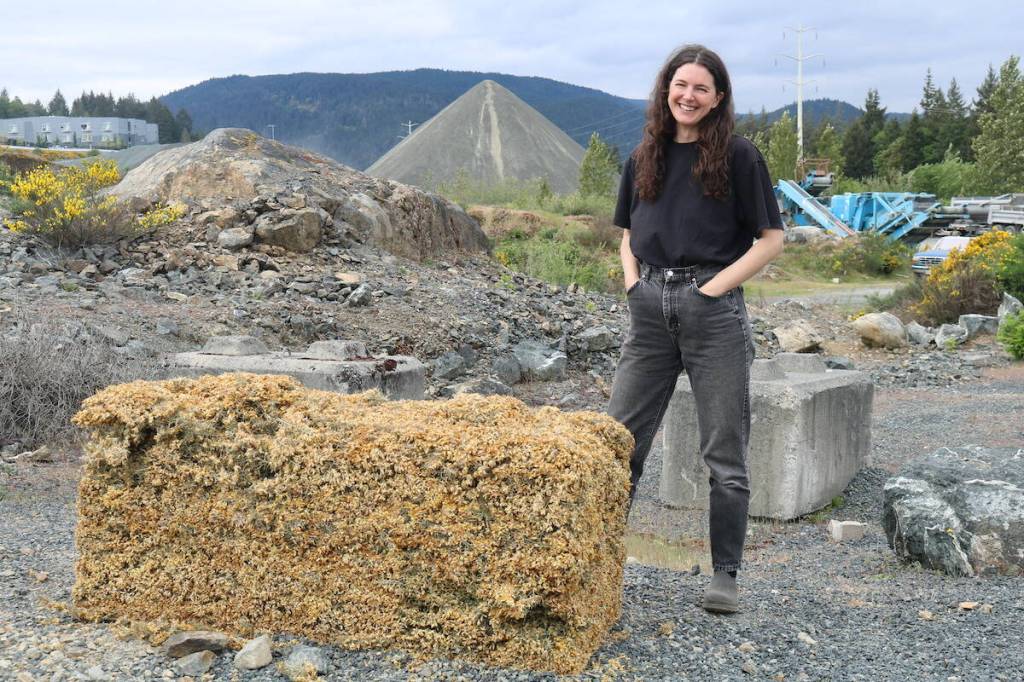
Blooms of seemingly harmless yellow brighten an otherwise barren stretch of Langford landscape, where a gravel pit looms in the distance, and three large concrete blocks line the roadside.
However, one of these blocks is not like the others.
One is made entirely from gorse, a spiny, perennial evergreen shrub native to Western Europe. The structure held together by interlocking spikes and the ‘blood, sweat and tears’ of South Island artist Natasha Lavdovsky.
While visually striking, Lavdovsky’s blooming ephemeral sculpture carries a warning about the destructive spread of the invasive plant species.
In landscapes stripped bare for development, gorse thrives, outcompeting native plants – just as it has along Langford Lake Road in the rapidly growing Westhills neighbourhood, where Lavdovsky placed her art piece.
With a lifespan of up to 45 years, a single mature shrub can produce as many as 18,000 seeds, capable of lying dormant for up to four decades.
Hidden among the gravel at the Langford site, those seeds wait for the next place to take root.
“Anywhere that gravel gets moved to a new development, the gorse is going to follow with it and likely take over, because a lot of these development projects don’t actually get completed on time, because of funding, the economy and all these other factors,” says Lavdovsky.
She hopes the sculpture will spark conversations about responsible land stewardship and accountability when invasive species are left to thrive. Lavdovsky notes municipalities such as Victoria and Saanich already have bylaws aimed at controlling noxious weeds.
Langford’s new community standards bylaw – given its first three readings in April – also states property owners must not allow noxious weeds to grow and accumulate on their land and are expected to make “reasonable efforts to eradicate” them.
Lavdovsky hopes Langford will enforce that bylaw after its adoption.
“Driving through here, it’s been noticeable the amount of time it’s been just sat here, invasive plants proliferating the landscape, and no one held accountable for that,” says Lavdovsky.
With her own gorse block inevitably shedding seeds, Lavdovsky acknowledges that some may argue the installation contributes to the very problem it critiques.
But she disagrees.
“In the grand scheme of things, I don’t see this as a destructive act,” she says. “To me, this is an act of care.”
She says the number of seeds released by her guerrilla art installation is insignificant when compared to the dense shrubs of gorse and Scotch broom already dominating the area.
Still, when removing the sculpture May 6, Lavdovsky said she will spend time picking up as many flowers and seeds as possible, before disposing of the block responsibly at the landfill.
“But also, when you look at this area, there’s nothing growing here other than invasive grasses … so it’s not like any seeds left behind are competing with an ecosystem,” she adds. “The damage is done.”
Creation of the gorse block involved dozens of hours of intense labour – around 25 to create the mould, and then another 20 hours to pack it full of gorse carefully and correctly harvested from the Westhills site.
“I thought initially it would take me two and a half hours to pack,” says Lavdovsky. “But there was a lot of decision-making when I was packing it – it wasn’t just pour it in and push it down, because I really wanted to make sure that it didn’t just fall apart.”
It’s one of many subversive public art projects spearheaded by the artist.
Lavdovsky works five jobs to support the projects she describes as “not necessarily commercially viable,” choosing instead to create conceptual pieces centred on environmental and social messages.
“I like my art to often decompose and fall apart,” she says. “Then it’s more the action and the idea that matters, rather than a physical object that somebody might trade for a profit later on.”
She is particularly drawn to working with invasive plant species, viewing it as a poetic way to confront her settler roots and embrace a responsibility to help remedy the environmental consequences of colonisation.
“Taking care of the land in a way that is effective and can support the ecosystem recover from a lot of the damage that’s been done through the colonial dispossession of Indigenous lands for the sake of capitalist exploitation,” Lavdovsky says.
Beyond raising awareness through her art, Lavdovsky also volunteers with ecosystem restoration groups, helping remove invasive plants from local habitats.
She notes that gorse is used as a natural remedy for hopelessness – a poetic irony not lost on the artist.
“Volunteering has been in itself a remedy for hopelessness,” she says. “Because taking even just small actions to help the land heal and give native plants, indigenous species a chance to reestablish themselves and come back from the brink has been really nourishing for my soul and has helped me feel less hopeless.”
To explore more of Lavdovsky’s work, visit:www.natashalavdovsky.com.