
The assumption seemed reasonable: smaller objects should break free faster. For massive star clusters buried inside their birth clouds of gas, you’d expect the heaviest ones to need more firepower, more time, more everything to push through.
That expectation shaped years of simulations. Then Webb pointed at four nearby galaxies and counted nearly 9,000 young clusters at different stages of emergence. The heavyweights were already out. Still stuck inside: the lightweights.
Catching clusters mid-escape

That answer came from an international team led by Alex Pedrini, an astronomer at Stockholm University (SU). The group sorted through deep images of four nearby galaxies and tagged nearly 9,000 young star clusters.
Four nearby galaxies provided the view. They were close enough that Webb’s mirror could resolve individual clusters down to just tens of light years across. That precision made the answer reachable.
Two telescopes, four galaxies
Hubble handles visible light. James Webb sees in the infrared, a wavelength that cuts through dust and shows what’s hidden inside. Two telescopes, one picture.
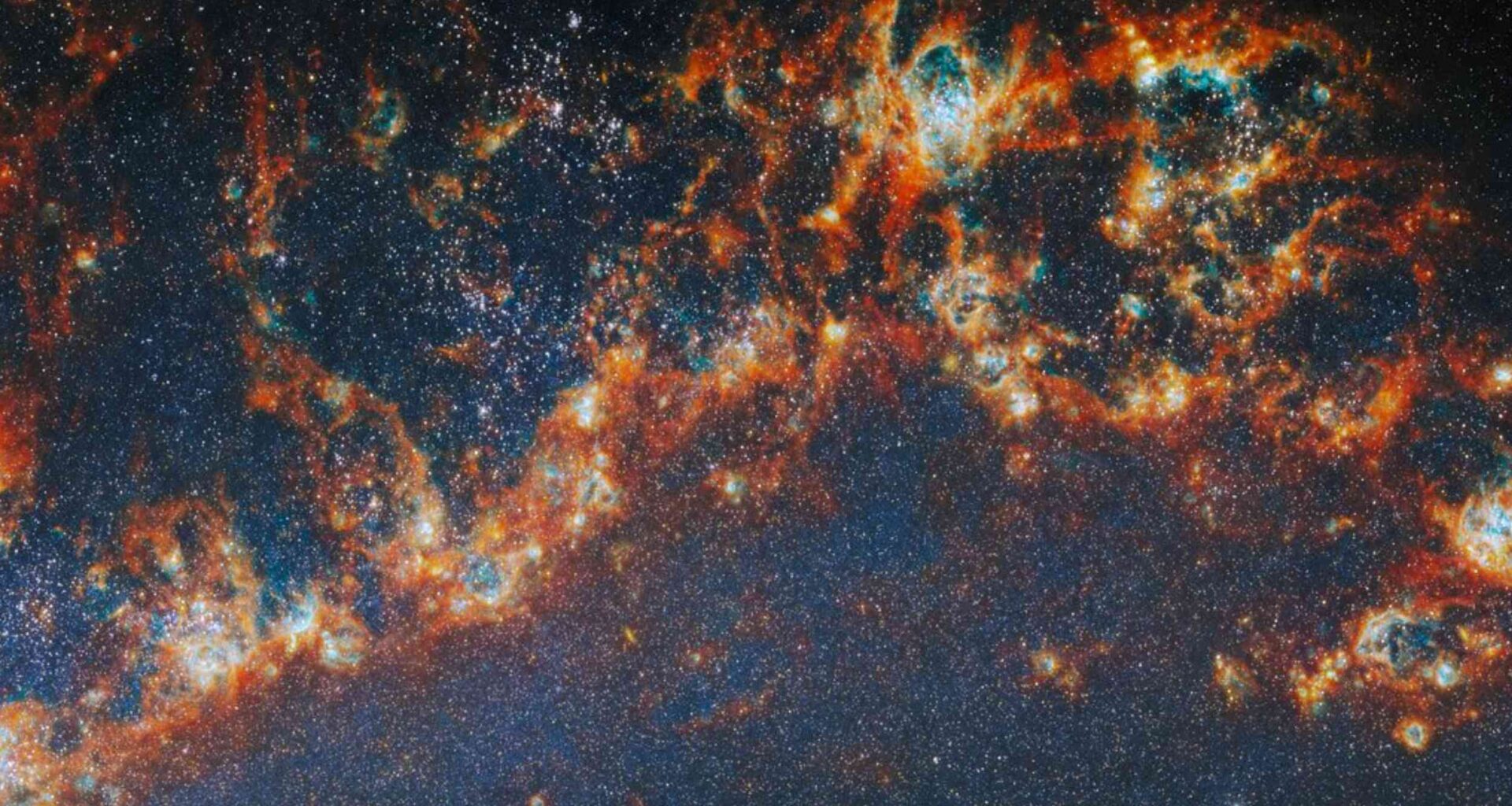
In Webb’s images of M51, the youngest clusters appear as bright points inside glowing pockets of gas, where radiation from newborn stars is already pushing against the cloud from within.
Three stages of emergence
Pedrini’s team sorted each of those 9,000 clusters into one of three stages. The youngest still sit inside compact clouds of glowing gas and dust, blazing from within but not yet pushing through the wall.
Middle-stage clusters have shaken off the dust but still keep a halo of glowing gas around them. Fully exposed clusters – the oldest – appear in Hubble’s optical images with no envelope left to hide them.
By counting how many clusters fell into each stage, the team turned a snapshot into a clock. No single cluster needed to be watched over time. The ratio between stages told them how long each stage takes.
Massive clusters break free
The biggest clusters – those holding more than 10,000 times the mass of the Sun – finish their emergence in about 5 million years. Fast.
Their lighter siblings take 7 to 8 million years to do the same thing. About 1.5 times longer. Until this study, no one knew which way the trend ran.
The heavyweights also spend most of their breakout still wrapped in a dusty cocoon of carbon molecules that glow in infrared light. Once those molecules get blown apart, the rest of the gas goes quickly after.
Why mass changes everything
What does mass have to do with the breakout speed? More massive clusters hold more massive stars – stars that pump out powerful stellar winds and blistering ultraviolet light.
The study suggests that radiation and outflows likely drive the gas clearing faster in bigger clusters, though the exact mechanism is still being worked out. Smaller clusters lack that firepower, and their birth clouds linger.
Data from the four galaxies also hints that the heaviest clusters may form in denser gas to begin with, which could help explain why their clearing runs quicker.
That timing controls how stellar feedback plays out across a galaxy. Most gas inside any galaxy never becomes stars, according to one review of cluster research. Radiation from the brightest clusters scatters the rest into the wider interstellar medium.
Trouble for forming planets
There’s a less obvious consequence buried in the timing. Planets form in disks of gas and dust around young stars. Those disks need time, and they need to keep being fed by the surrounding cloud.
Stars born inside a massive cluster don’t get either. Once the gas clears, the disks around those stars take a direct hit from ultraviolet light pouring off nearby stars, stripping them away before much of anything can grow.
If massive clusters clear in 5 million years instead of 8, that’s 3 million fewer years for planet formation to run. Recent research on planet-forming disks suggests the lost time can derail planet building before it gets going.
What comes next
The findings give simulations a hard target. Galaxy models have struggled to reproduce how clusters actually clear their birthplaces, and now there’s a mass-dependent timescale to test against.
“This work brings together researchers simulating star formation and those working with observations, as well as groups researching planet formation,” said Pedrini, the study’s lead author.
Until this study, the field had no clean measurement of how cluster mass changes the emergence clock across galaxies. Pairing Webb’s infrared eyes with Hubble’s older optical archive made the count possible.
What’s now clear: the giants of the cluster population finish their breakout first, and they do most of the work flooding their galaxies with high-energy light.
Future maps of how galaxies evolved, and where planets had time to form inside crowded clusters, will need to build that difference in. The clock for massive clusters is shorter than the field assumed.
The study is published in Nature Astronomy.
—–
Like what you read? Subscribe to our newsletter for engaging articles, exclusive content, and the latest updates.
Check us out on EarthSnap, a free app brought to you by Eric Ralls and Earth.com.
—–