
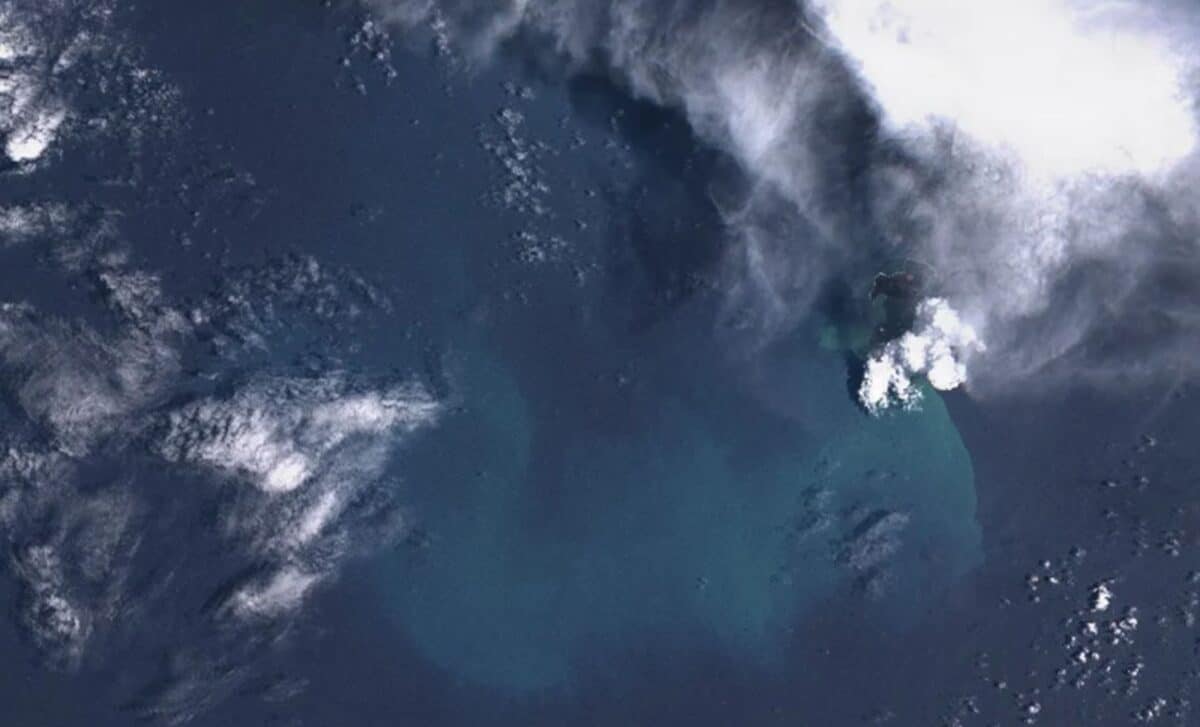
Scientists have identified an unexpected chemical process in the 2022 Hunga Tonga-Hunga Ha’apai eruption plume that destroyed measurable quantities of atmospheric methane. The findings, published in Nature Communications, may inform future efforts to monitor and accelerate methane removal.
When the Hunga Tonga-Hunga Ha’apai volcano erupted beneath the South Pacific in January 2022, it produced one of the most powerful eruptions recorded in modern history, blasting material to altitudes exceeding 55 kilometers. Scientists have since confirmed that the event did more than reshape the stratosphere, it triggered a previously unobserved chemical reaction that broke down methane, a potent greenhouse gas, within the eruption’s vast atmospheric plume.
The discovery emerged from satellite analysis conducted by a team of European researchers, who detected unusually elevated concentrations of formaldehyde inside the volcanic cloud. Formaldehyde forms as a short-lived intermediate when methane oxidizes in the atmosphere, making its presence a reliable indicator that methane destruction is occurring.
A Chemical Process Observed for the First Time in the Stratosphere
According to the study’s authors, the mechanism responsible appears to involve iron-bearing volcanic ash, seawater salt blasted into the stratosphere during the eruption, and ultraviolet sunlight. Together, these elements are thought to have generated reactive chlorine particles that then attacked and broke apart methane molecules within the plume.
The process is not entirely new to science. In 2023, researchers from the same group documented a similar reaction occurring in the lower atmosphere over the North Atlantic, where iron-rich Saharan dust mixed with ocean salt spray to produce chlorine radicals. What the Tonga eruption revealed is that the same mechanism can operate in the stratosphere, an environment with substantially different temperature, pressure, and chemical conditions.
“What is new — and completely surprising — is that the same mechanism appears to occur in a volcanic plume high up in the stratosphere, where the physical conditions are entirely different,” said Professor Matthew Johnson of the University of Copenhagen, one of the study’s co-authors.
The formaldehyde signal, detected using the TROPOMI instrument aboard the European Space Agency’s Sentinel-5P satellite, persisted for at least ten days and was tracked as far as South America. Because formaldehyde breaks down within hours under normal atmospheric conditions, its continued presence indicated that methane was being destroyed on an ongoing basis throughout that period rather than as a single isolated event.
Scale of Removal and What It Means for the Methane Budget
The researchers estimated that the volcanic plume destroyed approximately 900 metric tons of methane per day. That figure, while notable, represented only a fraction of the methane the eruption itself injected into the stratosphere, the team calculated that at least 330,000 metric tons of volcanic methane entered the upper atmosphere in total.
The volcanic plume, in other words, did not come close to neutralizing its own methane output. What the findings do establish, according to the paper, is that enhanced methane oxidation in the atmosphere can be detected and measured from orbit, a capability researchers describe as significant for verifying any future deliberate methane removal efforts.
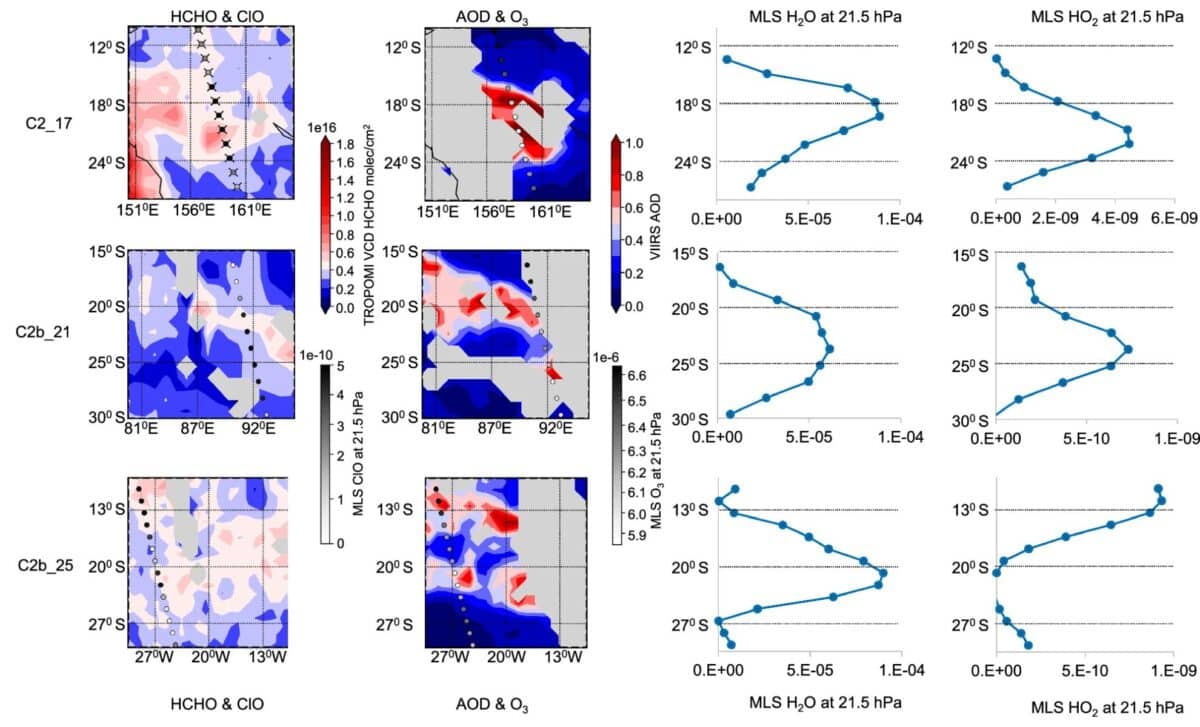 HCHO, AOD and MLS measurements tracking volcanic plume evolution from Jan 17 to Jan 25, showing progressive spatial separation of H₂O enhancement from other signals ©Nature
“How do you prove that methane has been removed from the atmosphere? How do you know your method works? It’s very difficult. But here we address that problem by showing that methane breakdown can in fact be observed using satellites,” said Dr. Jos de Laat of the Royal Netherlands Meteorological Institute, a senior author of the study.
The research also carries implications for how scientists calculate the global methane budget, the accounting of how much methane enters and leaves the atmosphere each year. Because iron-bearing dust particles have not previously been factored into atmospheric methane chemistry, existing estimates of methane sources and sinks may require revision.
Maarten van Herpen of Acacia Impact Innovation BV, the study’s lead author, noted that while the practical application of this chemistry remains speculative, the satellite methodology itself now offers a means of quantifying methane removal at scale, something the field has lacked. Whether that process could ever be replicated safely and effectively under controlled conditions remains an open question that researchers say would require extensive further investigation.