
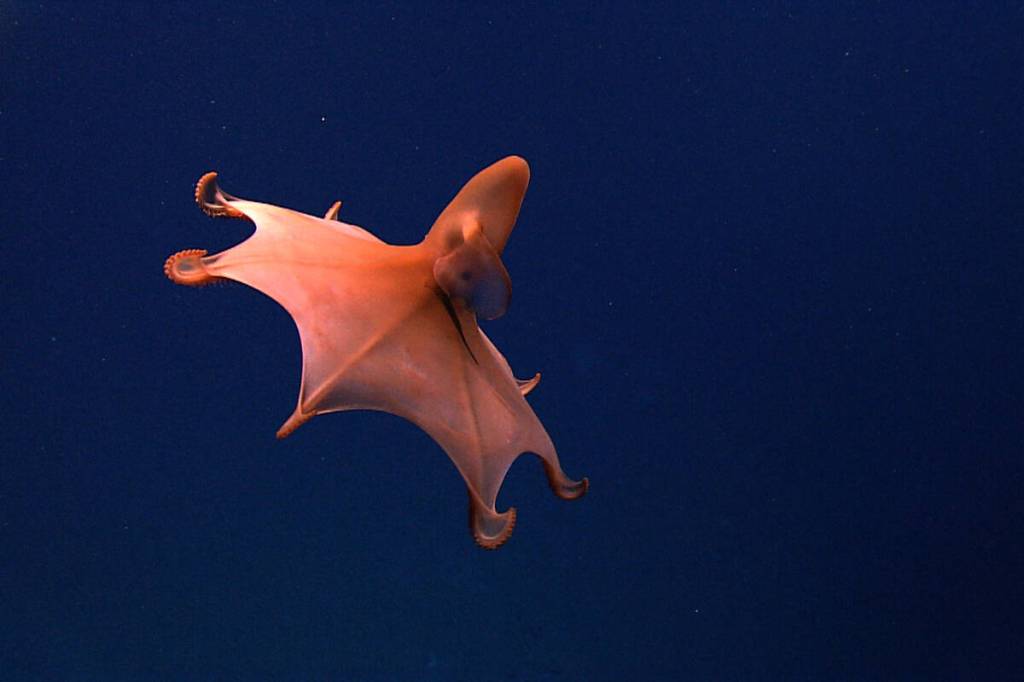
Giant 19-metre finned octopus could live up to the legend of the kraken
Published 1:30 am Saturday, May 16, 2026
“Release the kraken!” are words of legend and myth that call to mind images of giant tentacled sea creatures grappling with ships and dragging them and their crew down to the depths of the ocean, never to be seen or heard from again.
In today’s oceans, the only creature that comes close to matching that description are the 10-metre long giant squid.
But in the past, the giant squid had a rival that could do justice to the fearsome kraken of legend, although they lived long before humans floated on the high seas in vessels made of wood, metal and canvas.
In an article published in the journal Science in April, the authors Shin Ikegami, et. al., describe a creature that matches the monster of myth and legend and dwarfs even the modern giant squid.
The authors studied the fossilized jaws of giant finned octopuses that ranged between 7 and 19 metres in length. They dominated the North Pacific of the late Cretaceous period (145 to 66 millions years ago) and preyed on huge reptiles like plesiosaurs and mosasaurs.
The authors of the Science research article revisited studies of the wear on fossilized jaws – also described as beaks – from Cretaceous sediments of Vancouver Island and Japan that were used to recreate their carnivorous feeding habits.
“The wear was caused by cracking skeletons of prey,” the authors say.
Octopuses are classified into two suborders, the Cirrata (finned octopuses) and the Incirrata (finless octopuses). In modern oceans, Cirrata primarily inhabit deep sea habitat and Incirrata are mainly found in coastal areas.
Two species of Cirrata have been identified from Cretaceous period sediments and reflect the site of their discovery, Nanaimoteuthis jeletzkyi and Nanaimoteuthis haggarti, and they may have been the largest animals in Cretaceous oceans. Their fossils were discovered in the Pender geologic formation of the Nanaimo geologic group on Vancouver Island.
Comparing jaw size to overall size in modern octopuses and applying that to Cretaceous octopuses, it is determined that N. jeletzkyi reached a length of 2.8 to 7.7 m and N. haggarti reached a total length of 6.6 to 18.6 m.
N. haggarti is bigger than modern giant squids and was bigger than anything else in the Cretaceous oceans. Wear patterns on their fossilized jaws indicated they frequently crushed hard shells and bones. The octopuses have a lateral wear patterns that links it to a high level of intelligence. Known as laterality, it is seen in modern octopuses which are known to be highly intelligent on an equivalent level to dogs.
So, patrolling the deep seas was this huge, powerful and intelligent invertebrate with many arms!
They were an exception in an ocean environment that was dominated by vertebrates, primarily reptiles and fish.
Vertebrates have been top predators in marine ecosystems for more than 370 million years, the authors of the Science article say. They repeatedly evolve large bodies and have advanced hunting abilities. Invertebrates, meanwhile, tend to be small prey with hard, mineralized shells for protection.
Octopuses are part of a superorder, Octobrachia, that “demineralized” their shells and evolved into a soft-bodied form that allowed them to swim freely and encouraged improved eyesight and intelligence.
The authors conclude that the discovery of top octopus predators illustrates a convergent evolution of “robust jaws and the reduction of superficial skeletons in cephalapods and vertebrates” essential for becoming “a large, intelligent marine top predator.”
So, not only were they big and scary, they were also probably hard for large prey, predators themselves, to outwit.
“Clever girl,” to quote the big game hunter in that famous film set in the earlier Jurassic period.